The big picture
Explain how commodities, coerced migration, Native exchange, mercantilist policy, consumer demand, and port commerce connected British North America to an unequal Atlantic economy.
Exam focus 01
Topic 2.4 connects markets, labor, government policy, and power across an Atlantic system
By the eighteenth century, British North America belonged to an Atlantic economy linking Europe, Africa, the Caribbean, mainland colonies, and Native homelands. Ships moved tobacco, rice, grain, fish, timber, furs, sugar, molasses, rum, manufactured goods, and people. Merchants also moved credit, insurance, news, and legal documents. The system enlarged markets and consumer choice while distributing wealth and risk unequally.
The College Board asks students to explain causes and effects over time. Strong answers move beyond naming cargo. European demand for plantation staples increased land seizure and labor demand; imperial governments tried to channel commerce through mercantilist laws; merchants sought profit through legal and illegal routes; and Atlantic exchange transformed Native diplomacy, colonial port cities, slavery, and colonial attitudes toward imperial authority.
Network 02
Atlantic commerce followed many overlapping routes rather than one perfect triangle
The familiar ‘triangular trade’ model can help students remember broad connections: European manufactures went to Africa, enslaved Africans were forced across the Middle Passage, and American plantation commodities went to Europe. But actual voyages rarely completed the same neat triangle. Vessels followed shifting bilateral, coastal, intercolonial, and multistage routes according to prices, warfare, seasons, credit, and law.
New England merchants carried fish, livestock, timber, and food to the Caribbean, returned with sugar or molasses, distilled rum, and traded throughout the Atlantic. Chesapeake tobacco and Lower South rice or indigo moved toward British and European markets. Middle Colony grain fed port cities, Atlantic islands, and plantation populations. British manufactures and re-exported Asian goods reached colonial consumers through imperial channels.
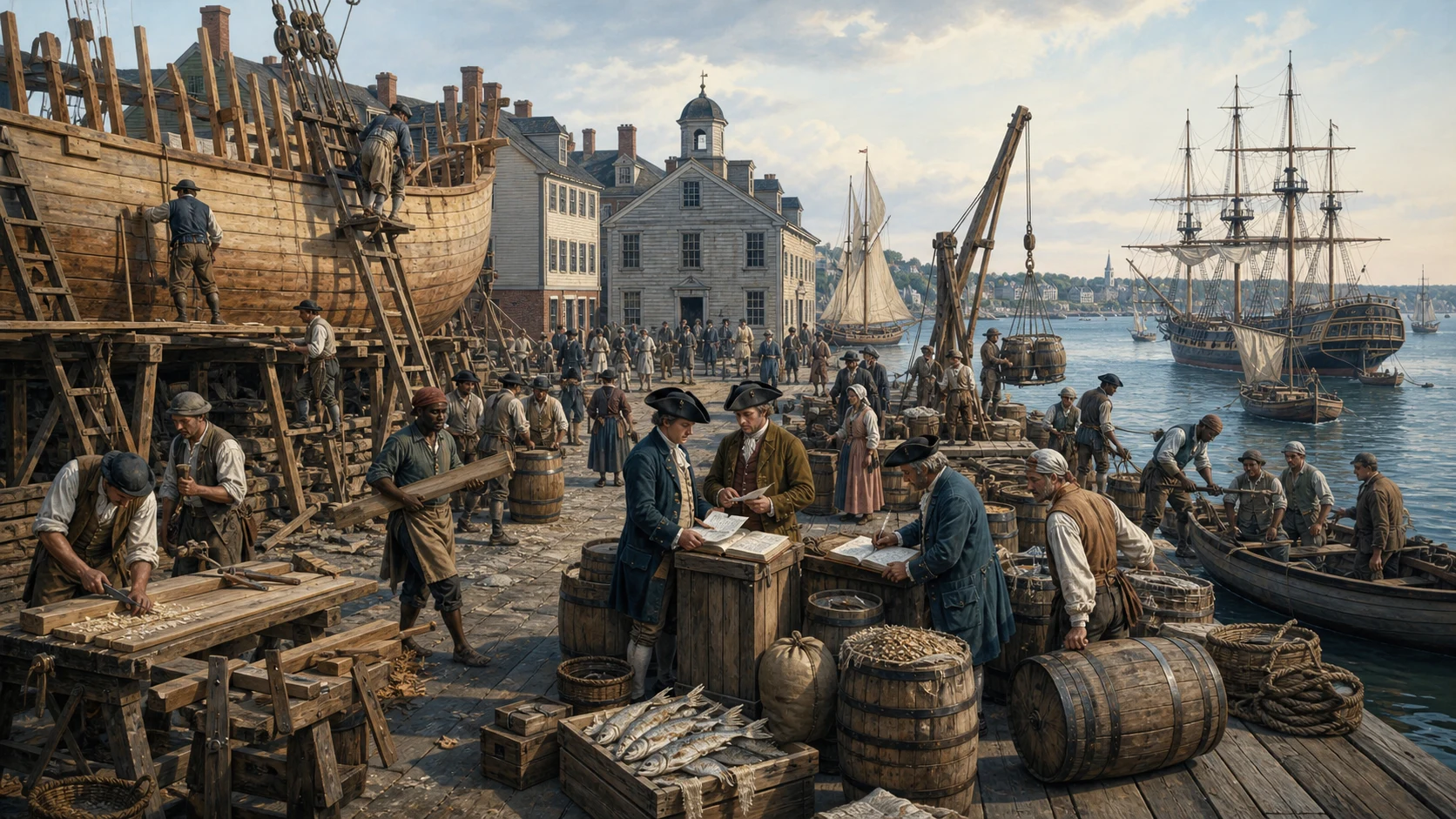
Ports such as Boston, Newport, New York, Philadelphia, and Charleston coordinated warehouses, shipyards, customs offices, taverns, printing, auctions, and finance. Artisans, sailors, dockworkers, merchants, women shopkeepers, servants, free Black workers, enslaved people, and Native traders all participated, but they did not share profits or legal power equally.
Markets 03
Staple crops, consumer demand, credit, and shipping made distant economies interdependent
European and colonial demand for tobacco, sugar, tea, textiles, ceramics, metalware, and other goods helped produce an eighteenth-century consumer revolution. Objects once treated as luxuries became more common markers of gentility and status. Consumption linked an English household using sweetened tea to coerced plantation labor, imperial shipping, Asian trade, and merchant credit.
Colonists often purchased imports on credit before harvest or sale. Merchants used bills of exchange and long chains of debt because coin was scarce. Credit expanded commerce but exposed planters, shopkeepers, farmers, and merchants to price changes and failure. Newspapers advertised imported goods, runaway servants and enslaved people, cargo auctions, and shipping schedules, revealing how commerce shaped daily life.
Regional specialization increased exchange without making regions economically isolated. New England supplied ships and provisions; the Middle Colonies exported grain; the Chesapeake exported tobacco; and the Lower South exported rice and indigo. Each region also produced for local markets and relied on family, indentured, wage, tenant, Native, or enslaved labor in different combinations.
Mainland exports
Tobacco, rice, indigo, grain, flour, fish, livestock, lumber, naval stores, iron, and furs connected regional producers to Atlantic buyers.
Atlantic imports
Textiles, tools, ceramics, tea, sugar, molasses, wine, and other manufactured or re-exported goods reshaped colonial consumption.
Commercial infrastructure
Ships, wharves, roads, warehouses, newspapers, credit, insurance, customs offices, and merchant correspondence made exchange possible.
Hidden foundation
Land dispossession and coerced labor made many of the most profitable commodities possible while merchants, planters, and imperial states captured much of the wealth.
Practice 05
Erratic enforcement encouraged smuggling, negotiation, and habits of commercial autonomy
Britain lacked enough officials and naval resources to monitor every harbor and inlet. Colonial juries, merchants, governors, and customs officers sometimes resisted, negotiated, ignored, or profited from violations. Smuggling with Dutch, French, Spanish, and Caribbean partners allowed merchants to reach cheaper supplies and better markets. Corruption and political connections further weakened uniform enforcement.
The 1696 Navigation Act strengthened customs machinery and the Board of Trade sought greater coordination, but enforcement remained uneven. The Molasses Act of 1733 placed a heavy duty on molasses from non-British Caribbean colonies in order to protect British sugar producers. Because mainland distillers and merchants depended on cheaper foreign molasses, evasion was widespread.
This pattern mattered after 1763. Before the French and Indian War, many colonists became accustomed to regulating local commerce within a loosely enforced empire. Later imperial efforts to collect duties more systematically felt like a change even when Parliament claimed longstanding authority. Topic 2.4 therefore provides background for revolutionary conflict without claiming independence was already inevitable.
Commodity system 06
Sugar and mainland provisioning tied northern commerce to Caribbean plantation slavery
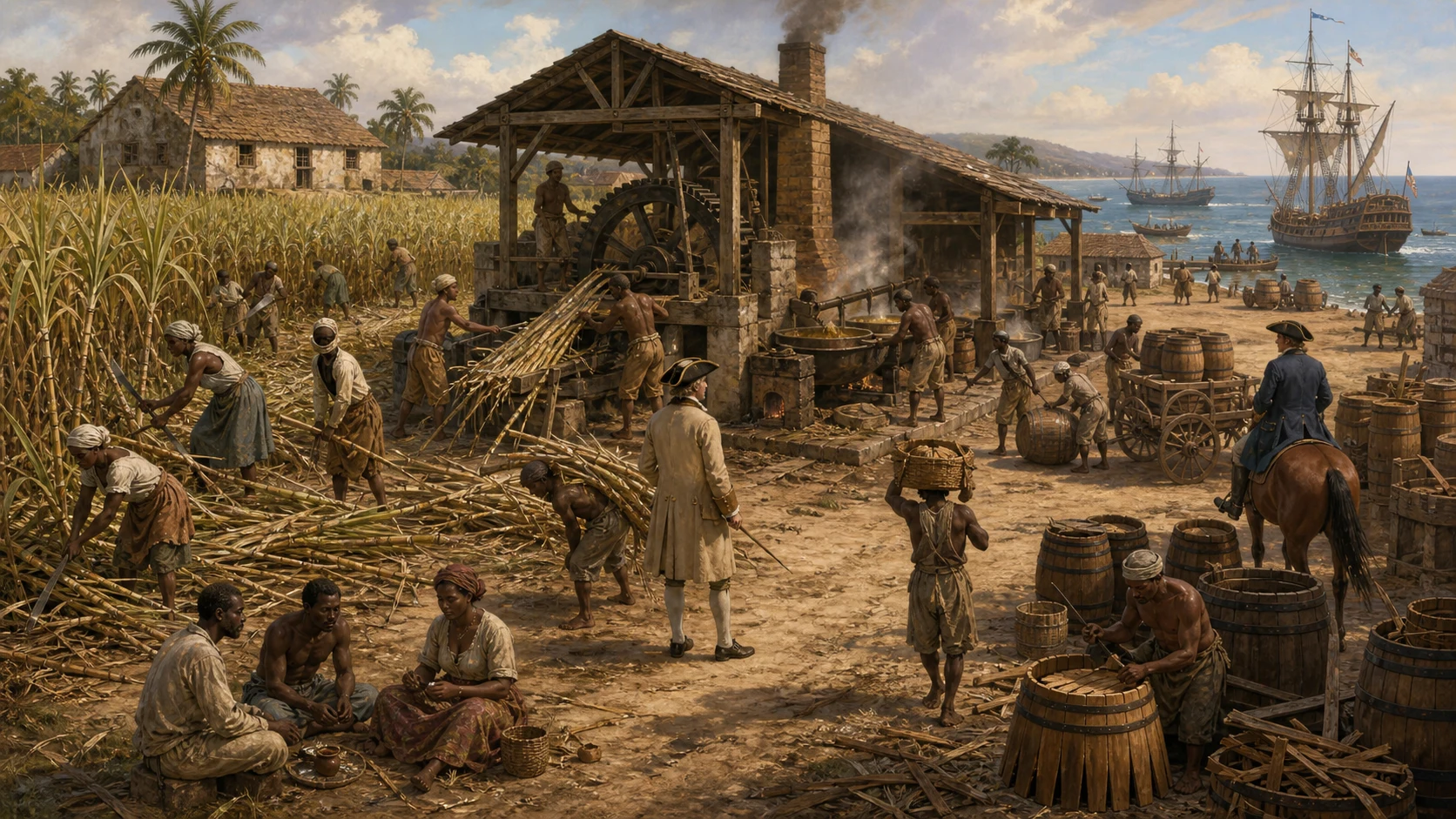
Caribbean sugar islands generated extraordinary profits but devoted extensive land and labor to export cane. They imported food, livestock, timber, barrels, and fish from mainland colonies. New England and Middle Colony producers therefore profited from feeding plantation societies, while merchants carried molasses to northern distilleries and rum or other cargo into wider Atlantic exchange.
Sugar production was a dangerous industrial process as well as field agriculture. Enslaved Africans cut cane, operated crushing mills, boiled juice, maintained fires, made barrels, handled animals, and loaded exports. Plantation owners and Atlantic creditors captured the profits created by coerced skill and labor. Consumer demand for sugar, rum, and sweetened tea made slavery part of ordinary Atlantic consumption, including in regions without dominant plantation agriculture.
The connection complicates a North-versus-South story. Boston and Newport merchants, shipowners, artisans, consumers, and insurers could benefit from slave-produced commodities or slave-trading voyages. Northern economic diversity did not separate those colonies from slavery; it often connected them to plantation markets in different ways.
Forced migration 07
The transatlantic slave trade converted African captivity into colonial labor and merchant profit
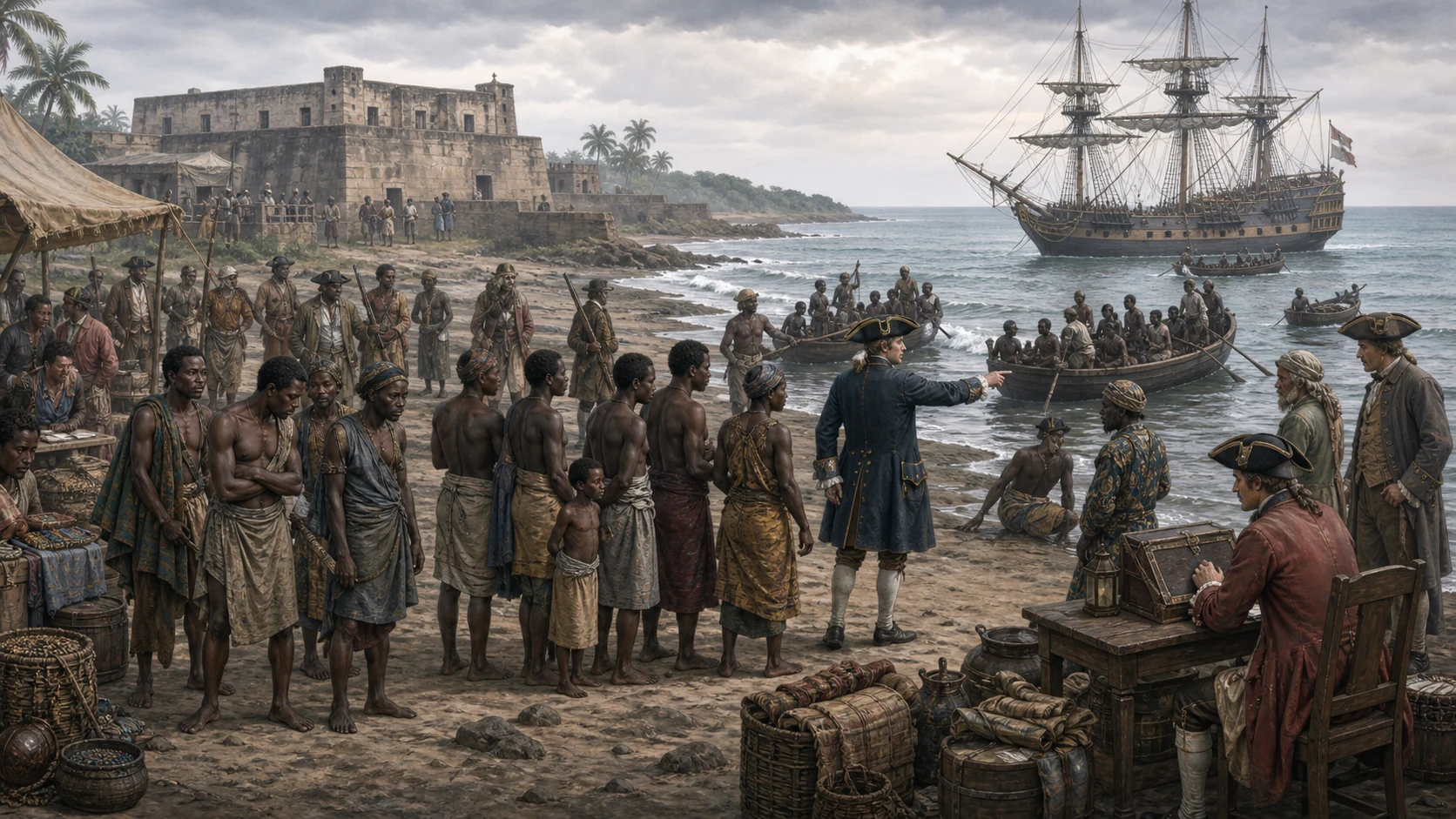
European colonial demand for labor expanded a commercial system that captured, purchased, transported, sold, and legally enslaved African people. African political conflicts and merchants formed part of this history, but European shipping, finance, plantation demand, weapons, and imperial law enlarged the trade and directed it toward American production. Europeans did not enter an empty or culturally uniform continent; captives came from diverse societies with languages, religions, skills, and identities.
The Middle Passage was the forced ocean crossing from Africa to the Americas. Captives experienced separation, confinement, disease, hunger, abuse, and death. Shipowners treated human survival as a calculation of profit. Captive Africans nevertheless resisted through revolt, refusal, communication, care, cultural memory, and attempts to escape; resistance demonstrates agency but does not erase the extreme imbalance of power.
Most people carried across the Atlantic went to Brazil and the Caribbean rather than British mainland North America, yet mainland colonies were deeply implicated through direct arrivals, intercolonial trafficking, plantation production, provisioning, finance, and consumption. Forced migration changed colonial demographics and created African diasporic communities whose knowledge and culture transformed the Americas.
Native exchange 08
Trade gave Native nations leverage and new goods while also intensifying disease, warfare, and dependence
Native nations were diplomatic and commercial actors, not passive suppliers. Haudenosaunee, Huron-Wendat, Lenape, Wabanaki, Creek, and many other peoples used access to furs, deerskins, routes, and markets to negotiate alliances or play empires against one another. European traders depended on Native knowledge, transport networks, hunting, diplomacy, and consent far beyond settled coastlines.
Metal tools, textiles, firearms, ammunition, and other imports changed production, warfare, status, and daily life, but outcomes varied. Competition over trade routes and hunting grounds could intensify conflict and ecological pressure. Debt and reliance on imported ammunition or goods could strengthen merchants' leverage. Epidemic diseases traveled through exchange networks even before direct settlement reached some communities.
Colonists also enslaved and exported Native captives, especially through wars in New England and the Southeast. Trade therefore ranged from negotiated exchange to coercive trafficking. Over time, land hunger and settler expansion increasingly undermined Native control even where commerce initially depended on Native power.
Exam tables 09
Organize evidence by network and distinguish imperial rules from colonial practice
These tables turn scattered facts into exam-ready relationships. Use the first to connect routes with labor and effects. Use the second to distinguish what Parliament intended from what merchants and officials actually did.
| Connection | Goods or people moved | Labor and power | Major effects |
|---|---|---|---|
| Mainland colonies → Britain and Europe | Tobacco, rice, indigo, grain, timber, naval stores, iron | Planter, farm, artisan, indentured, and enslaved labor on Native land | Regional specialization, merchant credit, planter wealth, imperial revenue |
| Caribbean ↔ mainland colonies | Sugar, molasses, rum exchanged for food, fish, livestock, timber, barrels | Enslaved plantation labor and mainland provisioning work | Northern shipping and distilling growth; plantation survival; intercolonial dependence |
| Africa → Americas | Millions of forcibly transported African people | Capture, sale, confinement, Middle Passage, hereditary chattel slavery | Plantation expansion, merchant profit, demographic transformation, African diaspora and resistance |
| Europe → colonies and Africa | Textiles, metal goods, firearms, ceramics, credit, re-exported Asian goods | Manufacturing, shipping, imperial regulation, commercial finance | Consumer revolution, trade competition, debt, greater imperial integration |
| Native interior ↔ colonial and imperial markets | Furs, deerskins, food, information exchanged for metal goods, cloth, weapons, and other imports | Native knowledge, diplomacy, hunting, transport, and control of routes | Alliance leverage, ecological change, disease spread, warfare, dependence, land pressure |
Policy table 10
Mercantilist law mattered most through the gap between design and enforcement
Imperial regulations were neither meaningless nor perfectly enforced. Their economic and political effects came from the ongoing contest among Parliament, customs officials, governors, merchants, juries, smugglers, planters, and consumers.
| Policy or idea | Imperial purpose | Colonial practice or response | AP significance |
|---|---|---|---|
| Mercantilism | Use colonies to strengthen imperial trade, shipping, raw-material supply, and revenue | Colonists participated for profit but pursued their own markets when useful | Shows mutual benefit and conflict inside an unequal empire |
| Navigation Act of 1651 | Challenge Dutch carrying trade by reserving commerce for English shipping | Enforcement capacity remained limited across a large Atlantic | Connects commerce to geopolitical rivalry |
| Navigation Acts of 1660 and 1663 | Use English or colonial ships and route enumerated goods or European imports through imperial channels | Some merchants complied; others rerouted cargo, bribed officials, or smuggled | Distinguish statutory design from actual practice |
| 1696 enforcement reforms | Expand customs supervision and coordinate imperial administration | Local juries, governors, distance, and commercial interests still limited uniform control | Explains a hierarchical empire with erratic enforcement |
| Molasses Act of 1733 | Protect British Caribbean sugar by taxing foreign molasses | Mainland merchants and distillers commonly evaded the high duty | Provides continuity into post-1763 disputes without making revolution inevitable |
High-yield review
Key developments
An interconnected Atlantic economy expanded
Regional goods, labor, shipping, credit, information, and consumption linked distant societies through overlapping routes.
Mercantilism organized imperial ambition
Navigation laws tried to reserve shipping, channel valuable goods, and strengthen British commercial power.
Consumer demand reshaped production
Tobacco, sugar, tea, textiles, and manufactured goods became increasingly important to everyday status and consumption.
Slavery became central to Atlantic profit
Forced African migration and hereditary labor supported plantation staples, merchant fortunes, shipping, and provisioning markets.
Native exchange transformed diplomacy and life
Furs, deerskins, weapons, tools, disease, debt, and imperial rivalry altered Native economies and power relations.
Loose enforcement encouraged autonomy
Smuggling, negotiation, local juries, corruption, and administrative limits created a contested commercial empire.
Chronological reasoning
Timeline — key moments
Tobacco cultivation expands at Jamestown
John Rolfe's experiments help make tobacco the Chesapeake's leading export and intensify demand for land and labor.
Africans arrive in English Virginia
Privateers deliver captive Africans into an evolving bound-labor system that later hardens into racial hereditary slavery.
First Navigation Act targets Dutch shipping
Parliament seeks to reserve English trade for English vessels during commercial rivalry with the Dutch.
Navigation Act defines ships and enumerated goods
English or colonial shipping requirements and commodity controls deepen imperial regulation.
Staple Act channels European imports
Goods bound from Europe to the colonies generally must pass through England or Wales.
Plantation Duty Act expands customs control
Parliament attempts to reduce evasion when enumerated goods move between colonies.
Native captives enter Atlantic slavery
During King Philip's War, colonists export some Native prisoners to Caribbean bondage.
Navigation enforcement is reorganized
A strengthened navigation statute and the Board of Trade seek closer imperial supervision.
Britain gains the asiento
The Treaty of Utrecht gives a British company a contract to supply enslaved Africans to Spanish America.
Port growth and consumer demand accelerate
Imported goods, newspapers, credit, shipbuilding, and intercolonial commerce expand across British North America.
Molasses Act taxes foreign molasses
Parliament tries to protect British Caribbean sugar, but mainland evasion is widespread.
War of Jenkins' Ear begins
Commercial and imperial rivalry with Spain turns Atlantic shipping and smuggling disputes into war.
Iron Act regulates colonial production
Britain encourages some raw iron exports while limiting selected colonial manufacturing.
Imperial war reshapes Atlantic priorities
The French and Indian War begins, eventually pushing Britain toward greater revenue collection and enforcement.
Remember these
Vocabulary
- Atlantic economy
- The interconnected movement of goods, people, capital, information, and power among Europe, Africa, the Caribbean, the Americas, and Native homelands.
- Mercantilism
- A set of imperial ideas and policies intended to direct colonial resources and commerce toward the power and wealth of the mother country.
- Navigation Acts
- A series of English laws regulating ships, routes, commodities, and customs within imperial trade.
- Enumerated goods
- Specified colonial commodities, including tobacco and sugar, whose export Parliament directed through English imperial channels.
- Staple Act of 1663
- A law generally requiring European goods bound for English colonies to pass through England or Wales.
- Customs duty
- A tax charged on imported or exported goods and collected by customs officials.
- Board of Trade
- The imperial body established in 1696 to advise the Crown and supervise colonial administration and commerce.
- Molasses Act of 1733
- A law imposing a high duty on molasses from non-British Caribbean colonies to protect British sugar interests.
- Smuggling
- Trading goods outside legal restrictions or without paying required duties.
- Salutary neglect
- A later label for Britain's relatively loose and inconsistent enforcement of many colonial rules before 1763; use it as a pattern, not a formal single policy.
- Triangular trade
- A simplified model connecting European goods, forced African migration, and American commodities; actual Atlantic routes were more complex.
- Middle Passage
- The forced Atlantic voyage that carried enslaved Africans to the Americas under lethal and dehumanizing conditions.
- Transatlantic slave trade
- The commercial system that captured, purchased, transported, and sold millions of African people into slavery in the Americas.
- Chattel slavery
- Lifelong, transferable, hereditary bondage in which law treated enslaved people as property.
- Consumer revolution
- The expanding purchase of imported and manufactured goods by a wider range of eighteenth-century households.
- Staple crop
- A commodity such as tobacco, rice, sugar, or indigo produced in large quantities for export.
- Bill of exchange
- A written financial instrument allowing merchants to transfer payment or settle debts without moving scarce coin.
- Credit
- Goods or money provided with repayment promised later, essential to long-distance trade and plantation production.
- Port city
- An urban commercial center where shipping, warehousing, customs, finance, artisan work, and migration converged.
- Shipbuilding
- A major maritime industry using timber, skilled labor, capital, and port facilities to produce trading vessels.
- Asiento
- A contract granted by Spain to supply enslaved Africans to Spanish colonies; Britain gained it in 1713.
- Diaspora
- A dispersed population linked by origins and cultural memory; forced migration created diverse African diasporic communities across the Americas.
Clear the confusion
Frequently asked questions
20 detailed answers to the questions students most often carry into Topic 2.4.
01What is the main idea of APUSH Topic 2.4?
Transatlantic trade linked British North America to Europe, Africa, the Caribbean, and Native homelands through goods, forced migration, shipping, credit, and imperial policy. It expanded colonial production and consumption while enriching merchants and planters, strengthening slavery, transforming Native exchange, and creating conflict over British regulation.
02What caused transatlantic trade to expand from 1607 to 1754?
European demand for plantation staples, colonial demand for manufactured goods, abundant shipping resources, port growth, merchant credit, imperial rivalry, and planters' demand for coerced labor all encouraged expansion. Native trade networks and African agricultural or technical knowledge also made colonial exchange and production possible.
03Was transatlantic trade really a triangle?
Some routes resembled a triangle, but the label is a simplified teaching model. Individual ships often traveled between only two ports or followed coastal, intercolonial, Caribbean, African, European, and Atlantic-island routes. Prices, winds, war, law, and available cargo changed each voyage. ‘Atlantic network’ is therefore more precise.
04What goods did British mainland colonies export?
The Chesapeake exported tobacco; the Lower South exported rice and indigo; the Middle Colonies exported grain and flour; and New England exported fish, livestock, timber, ships, and provisions. Colonies also exported furs, deerskins, naval stores, and iron. These are dominant patterns, not exclusive regional products.
05What did colonists import?
Colonists imported British textiles, tools, ceramics, metal goods, books, and furniture; Caribbean sugar and molasses; wine and specialty foods; re-exported tea and Asian goods; and enslaved Africans through direct and intercolonial trafficking. Imports changed household consumption, status, labor, and debt.
06What was mercantilism?
Mercantilism was a broad belief that colonial commerce should strengthen imperial wealth and power. Britain expected colonies to supply raw materials, buy manufactures, use imperial shipping, and contribute customs revenue. It was an organizing idea expressed through many laws, not one statute or a perfectly coherent economic theory.
07What did the Navigation Acts do?
The acts reserved much imperial commerce for English or colonial ships, directed enumerated commodities through approved channels, and generally required European goods bound for colonies to pass through England or Wales. Later rules added duties and customs supervision. The precise mechanism and enforcement changed over time.
08Did the Navigation Acts only hurt colonists?
No. They restricted markets and could raise prices, but some colonists benefited from protected British markets, English credit, shipbuilding demand, and imperial military protection. Merchants, planters, consumers, and regions experienced the rules differently. The strongest answer explains mixed effects within an unequal imperial structure.
09Why was enforcement of trade law erratic?
The Atlantic was vast, officials were few, coastlines were difficult to patrol, and colonial governors, juries, merchants, and customs officers had local interests. Bribery, political connections, false papers, and smuggling weakened enforcement. Britain still regulated commerce, but control was negotiated and incomplete.
10What was the importance of the Molasses Act of 1733?
It imposed a high duty on molasses imported from non-British Caribbean colonies to protect British sugar planters. Mainland merchants and distillers relied on cheaper foreign molasses, so widespread evasion demonstrated the gap between Parliament's mercantilist design and colonial commercial practice.
11How did transatlantic trade affect colonial port cities?
Trade expanded wharves, warehouses, shipyards, customs offices, shops, newspapers, taverns, auctions, and finance in Boston, Newport, New York, Philadelphia, and Charleston. It created work and fortunes but also exposed workers to danger, spread disease, trafficked enslaved people, and concentrated wealth among connected merchants.
12How did trade create a colonial consumer revolution?
Falling costs, expanding credit, merchant advertising, and wider shipping made textiles, ceramics, tea, sugar, metalware, and other imports available to more households. Consumers used goods to express status and gentility, but their purchases linked daily life to debt, empire, Asian commerce, and coerced plantation labor.
13How were northern colonies connected to slavery?
Northern merchants owned ships, insured voyages, trafficked enslaved people, sold slave-produced commodities, distilled Caribbean molasses, provisioned plantations, and held enslaved workers. Plantation agriculture was less dominant in the North, but northern commerce and consumption were deeply integrated with Atlantic slavery.
14What was the Middle Passage?
It was the forced ocean crossing that carried captive Africans to the Americas. Confinement, disease, hunger, violence, family separation, and death made it a human catastrophe organized for commercial profit. Captives resisted through revolt, refusal, escape attempts, mutual care, and the preservation of knowledge and culture.
15Did most enslaved Africans arrive in British North America?
No. Most Africans transported across the Atlantic went to Brazil and the Caribbean, where plantation demand was enormous. British mainland colonies nevertheless participated through direct importation, intercolonial trafficking, plantation slavery, provisions, shipping, credit, consumption, and the sale of slave-produced staples.
16How did African people shape the Atlantic world beyond their forced labor?
Africans brought agricultural, metallurgical, maritime, linguistic, culinary, religious, and artistic knowledge. They created families and diasporic communities, adapted traditions, negotiated daily life, and resisted enslavement. Recognizing this agency does not diminish the coercive power of enslavers and colonial law.
17How did Atlantic trade affect Native American communities?
Native nations gained goods and diplomatic leverage by controlling furs, deerskins, routes, and alliances. Trade also altered hunting, ecology, status, warfare, and political relationships; increased exposure to disease; and could produce debt or dependence. Settler land expansion increasingly undermined Native control.
18Were Native Americans part of Atlantic slavery?
Yes. Colonists enslaved and exported Native captives, including prisoners from wars in New England and the Southeast, while other Native communities held captives under practices that changed through colonial commerce. The topic includes negotiated trade and coercive trafficking, so these experiences should not be collapsed into one pattern.
19How did transatlantic trade prepare the way for the American Revolution?
Loose enforcement allowed many colonists to develop habits of smuggling, local commercial decision-making, and negotiation with imperial officials. After 1763, stricter enforcement and new revenue measures felt disruptive. This continuity helps explain later resistance, but trade alone did not make revolution inevitable.
20How can Topic 2.4 appear on an APUSH exam?
A multiple-choice set may use a shipping record, law, port image, advertisement, or commodity table. An SAQ may ask for a cause or effect of trade. An LEQ may connect trade to slavery, regional economies, Native relations, or imperial policy. Identify the evidence, explain the mechanism, and qualify broad claims.
Use the knowledge
AP exam connections
- 1
Explain trade as a network of commodities, people, credit, information, law, and power rather than memorizing one triangular route.
- 2
Connect consumer demand to production and labor: sugar, tobacco, rice, and imported goods reveal who worked, who consumed, and who profited.
- 3
Distinguish mercantilist aims, specific Navigation Act mechanisms, uneven enforcement, and mixed colonial responses.
- 4
Show how Atlantic trade increased both Native diplomatic leverage and long-term pressures from disease, ecological change, debt, warfare, and settlement.
- 5
Use loose enforcement before 1763 as context for later imperial conflict, while avoiding a teleological claim that revolution was inevitable.
Editorial trust
Sources and review
These notes are original OnlyPrepy content. The syllabus scope and historical framing were checked against the following authoritative sources on August 15, 2026.
- AP U.S. History Course and Exam Description, Effective Fall 2026College Board
- Trade & Mercantilism — Colonies in AmericaLibrary of Congress
- New Tastes, New TradesSmithsonian National Museum of American History
- The Atlantic Empire of Peter FaneuilNational Park Service
- The Middle PassageNational Park Service
- Through the Oneida Carrying Place: Travel, Trade, and ConflictNational Park Service