The big picture
Explain how Native sovereignty, European rivalry, trade, religion, disease, land pressure, diplomacy, and warfare produced both accommodation and conflict from 1607 to 1754.
Exam focus 01
Topic 2.5 asks why accommodation and conflict coexisted—and why their balance changed
From 1607 to 1754, Europeans did not simply act upon passive Native populations. Hundreds of sovereign Native nations controlled homelands, trade routes, food supplies, diplomacy, and military alliances. French, Dutch, British, and Spanish colonies needed Native knowledge and often Native support, while Native leaders evaluated imperial partners according to local rivalries, security, commerce, and community goals.
Interaction ranged from trade, intermarriage, translation, alliance, conversion, and cultural borrowing to epidemic disease, mission coercion, captive-taking, land fraud, forced migration, and war. The same relationship could contain cooperation and violence at once. Over time, growing English settler populations and hunger for permanent farmland made land conflicts especially destructive in the East, while the Pueblo Revolt forced Spanish colonizers to accommodate some Native practices after reconquest.
Starting point 02
Native sovereignty, internal diversity, and European rivalry shaped every encounter
Native America was not one political unit. Haudenosaunee, Wampanoag, Narragansett, Mohegan, Pequot, Powhatan, Pueblo, Cherokee, Yamasee, Creek, Lenape, Wabanaki, and other peoples had distinct governments, languages, economies, spiritual traditions, and diplomatic histories. Nations competed, allied, divided internally, adopted captives, and changed strategies. A label such as ‘American Indian response’ is too broad unless supported by a specific nation, place, and goal.
European empires were also rivals. France, the Netherlands, Britain, and Spain armed and allied with Native partners to compete for trade and territory. Native nations could redirect commerce, deny passage, threaten colonial settlements, or balance one empire against another. Because European populations and strategies differed, relationships varied across regions and decades.
Disease remained a major structural force. Epidemics reduced populations, disrupted leadership and kin networks, and sometimes altered bargaining power before permanent settlement arrived. Disease was not evidence that Native decline was inevitable: colonial violence, forced labor, displacement, food insecurity, and political decisions shaped who was exposed and how communities recovered.
Identify the nation
Use Wampanoag, Pueblo, Haudenosaunee, Powhatan, Yamasee, or another specific people rather than treating Native America as one group.
Identify the European strategy
Trade-focused colonies, mission colonies, and settler colonies created different pressures, though every empire mixed strategies.
Identify the contested resource
Land, tribute, labor, converts, furs, deerskins, weapons, routes, captives, or political boundaries often explain the relationship.
Track the power balance
Ask who needed whom, who controlled geography and information, and how migration or war changed that balance.
Diplomacy 03
Trade and alliance required Native consent, protocol, and knowledge
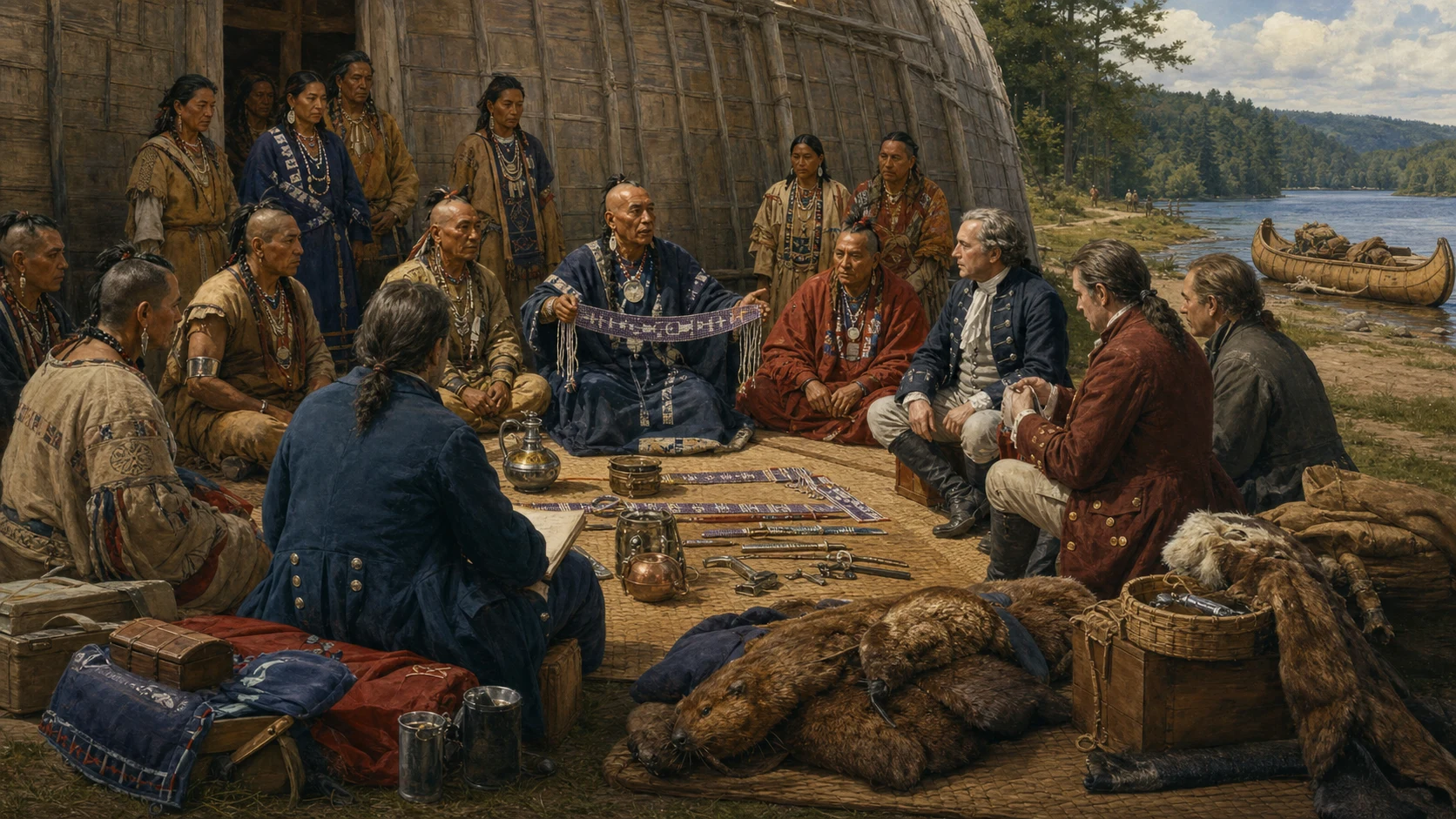
European traders depended on Native hunters, producers, interpreters, guides, kinship ties, and transport networks. Native nations exchanged furs or deerskins for cloth, metal tools, firearms, ammunition, and other goods, but commerce was also diplomacy. Gifts, speeches, councils, mourning rituals, and wampum established obligations that European officials sometimes misunderstood as permanent submission.
Trade could strengthen Native leverage. Control of the Oneida Carrying Place connected the Mohawk River to the Great Lakes, and Oneida people charged for transport and influenced who could reach interior markets. The Haudenosaunee Confederacy used geography, military power, diplomacy, and the Covenant Chain relationship with New York to preserve autonomy and bargain between imperial competitors.
Exchange also produced risks. Dependence on ammunition or imported goods could make disrupted trade dangerous; demand for furs and deerskins changed hunting and environments; traders created debt and sometimes seized people as collateral; and weapons intensified existing conflicts. These effects were uneven and contested, not a one-directional story of instant dependence.
Imperial comparison 04
French, Dutch, British, and Spanish relationships differed because their colonial goals differed
French colonies had relatively small settler populations and depended heavily on fur trade, missionaries, and broad Native alliances. French traders often lived near or within Native communities, and some intermarried, but alliance did not eliminate disease, cultural pressure, or conflict. Wabanaki and Great Lakes nations used French ties against English or Haudenosaunee pressure.
Dutch New Netherland prioritized commerce and the Hudson River fur trade. Dutch merchants relied on Haudenosaunee exchange and sold weapons, but land purchases and settlement still created conflict. After England seized New Netherland in 1664, New York preserved important commercial and diplomatic relationships, including the Covenant Chain, while pursuing its own expansion.
English family migration and permanent agriculture produced intense land demand, especially in New England and the Chesapeake. English colonies also relied on Native trade and allies, yet expanding farms, livestock, towns, and legal jurisdiction created recurring conflict. Spanish colonies emphasized missions, tribute, labor, settlement, and conversion; Pueblo resistance forced partial accommodation after 1692.
Southwest 05
The Pueblo Revolt expelled Spanish rule and changed the terms of Spanish reconquest
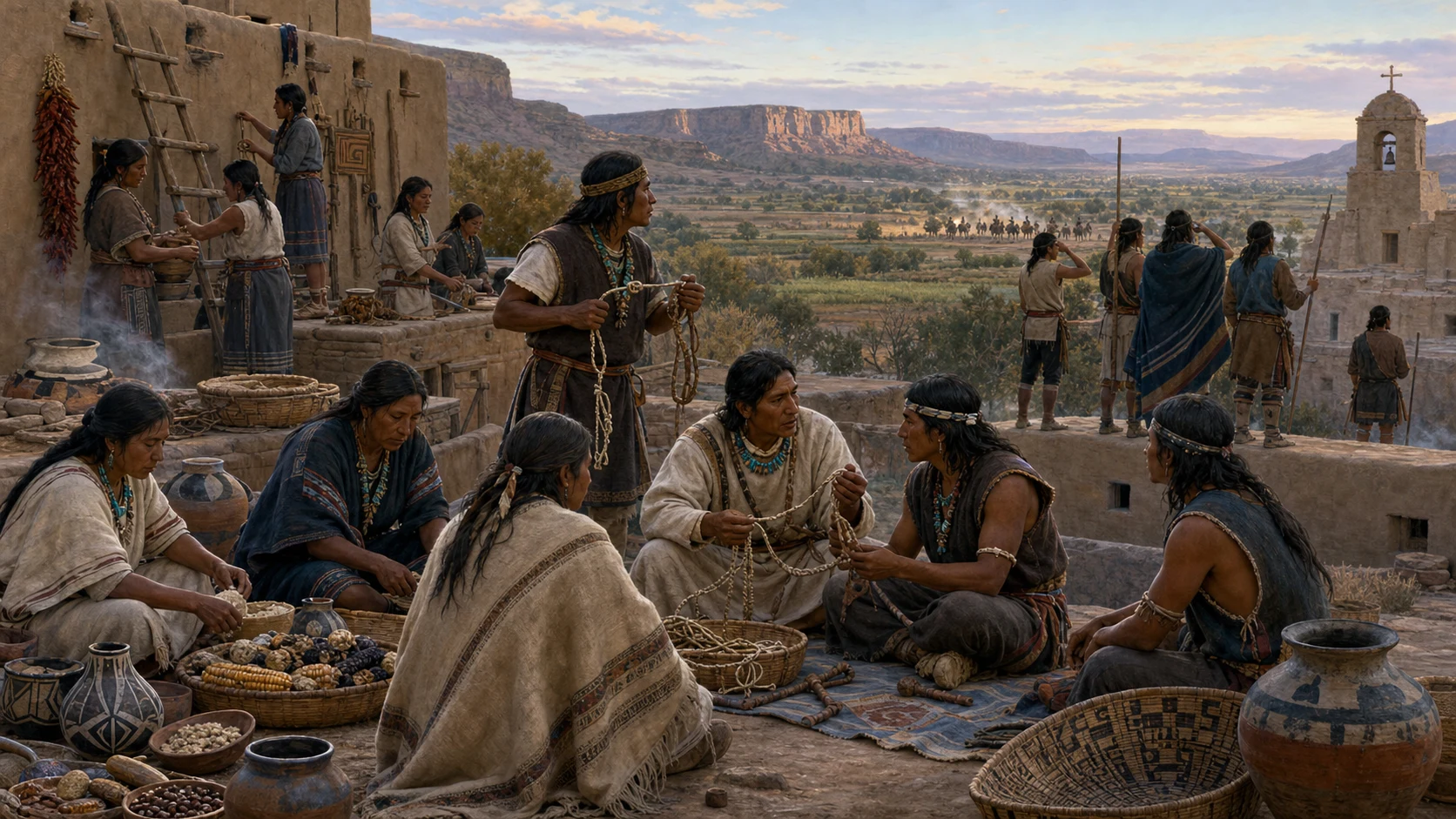
In New Mexico, Spanish civil officials and Franciscan missionaries demanded tribute and labor while attempting to suppress Pueblo religious practices. Missions also introduced livestock, tools, crops, and Catholic traditions that Pueblo communities selectively adopted or reinterpreted. Drought, raids, disease, famine, and punishment intensified resentment, but Pueblo people did not respond uniformly.
In 1680, Po'pay of Ohkay Owingeh and leaders across many independent pueblos coordinated a major uprising. Messengers reportedly carried knotted cords to synchronize action. Pueblo forces drove Spanish settlers and missionaries from New Mexico and restored political and religious control for twelve years. The victory demonstrates the power of communication, coalition, local geography, and shared opposition to colonial demands.
Spain returned under Diego de Vargas in 1692 and violently reestablished authority over time. Yet reconquest did not simply restore the previous system. Spanish rule became more willing to tolerate some Pueblo religious and cultural practices, and the encomienda was not reimposed in the same form. Accommodation remained unequal, but successful resistance changed colonial policy.
Settler expansion 06
English population growth converted land use and political boundaries into recurring conflict
Many Native peoples understood land through overlapping rights to plant, hunt, fish, travel, and use seasonal resources. English colonists increasingly treated land as surveyed, fenced, individually transferable property under colonial law. Deeds signed under unequal conditions or interpreted differently could become claims to permanent exclusive ownership.
Livestock damaged Native fields, fences blocked movement, and new towns expanded colonial courts and jurisdiction. Settlers often demanded that Native communities accept English legal authority, Christian ‘praying towns,’ tribute, or restricted territories. Native leaders sold or leased land strategically at times, but population pressure and legal inequality steadily narrowed the ability to control future use.
Conflict was never a simple racial two-sided war. Colonies relied on Native scouts and allied nations; Native coalitions contained disagreements; Christian Native communities faced suspicion from both sides; and individuals crossed cultural boundaries. Alliances reflected survival and strategy, not a fixed ‘European versus Indian’ division.
New England war 07
The Pequot War joined trade rivalry, alliance politics, violence, and colonial expansion
The Pequot held a powerful position in southern New England trade. English expansion into the Connecticut Valley, competition over wampum and commerce, deaths of traders, and existing rivalries among Native nations escalated into war from 1636 to 1638. Mohegan and Narragansett forces allied with English colonies for their own strategic reasons.
In 1637, colonial and Native allied forces attacked the fortified Pequot community at Mystic. English troops set fire to the settlement and killed hundreds, including noncombatants. The Treaty of Hartford attempted to dissolve Pequot political identity, distribute captives, and open land to English settlement. Pequot survivors nevertheless persisted and later rebuilt communities.
The war demonstrates why ‘Europeans versus Native Americans’ is inadequate. Native alliances affected the outcome, yet English colonists converted victory into territorial expansion, captive enslavement, and legal domination that ultimately altered the regional balance of power.
New England war 08
Metacom's War devastated New England and accelerated English control over Native homelands
By the 1670s, decades of English population growth, livestock expansion, land sales, missionary activity, legal intervention, and demands for political submission had strained relations. Metacom, a Wampanoag sachem known to the English as King Philip, built support among Wampanoag, Nipmuc, Narragansett, and other communities, although Native nations and villages chose different sides.
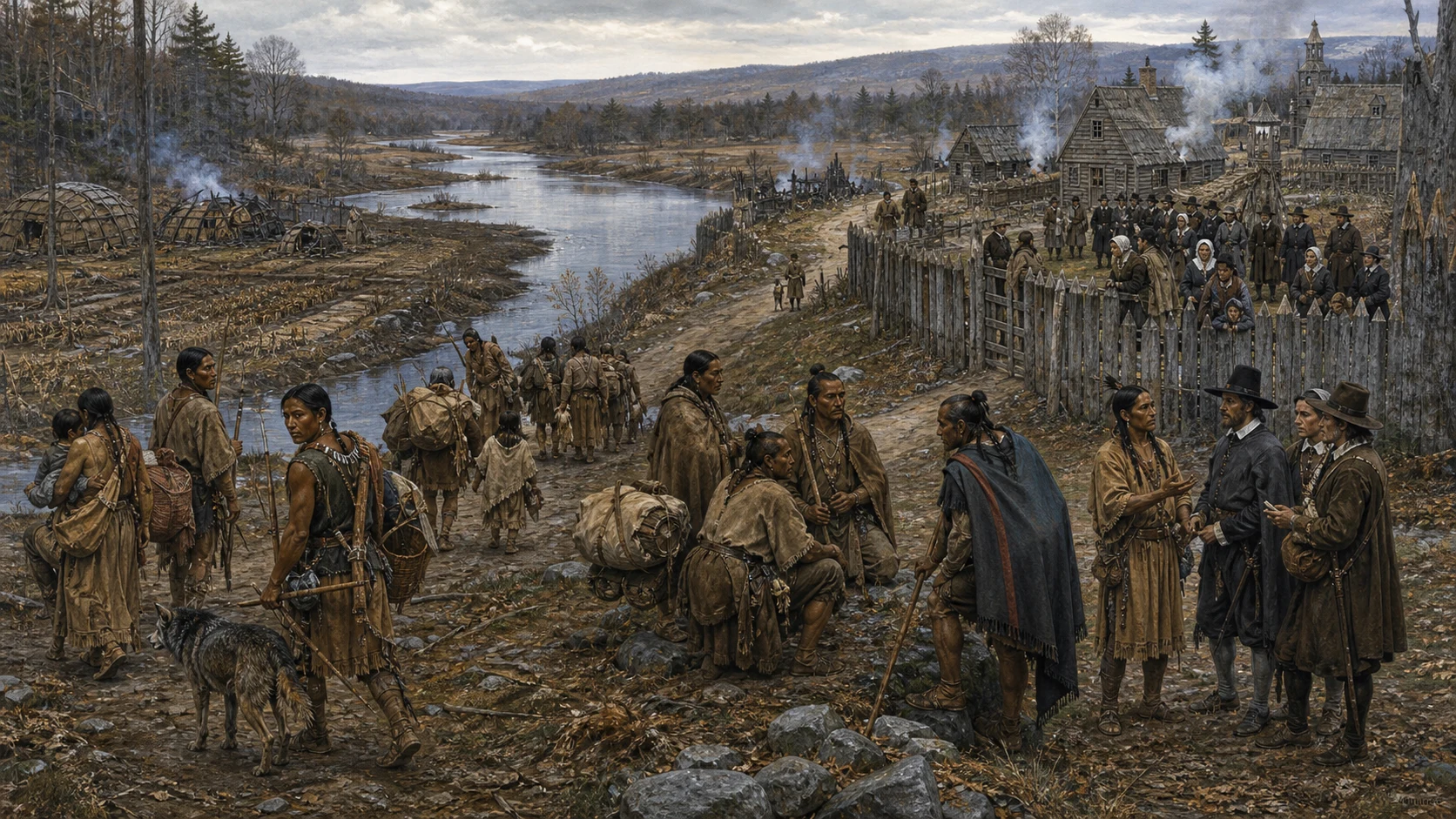
War beginning in 1675 spread across southern New England. Native forces attacked numerous towns, while colonial armies and Native allies destroyed villages, food stores, and refuge sites. Both Native and colonial populations suffered enormous losses relative to their size. Colonists interned Christian Indians, executed leaders, and sold captives into Atlantic slavery.
The death of Metacom in 1676 helped end the southern conflict, though related fighting continued in northern New England. Many Native communities lost land, population, and political independence; some people joined other nations or moved away, while survivors maintained communities and identities. Colonists also faced debt and destruction but emerged with expanded territorial control.
Chesapeake and Southeast 09
Frontier violence and captive trading destabilized the Chesapeake and Southeast
In Virginia, tobacco expansion increased pressure on Powhatan and other Native homelands. Anglo-Powhatan wars, shifting treaties, and colonial jurisdiction gradually reduced Powhatan power. In 1675–1676, conflict involving Doeg and Susquehannock communities helped ignite Bacon's Rebellion. Nathaniel Bacon attacked both hostile and allied Native peoples while challenging Governor Berkeley, revealing how land hunger, Native diplomacy, class tension, and elite politics intersected.
Carolina traders exchanged guns and manufactured goods for deerskins and Native captives. Debt, fraud, abuse, slave raiding, and imperial competition with Spanish Florida and French Louisiana destabilized alliances. Native nations used trade strategically but faced mounting pressure as colonial merchants turned people and hunting grounds into commodities.
In 1715, Yamasee, Creek, Catawba, and other participants attacked South Carolina traders and settlements in a broad but shifting coalition. Cherokee divisions and eventual support for Carolina helped change the war. The Yamasee War nearly destroyed the colony, reordered Native settlement and alliances, weakened proprietary rule, and forced tighter regulation of the trade even as colonial expansion continued.
Comparison table 10
Compare imperial patterns without reducing any empire to one strategy
The table identifies dominant patterns useful for an AP comparison. Every row requires qualification because relationships changed by nation, place, leader, and decade.
| Colonial power | Dominant goals and methods | Native leverage and response | Key change or conflict |
|---|---|---|---|
| French | Fur trade, missions, waterways, limited settlement, military alliances | Control of routes, furs, food, diplomacy, and military support; selective conversion and intermarriage | Great Lakes and Wabanaki alliances tied Native strategy to imperial wars |
| Dutch | Hudson commerce, furs, merchant posts, limited early settlement | Haudenosaunee trade power and diplomacy shaped access to the interior | English conquest in 1664 changed the empire but preserved major trading relationships |
| British | Permanent farms and towns plus trade, missions, law, and alliances | Land sales, war, diplomacy, mobility, alliance shifts, and resistance | Pequot War, Metacom's War, Anglo-Powhatan wars, Bacon's Rebellion, Yamasee War |
| Spanish | Missions, conversion, tribute, labor, settlement, and military control | Selective adaptation, hidden continuity, flight, negotiation, and coordinated revolt | Pueblo Revolt expelled Spain for twelve years and forced partial accommodation after reconquest |
Reasoning table 11
Turn events into claims about causation, comparison, and change over time
Do not name a war without explaining the relationship it changed. Pair an event with its structural cause, Native strategy, and longer consequence.
| Evidence | Analytical use | Common mistake to avoid |
|---|---|---|
| Haudenosaunee diplomacy and Oneida Carry | Shows Native control of geography, trade, and imperial balance | Calling alliance submission or assuming Europeans controlled every negotiation |
| Pequot War | Connects trade rivalry and Native alliances to English territorial expansion | Presenting two unified racial sides or implying the Pequot disappeared |
| Metacom's War | Shows land and jurisdiction pressure producing destructive settler–Native war | Reducing the cause to one incident or ignoring Christian Indians and Native colonial allies |
| Pueblo Revolt | Demonstrates coordinated resistance changing Spanish policy after reconquest | Claiming Spanish rule ended permanently or all Pueblo communities acted identically |
| Yamasee War | Connects abusive trade, debt, captive slavery, imperial rivalry, and shifting alliances | Treating the Southeast as isolated from Atlantic markets and European competition |
| Epidemic disease | Explains demographic and political disruption alongside colonial systems | Describing Native dispossession as automatic, natural, or inevitable |
High-yield review
Key developments
Native nations exercised strategic sovereignty
Leaders used geography, trade, diplomacy, mobility, and military alliances to pursue community goals.
European rivalry created bargaining space
French, Dutch, British, and Spanish competition encouraged alliances and the exchange of weapons and goods.
Trade fostered accommodation and disruption
Exchange created mutual dependence while altering ecology, warfare, material life, debt, and disease exposure.
English settlement intensified land conflict
Population growth, farms, livestock, deeds, courts, and jurisdiction pressured Native homelands.
Native resistance changed colonial policy
The Pueblo Revolt expelled Spain and produced partial cultural accommodation after reconquest.
Wars reordered regional power
Pequot, Metacom's, Anglo-Powhatan, and Yamasee conflicts changed territory, alliances, governance, slavery, and migration.
Chronological reasoning
Timeline — key moments
Jamestown enters Powhatan homelands
English survival initially depends on trade, diplomacy, and food from the Powhatan paramount chiefdom.
First Anglo-Powhatan War
Food demands, settlement, violence, and political misunderstanding produce recurring Chesapeake conflict.
Powhatan coordinated attack challenges Virginia
Opechancanough's forces strike expanding settlements; colonists retaliate and intensify territorial war.
Pequot War transforms southern New England
English colonies and Native allies defeat the Pequot and expand colonial land control.
Third Anglo-Powhatan War
Another major uprising ends with a treaty that sharply restricts Powhatan territory and autonomy.
Haudenosaunee power reshapes the Great Lakes
Warfare, captive adoption, trade, disease recovery, and access to weapons alter regional alliances.
England takes New Netherland
New York inherits Dutch trade relationships and develops the Covenant Chain with Haudenosaunee nations.
Metacom's War devastates New England
Land pressure and jurisdiction conflict produce a regional war with catastrophic Native losses and major colonial destruction.
Bacon's Rebellion targets Native communities
Virginia frontier settlers attack allied and hostile peoples while rebelling against Governor Berkeley.
Pueblo Revolt expels Spanish rule
Coordinated Pueblo resistance drives colonists and missionaries from New Mexico for twelve years.
Spanish reconquest meets continued resistance
Spain reestablishes rule but tolerates some Native cultural practices more than before 1680.
Queen Anne's War expands alliance warfare
English, French, Spanish, and Native partners fight across northern and southeastern borderlands.
Tuscarora War displaces communities
Settlement, trade abuse, and captive slavery produce war in North Carolina; many Tuscarora later move north.
Yamasee War nearly destroys South Carolina
A shifting Native coalition challenges abusive traders, debt, captive-taking, and colonial expansion.
Walking Purchase expands Pennsylvania
Colonial manipulation of a disputed agreement dispossesses Lenape people and damages diplomatic trust.
Remember these
Vocabulary
- Native sovereignty
- The authority of Native nations to govern their people, territory, diplomacy, and political relationships.
- Accommodation
- Practical adjustment or cooperation among groups that preserve different interests; it does not necessarily mean equality or assimilation.
- Alliance
- A negotiated political or military relationship based on reciprocal obligations and strategic interests.
- Wampum
- Shell beads woven into belts or strings that recorded diplomacy, condolence, memory, obligations, and exchange in northeastern Native societies.
- Haudenosaunee Confederacy
- The alliance of Mohawk, Oneida, Onondaga, Cayuga, and Seneca nations, joined by the Tuscarora in the early eighteenth century.
- Covenant Chain
- A series of diplomatic agreements linking New York and Haudenosaunee nations from the late seventeenth century; continually renewed and contested.
- Middle ground
- An analytical term for borderlands where no side held complete power and different peoples developed negotiated practices.
- Fur trade
- Exchange of animal pelts for European goods that linked Native economies, imperial rivalry, diplomacy, and environmental change.
- Deerskin trade
- Southeastern commerce in hides that connected Native hunters and towns to Carolina and Atlantic markets.
- Mission system
- Spanish religious settlements intended to convert, organize, and control Native communities while supporting colonial rule.
- Syncretism
- The blending or coexistence of cultural and religious practices through selective adaptation.
- Pueblo Revolt
- The coordinated 1680 uprising that expelled Spanish colonizers from New Mexico for twelve years.
- Po'pay
- A religious and political leader from Ohkay Owingeh who helped coordinate the Pueblo Revolt.
- Settler colonialism
- A system in which newcomers seek permanent control of Indigenous land and attempt to replace or subordinate existing peoples and sovereignty.
- Pequot War
- The 1636–1638 conflict involving the Pequot, English colonies, Mohegan, Narragansett, and others that expanded English control in southern New England.
- Metacom's War
- The 1675–1676 New England conflict, also called King Philip's War, rooted in land, jurisdiction, and political pressure.
- Praying town
- A New England settlement intended for converted Native Christians under missionary and colonial supervision.
- Sachem
- A political leader in several northeastern Native societies whose authority depended on kinship, diplomacy, persuasion, and community relationships.
- Anglo-Powhatan Wars
- A series of seventeenth-century conflicts over settlement, food, trade, political authority, and land in the Chesapeake.
- Bacon's Rebellion
- The 1676 Virginia uprising in which frontier land, Native policy, class conflict, taxation, and elite power intersected.
- Yamasee War
- The 1715–1717 southeastern conflict driven by abusive trade, debt, captive slavery, land pressure, and shifting alliances.
- Walking Purchase
- Pennsylvania's disputed 1737 land acquisition that used a manipulated ‘walk’ to claim far more Lenape land than expected.
- Captive adoption
- A practice in some Native societies of incorporating captives into families or communities, distinct from but transformed by colonial slave markets.
Clear the confusion
Frequently asked questions
20 detailed answers to the questions students most often carry into Topic 2.5.
01What is the main idea of APUSH Topic 2.5?
Native–European relations produced both accommodation and conflict. Native nations used trade, geography, diplomacy, and alliances to defend sovereignty, while European empires competed for land, labor, converts, commerce, and military support. Over time, English settler growth and colonial coercion made many eastern relationships increasingly unequal.
02Why should Native nations be treated as separate political actors?
Native peoples belonged to distinct nations with different languages, governments, interests, and rivals. A Wampanoag decision in New England cannot represent Pueblo strategy in New Mexico or Haudenosaunee diplomacy in New York. Specific naming produces more accurate evidence and explains why Native groups sometimes allied against one another.
03Why did Native nations form alliances with Europeans?
Leaders sought trade goods, weapons, military partners, diplomatic leverage, or support against Native and European rivals. Alliances were conditional exchanges of obligations, not automatic acceptance of European sovereignty. Nations could change partners, remain neutral, divide internally, or use several relationships simultaneously.
04How did European rivalry benefit Native nations?
Competition allowed strategically located nations to compare offers, redirect furs, demand gifts, secure weapons, and threaten alliance changes. French, Dutch, British, and Spanish colonies often lacked enough people or knowledge to operate without Native partners. That leverage declined in some regions as settler populations and military resources grew.
05How did trade change Native communities?
Metal tools, textiles, firearms, and other goods could increase productivity or political leverage. Trade also altered hunting, ecology, warfare, status, and diplomacy and sometimes created debt or dependence on ammunition. Native communities selectively adopted goods and negotiated their meanings rather than simply abandoning older cultures.
06What role did disease play in Native–European relations?
Epidemics caused severe population loss, disrupted leadership and kinship, weakened some military positions, and created refugees. Disease could travel through Native exchange routes ahead of settlement. It worked together with violence, displacement, forced labor, malnutrition, and political decisions; dispossession was not an automatic biological outcome.
07How were French relationships with Native nations different?
French colonies generally had fewer settlers and depended heavily on furs, waterways, and Native alliances. Traders and missionaries often lived near Native communities, and intermarriage occurred. Accommodation was relatively important, but French relationships still involved conversion pressure, disease, warfare, and strategic manipulation.
08How were Dutch relationships with Native nations different?
New Netherland emphasized Hudson River commerce and the fur trade. Dutch merchants relied heavily on Haudenosaunee exchange and sold weapons, while land purchases and settlement created conflict closer to colonial farms. English New York inherited and reshaped many commercial and diplomatic ties after 1664.
09Why did English colonies have frequent land conflicts?
Large settler populations established permanent farms and towns. English property law treated surveyed and fenced land as exclusive ownership, while Native communities often held layered rights to plant, hunt, fish, and travel. Livestock, courts, disputed deeds, and expanding jurisdiction turned land pressure into a sovereignty conflict.
10What was the Covenant Chain?
It was a set of late-seventeenth-century diplomatic relationships between New York and Haudenosaunee nations, symbolized as a chain requiring regular polishing or renewal. Both sides used it strategically. It was not a single permanent treaty and did not place Haudenosaunee nations under simple English control.
11What caused the Pequot War?
English expansion into the Connecticut Valley, competition over trade and wampum, violent incidents, and existing Native rivalries escalated into war. Mohegan and Narragansett forces allied with English colonists for strategic reasons. English victory then enabled territorial expansion, captivity, and attempts to suppress Pequot political identity.
12What caused Metacom's War?
Decades of settlement, land sales, livestock expansion, missionary pressure, colonial legal intervention, and demands for Native submission weakened Wampanoag autonomy. A local crisis triggered war, but the underlying causes were structural. Wampanoag, Nipmuc, Narragansett, Christian Native, and other communities made different alliance choices.
13Why was Metacom's War historically significant?
It devastated Native and colonial communities, destroyed towns and food supplies, created debt, and led to executions, displacement, and the overseas sale of Native captives. English colonies recovered and expanded territorial control, while Native sovereignty in southern New England was severely constrained, though Native communities endured.
14What caused the Pueblo Revolt of 1680?
Spanish tribute and labor demands, religious repression, punishment, mission authority, drought, famine, disease, and raids generated resentment. Po'pay and other leaders coordinated across many independent pueblos, transforming shared grievances and communication networks into a successful regional uprising.
15How did the Pueblo Revolt change Spanish policy?
Pueblo forces expelled Spanish rule for twelve years. After returning in 1692, Spanish colonizers gradually reestablished power but tolerated some Pueblo ceremonial and cultural practices more than before and did not restore the same encomienda arrangement. Accommodation remained unequal, but resistance changed colonial governance.
16How does Bacon's Rebellion connect to Native relations?
The rebellion emerged partly from frontier settlers' demands for land and harsher war against Native peoples. Bacon attacked communities considered hostile and those allied with Governor Berkeley. The conflict tied Native diplomacy to class tension, taxation, elite trade privileges, and struggles over who controlled Virginia policy.
17What caused the Yamasee War?
Carolina traders' fraud, debt, violence, enslavement of relatives as collateral, land pressure, and imperial rivalry produced a broad Native backlash in 1715. The coalition shifted, and Cherokee divisions helped Carolina survive. The war reordered alliances and exposed the dangers of an abusive captive and deerskin trade.
18Did Native military defeat mean Native peoples disappeared?
No. Colonial treaties sometimes attempted to erase political identities, and war caused enormous loss, but survivors rebuilt communities, joined relatives, migrated, adapted diplomacy, preserved language and ceremony, and continued asserting sovereignty. Avoid narratives that turn military defeat into disappearance.
19What changed most in Native–European relations from 1607 to 1754?
Early colonies often depended heavily on Native food, trade, knowledge, and alliances. Those dependencies continued in borderlands, but English population growth, permanent settlement, colonial law, and military institutions increasingly shifted power in eastern farming regions. Spanish policy also changed after successful Pueblo resistance.
20How can Topic 2.5 appear on the APUSH exam?
A question may provide a treaty, wampum image, mission account, trade record, land deed, map, or war narrative. Source the document's author, audience, and purpose; identify a specific Native nation and European power; explain accommodation or conflict; and connect immediate decisions to land, trade, religion, rivalry, or sovereignty.
Use the knowledge
AP exam connections
- 1
Name specific Native nations, places, and goals; never use one undifferentiated ‘Native response.’
- 2
Source European records carefully because officials often described diplomacy, land, conversion, or war to justify colonial authority.
- 3
Compare alliances as reciprocal, strategic, and conditional while recognizing unequal demographic and institutional power.
- 4
Connect wars to structural causes—land, jurisdiction, trade, religion, debt, captives, and imperial rivalry—rather than one triggering incident.
- 5
Use the Pueblo Revolt and Metacom's War to compare how resistance produced different outcomes in Spanish mission and English settler regions.
Editorial trust
Sources and review
These notes are original OnlyPrepy content. The syllabus scope and historical framing were checked against the following authoritative sources on August 15, 2026.
- AP U.S. History Course and Exam Description, Effective Fall 2026College Board
- Understanding Northeastern Contact, Part IINational Park Service
- San José de los Jémez Mission and Gíusewa Pueblo SiteNational Park Service
- The Key to the Continent: Early Military History of the Oneida CarryNational Park Service
- Massachusetts — 1676 Battle of Wissatinnewag-PeskeompskutNational Park Service
- The People Before FredericaNational Park Service