The big picture
Explain why every British colonial region participated in slavery while law, staple crops, labor organization, demography, culture, family life, and resistance differed by place.
Exam focus 01
Topic 2.6 explains both a shared colonial institution and sharply different regional systems
Every British mainland colony participated in slavery and the Atlantic slave trade to some degree. Enslaved people worked on plantations and small farms, in ports and ships, in artisan shops and mines, and within households. The scale and concentration differed: Chesapeake tobacco and Lower South rice or indigo systems employed large enslaved populations, while New England farms usually held fewer people and port cities contained significant enslaved minorities.
The institution did not appear fully formed. Colonial assemblies, courts, merchants, planters, and imperial companies built it over decades by combining Atlantic trafficking, racial ideology, land and crop demand, violent coercion, and laws that made status lifelong, transferable, and hereditary through the mother. Enslaved Africans and their descendants resisted, formed families, created communities, and transformed colonial culture without controlling the legal system that defined them as property.
Causation 02
Land, Atlantic demand, labor supply, mortality, profit, and state power expanded slavery
Abundant seized land created opportunity for export agriculture, while European demand rewarded tobacco, rice, indigo, sugar, and other staples. Planters wanted a controllable workforce, and merchants or imperial companies supplied captives through Atlantic and intercolonial markets. As life expectancy improved in the Chesapeake, lifetime enslavement became even more profitable to owners.
Indentured servants remained important, but the supply and cost of English servants changed. Freed servants also competed for land and political access. Planters increasingly preferred enslaved workers whose labor claims could be inherited and whose legal rights were deliberately restricted. The expansion of the Royal African Company's trade after 1672 and its loss of monopoly in 1698 widened English participation in slave trafficking.
Racism was both a cause and a product of slavery. Europeans carried prejudices and used religion, ancestry, and color to mark difference; colonial lawmakers then hardened these categories into rights and disabilities. Economic interest alone cannot explain why law selected Africans and their descendants for permanent hereditary status, while ideology alone cannot explain the scale created by plantation profits and Atlantic markets.
Land and staples
Seized land and profitable crops created continuing demand for labor in expanding colonial economies.
Atlantic supply
European and colonial merchants, ships, credit, insurers, and markets converted captive Africans into legally saleable labor.
Changing alternatives
Servant supply, mortality, costs, and elite fear of landless freed workers made lifetime labor claims more attractive to owners.
Law and ideology
Assemblies created racial inheritance, unequal punishment, restricted movement, and owners' property claims.
Transition 03
The Chesapeake shifted gradually from mixed bound labor toward dominant racial chattel slavery
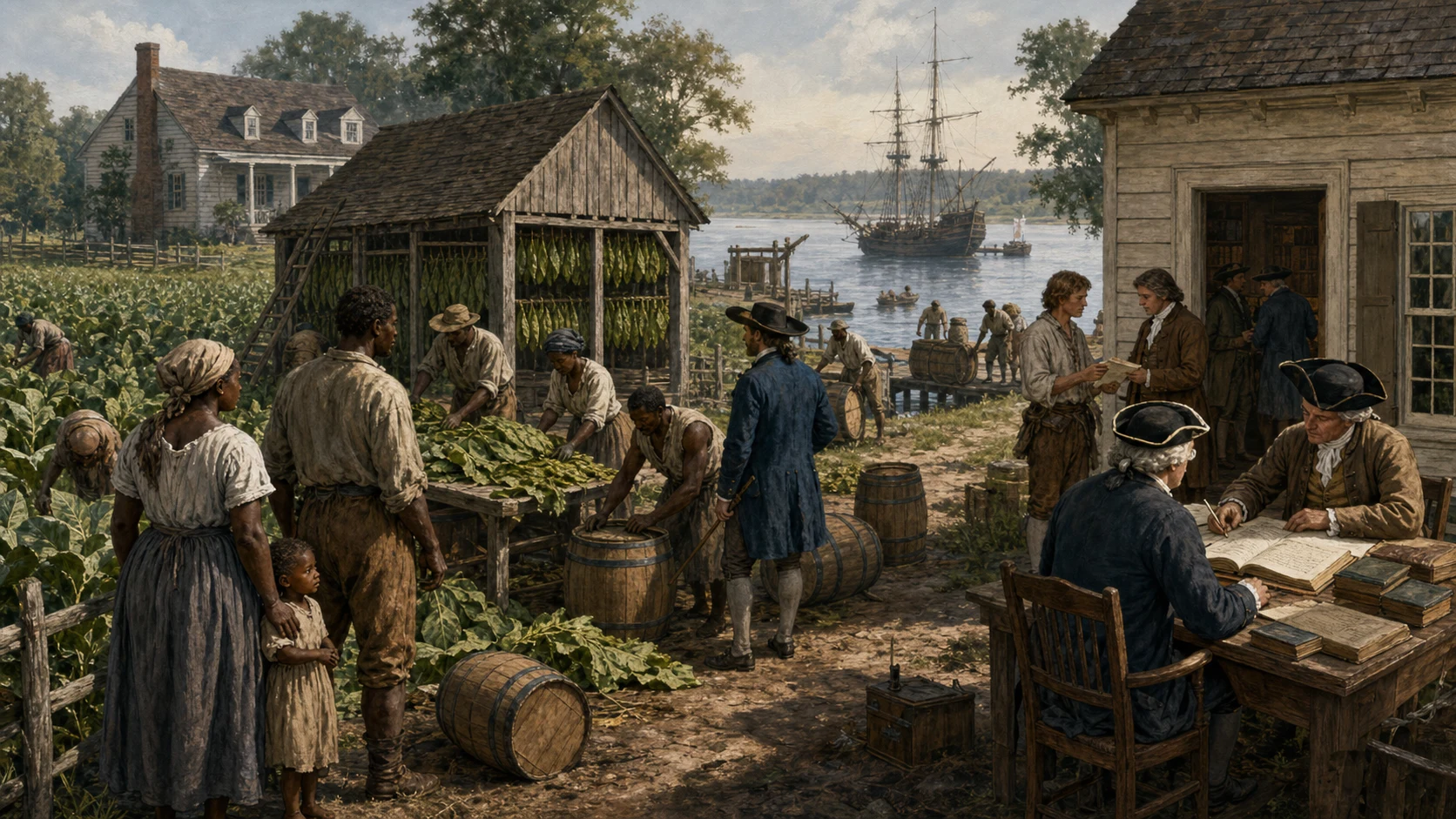
The first Africans documented in English Virginia arrived in 1619, but early labor status was not yet governed by one complete slave code. Africans, Europeans, and Native people experienced different forms of servitude, and a small number of Africans gained freedom and property. Unequal treatment appeared early, however, and court decisions increasingly associated African ancestry with lifetime bondage.
Tobacco created relentless demand for land and labor. During much of the seventeenth century, indentured English servants supplied a large share of field labor. As mortality fell, servant migration changed, the slave trade expanded, and planters sought labor claims lasting across generations, enslaved African labor grew rapidly. This was a transition produced by choices and institutions, not an automatic response to climate.
Bacon's Rebellion in 1676 exposed conflict among frontier settlers, servants, Native nations, and the planter government. Elite fear of unrest contributed to efforts to divide poor Europeans from Africans and stabilize rule, but the rebellion did not single-handedly create slavery. Racial laws, Atlantic supply, tobacco profit, demographics, and earlier precedents were already developing.
Law 04
Colonial law converted racial difference into permanent, hereditary, and unequal status
Virginia's 1662 law made a child's status follow the mother, reversing English paternal inheritance norms and allowing owners to claim children born to enslaved women. A 1667 law declared that Christian baptism did not free an enslaved person. Such rules closed paths that earlier Africans might have used to challenge bondage and made sexual exploitation economically valuable to enslavers.
The Virginia Slave Codes of 1705 consolidated earlier statutes distinguishing white servants from enslaved and free Black people. Other colonies built related systems restricting movement, weapons, assembly, testimony, marriage, property, manumission, and resistance. Legal details differed, but law increasingly protected owners and made African ancestry a presumption of enslaveability.
Poor and indentured Europeans remained exploited, and Native people were also enslaved, but neither condition became identical to African hereditary chattel slavery. White servants served finite terms and retained legal personhood, while enslaved status could be lifelong, inherited, sold, and enforced across family generations.
Forced migration 05
The Middle Passage supplied labor while violently reshaping population and identity
The transatlantic slave trade forcibly carried millions of African people to the Americas, with the great majority sent to Brazil and the Caribbean rather than British mainland colonies. Captives endured forced marches, coastal confinement, family separation, shipboard crowding, disease, hunger, abuse, and death. Merchants treated survival and cargo capacity as calculations of profit.
British mainland colonies received people from many West and West Central African societies. New arrivals brought languages, religions, farming knowledge, crafts, healing practices, maritime experience, and political memories. Enslavers tried to divide people by language, origin, plantation, and sale, while captives communicated, formed new relationships, resisted aboard ships, and rebuilt community after arrival.
Regional demography mattered. Chesapeake populations increasingly grew through births during the eighteenth century, while the Lowcountry continued receiving large numbers of Africans and developed African-majority districts. Sex ratios, disease, plantation size, and distance between households shaped family formation and cultural continuity.
Chesapeake 06
Tobacco slavery combined gang labor, dispersed plantations, and growing family communities
In Virginia and Maryland, enslaved workers cultivated tobacco and corn, raised livestock, processed crops, made barrels, loaded ships, built structures, cooked, cleaned, and practiced skilled trades. The gang system commonly organized groups under continuous supervision from early morning through the workday, though practice varied by plantation and season.
Dispersed river plantations and smaller enslaved workforces could separate families across properties. Owners used sale, hiring, inheritance, and punishment to control labor and kinship. Yet improving sex ratios and natural population growth helped enslaved communities form extended family and social networks during the eighteenth century.
A planter elite converted tobacco profits and enslaved property into political authority. County courts and assemblies dominated by slaveholders wrote and enforced racial law. Small farmers without large workforces still lived within an economy and political order whose land values, taxes, trade, and status were shaped by slavery.
Lower South 07
Lowcountry rice slavery relied on African expertise, task labor, and an African-majority population
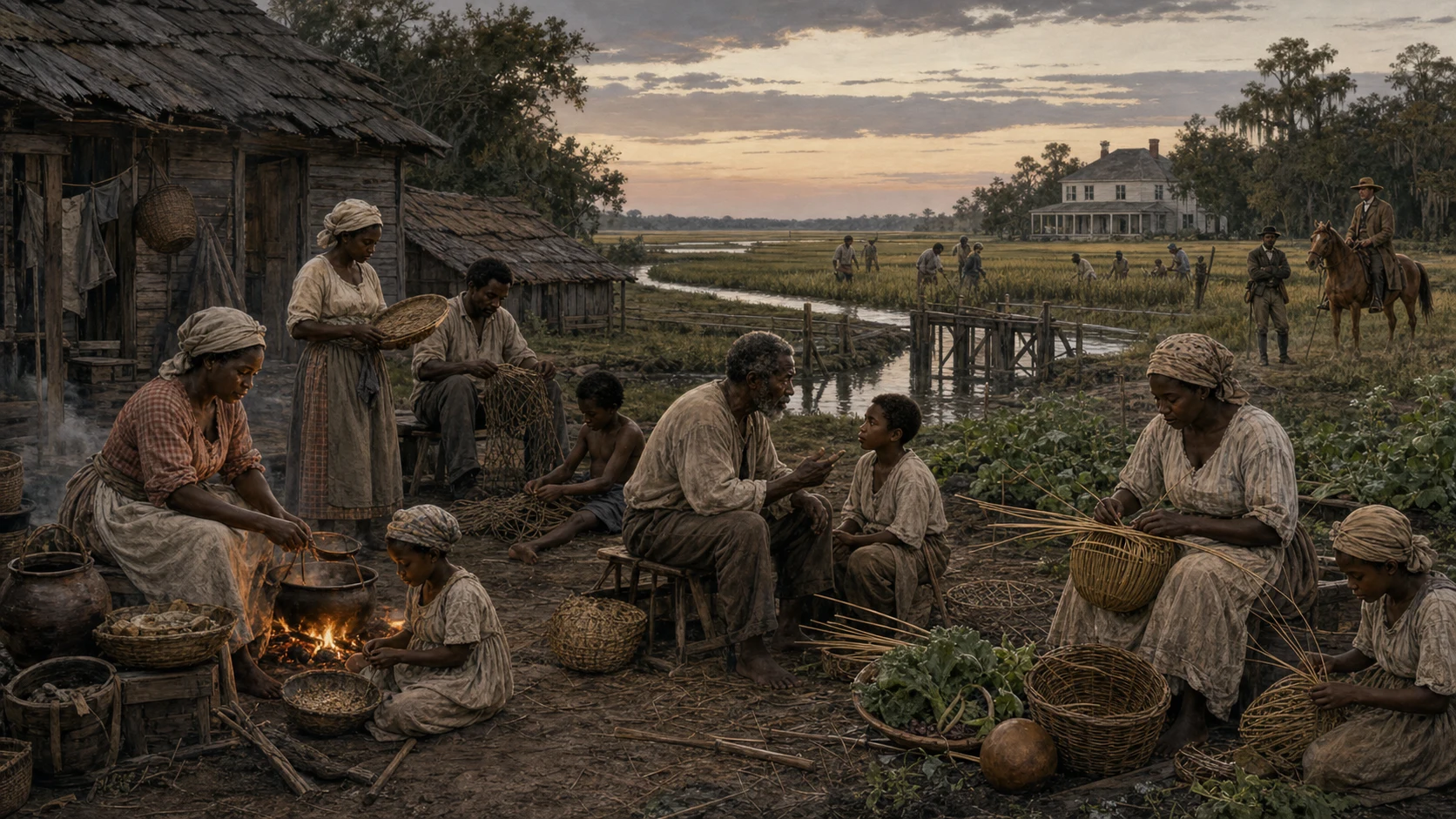
South Carolina and Georgia developed strong ties to Barbados and Caribbean plantation models. Rice and indigo generated high profits and concentrated large enslaved workforces in humid coastal districts. Enslaved West Africans brought expertise in rice cultivation, irrigation, processing, basketry, food systems, and environmental knowledge that owners appropriated.
The task system assigned defined daily work according to skill, age, and capacity. Completing a task could leave limited time for gardens, fishing, marketing, craft, rest, or community, but it did not make slavery humane. Owners, overseers, drivers, patrols, punishment, disease exposure, and sale still controlled life and labor.
Large plantations and African-majority districts enabled stronger cultural continuities and contributed to Gullah Geechee language and culture. People built families, foodways, spiritual practices, music, stories, and exchange networks from diverse African and American experiences. Community life was a survival achievement within coercion, not evidence that plantation control was weak.
North and Middle Colonies 08
Northern slavery was less concentrated but embedded in farms, households, ports, and Atlantic commerce
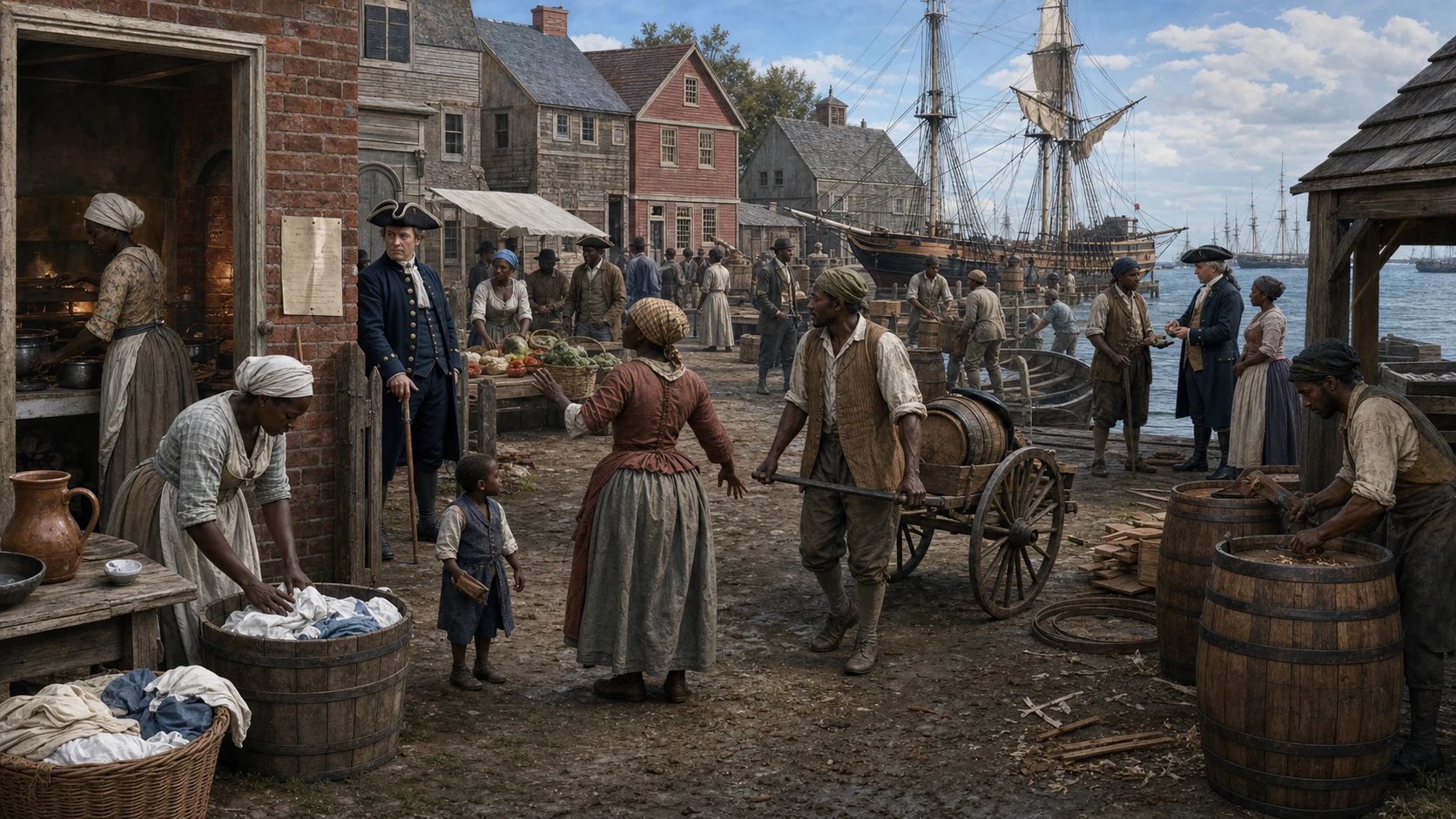
Small New England farms usually held fewer enslaved people than southern plantations, while New York, New Jersey, Rhode Island, Massachusetts, Pennsylvania, and other colonies used enslaved labor in agriculture, households, workshops, docks, ships, construction, carting, and markets. New York's infrastructure and commerce depended heavily on African and African-descended labor from its Dutch beginnings through British rule.
Urban slavery could allow movement between work sites, hiring out, market participation, or access to larger Black communities. These conditions sometimes created opportunities to exchange information or earn limited money, but owners could seize wages, restrict travel, punish assembly, separate families, and sell people. Visibility in a town did not equal freedom.
Northern merchants financed or conducted slave-trading voyages, provisioned Caribbean plantations, insured ships, distilled molasses, and sold slave-produced goods. The region's mixed economy explains a different concentration of slavery, not separation from the institution or its profits.
Family and gender 09
Hereditary law made Black women's labor, sexuality, and children central to slaveholders' wealth
Enslaved women performed agricultural, domestic, market, craft, and reproductive labor. The rule that status followed the mother gave owners a legal claim to children born to enslaved women and insulated white fathers from conferring freedom. Sexual coercion and assault operated within this extreme imbalance of legal power.
Marriage between enslaved people generally lacked secure legal protection. Owners could separate spouses, parents, and children through sale, inheritance, migration, or hiring. Families nevertheless developed naming practices, godparent-like ties, extended kin, cross-plantation visitation, shared child care, and community obligations.
Gender shaped resistance and survival. Women traded goods, preserved healing and food knowledge, protected children, negotiated work, carried information, fled temporarily or permanently, and challenged owners through courts or petitions when possible. Men's and women's experiences overlapped but were not identical.
Agency and resistance 10
Enslaved people resisted from daily negotiation to escape and organized revolt
Resistance included slowing work, breaking tools, preserving food, feigning illness, bargaining over tasks, practicing religion, learning to read despite restrictions, creating independent markets, stealing back time or goods, running away, forming maroon communities, petitioning, and open rebellion. These actions had different goals and risks; not every act sought immediate abolition of the entire system.
African cultural retention and creolization occurred together. Language, music, rhythm, religion, burial practice, naming, craft, foodways, and oral tradition drew on multiple African origins and new American conditions. Christianity could be imposed by enslavers, selectively adopted, blended with African beliefs, or used to claim spiritual equality and criticize bondage.
In the 1739 Stono Rebellion, a group of enslaved people in South Carolina seized weapons, gathered followers, and moved south, likely seeking Spanish Florida, where freedom had been offered to some British fugitives. Colonial militia suppressed the uprising. South Carolina's 1740 Negro Act tightened restrictions, showing a recurring chain: resistance exposed instability, and slaveholders answered with harsher surveillance and law.
Comparison table 11
Compare slavery using crop, scale, work, demography, and community—not a simple North–South binary
Regional patterns describe dominant tendencies. Farms, ports, towns, plantations, and households existed within each broad region, and an enslaved person's experience depended on gender, skill, age, origin, owner, family access, and local law.
| Region | Economic setting | Typical work and organization | Demography, culture, and control |
|---|---|---|---|
| New England | Small farms, households, shipping, fishing, artisans, Caribbean commerce | Domestic, farm, craft, maritime, dock, and infrastructure labor; usually smaller holdings | Dispersed households and port communities; slavery and slave trading embedded in Atlantic economy |
| Middle Colonies | Grain farms, estates, ports, workshops, households | Agricultural, tenant-estate, domestic, artisan, market, carting, and dock labor | Significant urban populations in New York and Philadelphia; varied work with restrictive law and sale |
| Chesapeake | Tobacco plantations and farms along rivers | Gang and seasonal field labor plus domestic, livestock, barrel, craft, and transport work | Increasing natural growth and family networks; dispersed plantations; planter-controlled law and politics |
| Lower South | Large rice and indigo plantations linked to Charleston and Caribbean markets | Task labor, tidal engineering, processing, craft, domestic, and port work | African-majority districts, continued imports, Gullah Geechee culture, patrols, disease, and concentrated planter control |
Legal table 12
Distinguish labor arrangements by duration, heredity, legal personhood, and control
Both indenture and slavery were coercive labor systems, but treating them as equivalent erases the permanent racial property regime created around African ancestry.
| Status or rule | Duration and inheritance | Legal position | Exam significance |
|---|---|---|---|
| Indentured servitude | Fixed contract term; children did not automatically inherit the contract | Restricted during service but retained legal personhood and expected freedom dues | Explains an important labor source and why slavery represented a different permanent system |
| Chattel slavery | Usually lifelong, transferable, and hereditary | Owners claimed property rights over labor, movement, family, and sale | Connects law, race, wealth, and labor across generations |
| Virginia 1662 maternal-status law | Child followed the free or enslaved status of the mother | Made enslaved women's children claimable property regardless of the father's status | Shows deliberate construction of hereditary racial slavery |
| Virginia 1667 baptism law | Christian conversion did not change lifetime status | Closed a potential religious argument for freedom | Shows economic property claims overriding a route to liberty |
| Virginia Slave Codes of 1705 | Consolidated earlier distinctions and restrictions | Separated white servants from enslaved and free Black people under law | Demonstrates race becoming a governing legal hierarchy |
| South Carolina Negro Act of 1740 | Expanded surveillance and restrictions after Stono | Limited movement, assembly, literacy, work, and autonomy while strengthening owner control | Connects resistance to a harsher colonial state response |
High-yield review
Key developments
All British regions participated
Slavery appeared in farms, plantations, households, ports, ships, markets, and workshops across mainland colonies.
A mixed labor system hardened into racial slavery
Atlantic supply, crop profits, servant changes, mortality, elite power, and prejudice expanded permanent African bondage.
Law made slavery hereditary
Maternal-status, baptism, policing, and slave-code rules transformed ancestry into permanent legal inequality.
Regional economies shaped work
Tobacco gangs, rice tasks, northern urban labor, maritime work, and household slavery created different daily conditions.
African knowledge transformed colonial production
Enslaved people applied expertise in agriculture, irrigation, craft, food, healing, trade, and maritime work.
Community and resistance challenged control
Families, cultural creation, negotiation, flight, markets, sabotage, petitions, maroonage, and revolt limited or opposed enslavers' power.
Chronological reasoning
Timeline — key moments
Captive Africans arrive in Virginia
The documented arrival enters an evolving labor system before a comprehensive racial slave code exists.
Pequot captives enter Atlantic slavery
Massachusetts colonists export Native prisoners and the ship Desire participates in an expanding slave trade.
John Punch receives lifetime servitude
A Virginia court gives an African runaway a lifelong sentence while European companions receive added terms.
Massachusetts Body of Liberties recognizes slavery
New England law permits forms of bondage, showing slavery was not confined to southern colonies.
Virginia formally recognizes slavery
Colonial law increasingly differentiates African bondage from white indenture.
Virginia makes status follow the mother
Children of enslaved women become enslaved, making bondage hereditary through maternal descent.
Baptism no longer changes slave status
Virginia protects owners' property claims by denying Christian conversion as a route to freedom.
Carolina colony begins
Settlers connected to Barbados import plantation practices and expand Native and African slavery.
Royal African Company expands English trafficking
A chartered company increases English participation in transporting enslaved Africans.
Bacon's Rebellion exposes labor and land tensions
Elite fear and frontier conflict reinforce, but do not originate, the transition toward racial slavery.
Rhode Island enters sustained slave trading
The Seaflower voyage marks Newport's growing role in transatlantic trafficking and Caribbean commerce.
Virginia consolidates slave codes
The colony formalizes racial distinctions between white servants and enslaved or free Black people.
Enslaved New Yorkers rebel
An urban uprising prompts executions and tighter restrictions, revealing slavery's northern presence.
Stono Rebellion challenges South Carolina
Enslaved people organize an armed movement toward possible freedom in Spanish Florida.
South Carolina passes the Negro Act
Slaveholders respond to Stono with expanded policing, restrictions, and legal control.
Remember these
Vocabulary
- Atlantic slave trade
- The commercial system that captured, transported, sold, and enslaved African people across Atlantic and intercolonial routes.
- Middle Passage
- The forced Atlantic crossing endured by captive Africans under crowded, violent, unhealthy, and often deadly conditions.
- Chattel slavery
- Lifelong, transferable, hereditary bondage in which law treated people as property.
- Racial slavery
- A system tying permanent bondage and legal disability to African ancestry and constructed racial categories.
- Hereditary slavery
- Bondage passed from one generation to the next, most importantly through the status of the mother.
- Partus sequitur ventrem
- The principle that a child's legal status followed the mother, associated with Virginia's 1662 law.
- Slave code
- A body of colonial laws defining enslaved status and restricting movement, assembly, weapons, testimony, education, and resistance.
- Indentured servitude
- A fixed-term labor contract commonly exchanged for Atlantic passage; coercive but not equivalent to hereditary chattel slavery.
- Royal African Company
- An English chartered company that held a major role in the slave trade after 1672.
- Plantation
- A large agricultural enterprise producing staple crops with controlled labor, capital, land, processing, and market connections.
- Gang system
- Work organization in which groups labored under continuous supervision, widely associated with tobacco and later cotton production.
- Task system
- Work organization assigning defined daily tasks, strongly associated with Lowcountry rice cultivation.
- Tobacco
- The Chesapeake staple crop that drove land expansion, export profit, and demand for bound labor.
- Rice
- The Lowcountry staple whose cultivation depended on tidal engineering and exploited West African knowledge and labor.
- Urban slavery
- Enslavement in towns and ports involving domestic, artisan, market, transport, maritime, and infrastructure work.
- Hiring out
- An arrangement in which an owner rented an enslaved person's labor to another employer and usually claimed the earnings.
- Driver
- An enslaved worker compelled to supervise or organize the labor of others, occupying a constrained intermediary position.
- Gullah Geechee
- A distinctive African American language and culture formed in the coastal Lowcountry through African continuities and American adaptation.
- Creolization
- The creation of new cultures, languages, and identities from interactions among diverse African, European, Native, and American experiences.
- Kinship network
- Family and family-like relationships that provided care, identity, obligation, and survival across legal and plantation boundaries.
- Cultural retention
- The preservation and adaptation of beliefs, skills, language, foodways, art, music, or social practices from earlier communities.
- Maroon
- A person who escaped slavery and lived independently, often in a community located beyond direct colonial control.
- Manumission
- The legal release of an enslaved person by an owner, often restricted by colonial law and never a guarantee of equal rights.
- Stono Rebellion
- The major 1739 South Carolina uprising in which enslaved people sought arms, recruits, and possible freedom in Spanish Florida.
- Negro Act of 1740
- South Carolina's post-Stono law expanding surveillance and restrictions on enslaved people's movement, assembly, literacy, work, and autonomy.
Clear the confusion
Frequently asked questions
20 detailed answers to the questions students most often carry into Topic 2.6.
01What is the main idea of APUSH Topic 2.6?
All British colonies participated in slavery, but regional systems differed. Plantation staples produced concentrated Chesapeake and Lower South slavery, while northern farms and ports used smaller-scale, household, urban, and maritime labor. Colonial law made African bondage lifelong, racial, and hereditary as enslaved people built communities and resisted.
02Why did slavery expand in the British colonies?
Expansion resulted from abundant seized land, European demand for colonial staples, planters' labor needs, changing indentured-servant supply, improving life expectancy, Atlantic slave trading, elite power, racial ideology, and laws granting owners permanent inheritable labor claims. No single factor explains the transition.
03Was slavery present in every British colony?
Yes. The concentration varied, but enslaved people worked throughout British mainland colonies. New England farms often held fewer people, while ports had significant enslaved minorities. The Middle Colonies used enslaved agricultural and urban labor, and southern plantation regions held much larger workforces.
04How was indentured servitude different from chattel slavery?
Indenture imposed a fixed contractual term and promised eventual release, although conditions could be violent and terms extended. Chattel slavery was generally lifelong, transferable, hereditary, and racially defined. Enslaved people lacked secure legal rights to their labor, movement, marriage, children, and family unity.
05Did Bacon's Rebellion cause racial slavery?
Not by itself. The 1676 rebellion increased elite fear of unrest and encouraged policies separating poor Europeans from Africans, but lifetime African bondage, racial court decisions, plantation demand, and slave trading existed earlier. It accelerated or reinforced a broader transition shaped by several causes.
06Why was the Virginia law of 1662 important?
It made children's status follow their mother. A child born to an enslaved woman was therefore enslaved regardless of the father's identity or status. The law made slavery inheritable, increased owners' wealth claims, and made enslaved women's reproduction and sexual vulnerability central to the system.
07Why was the Virginia law of 1667 important?
It declared that Christian baptism did not free an enslaved person. This protected owners' property claims and closed a possible religious path to freedom. It also demonstrated that colonial economic and racial interests could override the claim that Christians should not enslave fellow Christians.
08What did the Virginia Slave Codes of 1705 do?
They consolidated earlier rules and sharpened legal distinctions among white servants, free Black people, and enslaved people. The codes strengthened owners' authority and racialized property status, punishment, movement, testimony, and social relations, making law an active creator rather than a passive description of slavery.
09What was slavery like in the Chesapeake?
Tobacco plantations used enslaved labor in fields, barns, transport, livestock, domestic work, and skilled trades. Gang labor and close supervision were common. Dispersed plantations could separate families, though natural population growth and more balanced sex ratios supported larger kin networks during the eighteenth century.
10What was slavery like in the Lower South?
Rice and indigo plantations concentrated wealth and large enslaved populations. Tidal rice cultivation exploited West African expertise and often used the task system. Continued African arrivals and African-majority districts supported strong cultural continuities and Gullah Geechee development amid disease, patrols, punishment, and sale.
11Did the task system make Lowcountry slavery less oppressive?
No. Completing assigned tasks could leave limited time for gardens, fishing, craft, markets, or family, but owners still claimed people as property and controlled punishment, movement, sale, family security, and work. Labor organization differed from gang labor; legal bondage did not.
12What was slavery like in northern ports?
Enslaved people worked as cooks, laundresses, domestic workers, sailors, dockworkers, cart drivers, artisans, construction laborers, and market sellers. Urban movement could create information and earning opportunities, but owners claimed wages and authorities restricted travel, assembly, family contact, and resistance.
13How did northern colonies profit from plantation slavery?
Northern merchants trafficked enslaved people, financed and insured voyages, built ships, distilled Caribbean molasses, provisioned plantations, and sold slave-produced commodities. Farmers and artisans supplied Atlantic markets. Economic diversity connected the North to slavery rather than isolating it.
14How did gender shape enslaved people's experiences?
Women performed agricultural, domestic, market, craft, and reproductive labor and faced sexual coercion. Maternal-status law made their children enslavers' property. Men and women both resisted and maintained families, but work assignments, punishment, mobility, sexual vulnerability, and sale affected them differently.
15Could enslaved people form families?
Yes. People formed marriages, extended kin, naming traditions, shared child care, and cross-property networks. These relationships created identity, care, and resistance to social isolation. Because colonial law rarely protected enslaved marriage, owners could still separate spouses, parents, and children through sale or migration.
16How did enslaved Africans influence colonial culture and production?
They contributed expertise in rice cultivation, irrigation, livestock, craft, metallurgy, food, healing, navigation, music, language, and religion. Diverse people created new African American cultures through retention and creolization. Owners appropriated this knowledge and captured profits under coercive law.
17How did enslaved people resist slavery?
Resistance ranged from work slowdowns, tool breaking, bargaining, markets, literacy, religion, kinship, and preserving culture to temporary flight, permanent escape, maroon communities, petitions, shipboard revolt, and armed uprising. Different acts pursued survival, family protection, autonomy, or freedom under different risks.
18What was the Stono Rebellion?
In 1739, enslaved people in South Carolina seized weapons, gathered followers, and moved south, probably hoping to reach Spanish Florida. Colonial militia suppressed the uprising. South Carolina responded with the 1740 Negro Act, expanding surveillance and restrictions while illustrating slaveholders' continuing fear of resistance.
19Why were most enslaved Africans sent to the Caribbean rather than British North America?
Caribbean sugar production demanded enormous labor forces and suffered high mortality, creating continuing import demand. Mainland colonies still received substantial forced migration and were deeply connected through direct trafficking, intercolonial sales, provisioning, finance, shipping, consumption, and shared law.
20How can Topic 2.6 appear on the APUSH exam?
Questions may use a slave code, labor advertisement, plantation record, map, runaway notice, trade data, or narrative. Compare regions through crop, scale, work, demography, and law; explain multicausal expansion; source documents from owners or officials critically; and connect enslaved agency to unequal power.
Use the knowledge
AP exam connections
- 1
Explain slavery's expansion through interacting economic, demographic, ideological, Atlantic, and legal causes rather than one event.
- 2
Compare regions with matched categories: crop, scale, labor organization, demography, family, culture, and control.
- 3
Use the 1662 maternal-status rule and 1705 codes to show that governments constructed hereditary racial slavery.
- 4
Recognize African knowledge, family, culture, and resistance while identifying who controlled law, violence, sale, and profit.
- 5
Connect northern ports and consumers to plantation slavery so regional difference does not become a false moral separation.
Editorial trust
Sources and review
These notes are original OnlyPrepy content. The syllabus scope and historical framing were checked against the following authoritative sources on August 15, 2026.
- AP U.S. History Course and Exam Description, Effective Fall 2026College Board
- Rise of the Colonial Plantation SystemNational Park Service
- Race, Slavery, and Freedom — The Evolution of Their StatusNational Park Service
- Colonial African EnslavementAfrican Burial Ground National Monument, National Park Service
- African Americans at Snee FarmNational Park Service
- The Middle PassageNational Park Service
- International Underground Railroad Month — Stono RebellionNational Park Service