The big picture
Trace how migration, pluralism, Anglicization, evangelical revival, Enlightenment thought, print culture, and self-government reshaped colonial culture and colonists’ relationship with Britain.
Exam focus 01
Colonial culture developed through a double movement: Anglicization and differentiation
From 1607 to 1754, British North American colonists became more closely connected to Britain through trade, imported goods, law, political models, print, and migration. This gradual Anglicization did not make the colonies culturally uniform. Regional economies, ethnic and religious pluralism, forced African migration, Native borderlands, and local institutions produced distinct colonial societies.
The College Board emphasizes movement across the Atlantic: religious revivals, European Enlightenment ideas, commercial networks, and print culture changed how colonists understood authority and identity. At the same time, colonists built autonomous political communities from English precedents. Their attachment to English rights could therefore strengthen British identity while also providing a language for criticizing imperial power.
For the exam, avoid treating colonial culture as a straight path toward independence. Before 1754 most colonists remained loyal to the empire. The defensible claim is that shared experiences, networks, and institutions created habits and ideas that later made resistance more possible when imperial policy changed.
People and identity 02
Voluntary and forced migration made British America ethnically, religiously, and culturally plural
Rapid natural increase and continuing migration expanded the colonial population. English families remained numerous, but German-speaking migrants settled especially in Pennsylvania’s interior; Scots-Irish migrants moved toward the backcountry; Dutch communities retained influence in New York; Huguenot and Jewish communities added to port and regional diversity. Migrants preserved languages, churches, foodways, and family networks while adapting to colonial law and markets.
Forced migration from Africa was indispensable to this demographic transformation. Enslaved people came from many West and West-Central African societies, created new African American cultures, and shaped agriculture, crafts, food, music, language, religion, and urban life. Their cultural influence must never be confused with voluntary inclusion: colonial law denied freedom and exposed families to sale and violence.
Native nations were not simply one group inside British colonial society. Many remained sovereign peoples whose homelands, trade, diplomacy, and warfare shaped colonial borders. Expansion pushed settlers into Native territories and made cultural exchange inseparable from dispossession and conflict.
Middle Colonies
Ports, fertile farms, and relatively broad toleration attracted diverse European communities and made Pennsylvania and New York especially plural.
Backcountry
Scots-Irish and German migration created inland communities whose security, land claims, and representation could diverge from coastal elites.
African diaspora
Forced migrants retained and recombined knowledge, kinship practices, belief, language, music, and foodways under bondage.
Native borderlands
Indigenous diplomacy and sovereignty continued to structure colonial expansion even where settlers described land as available.
Social structure 03
Opportunity for some coexisted with entrenched hierarchies of wealth, race, gender, and legal status
Colonial society was hierarchical. Large planters and wealthy merchants used land, credit, officeholding, and family connections to form regional elites. A broad middling population included independent farmers, shopkeepers, and artisans. Tenant farmers, laborers, indentured servants, sailors, and the poor held fewer resources, while enslaved people were legally treated as property. Land availability allowed some European men greater mobility than in Europe, but opportunity varied sharply by region and generation.
The household was an economic and political unit. Men normally held formal authority, and English coverture placed a married woman’s legal identity and property under her husband. Women nevertheless managed farms, shops, accounts, food production, textile work, childbirth, and community exchange. Widows could exercise greater property rights, and some unmarried women operated businesses, but exceptions did not erase patriarchal rules.
Family life also varied regionally. New England’s healthier climate and family migration encouraged long-lived households and towns. Early Chesapeake disease and male-heavy migration weakened family formation before mortality declined and sex ratios became more balanced. Enslaved families created durable kinship networks everywhere, yet law gave owners power to separate relatives through sale or movement.
Atlantic bonds 04
Anglicization spread through goods, credit, law, fashion, print, and imperial institutions
Anglicization was the gradual adoption or reinforcement of English and British cultural patterns. Colonists read British books and newspapers, followed London fashions, used English common-law traditions, named counties and towns after imperial figures, and modeled assemblies and elite manners on British examples. Growing intercolonial trade and travel also connected colonies to one another.
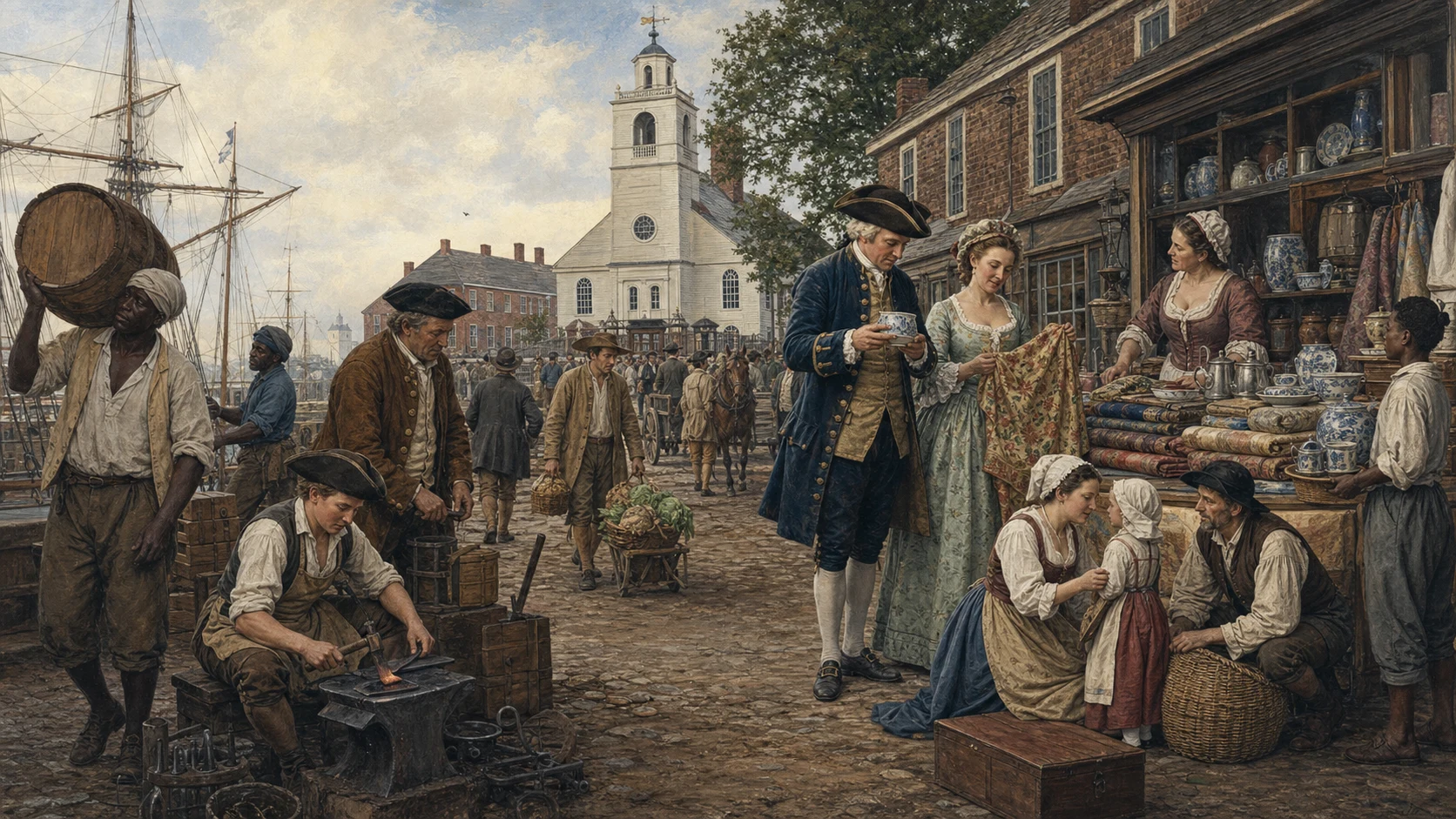
The eighteenth-century consumer revolution widened access to imported tea, textiles, ceramics, metalware, books, and household furnishings. Ownership allowed families to display gentility and connection to the empire. Merchants extended credit, shopkeepers advertised fashions, and consumers learned to compare goods. Women’s purchasing and shopkeeping labor made them important economic actors even when formal political power remained male.
Consumption rested on unequal Atlantic systems. British manufacturing, colonial shipping, Caribbean plantations, Indigenous dispossession, and enslaved labor all helped place goods in colonial shops and homes. Debt also made households vulnerable to distant merchants and market shifts. Material Anglicization therefore strengthened empire while creating the consumer networks that later boycotts could politicize.
Cultural signal
Imported goods and genteel manners communicated status and participation in a British Atlantic world.
Economic structure
Credit linked colonial consumers and retailers to British exporters, shipping, insurance, and slave-produced commodities.
Political potential
Shared consumer habits later made nonimportation meaningful, though widespread imperial protest came after this period.
Religion 05
Religious diversity expanded, but toleration remained regional, conditional, and incomplete
Colonial religion reflected settlement patterns. Congregational churches held public authority in much of New England; the Church of England was established in Virginia and other southern colonies; Quaker Pennsylvania attracted diverse believers; and the Middle Colonies contained Quakers, Presbyterians, Dutch Reformed congregations, Lutherans, German Reformed churches, Baptists, Anglicans, Catholics, and Jewish communities.
Documents such as Maryland’s 1649 Toleration Act and Pennsylvania’s 1701 Charter of Privileges protected meaningful religious practice, but within limits. Maryland’s law applied to Christians who accepted the Trinity, and several colonies taxed residents to support established churches or restricted officeholding. Rhode Island offered unusually broad freedom, yet no colony created modern equality for every belief.
Pluralism grew because migrants carried faiths across the Atlantic and because imperial authorities often lacked the capacity or incentive to impose one uniform church. Competition among congregations encouraged publishing, schools, missionary work, and debate—conditions that helped revivalism spread.
Evangelical revival 06
The First Great Awakening made personal conversion a transatlantic public movement
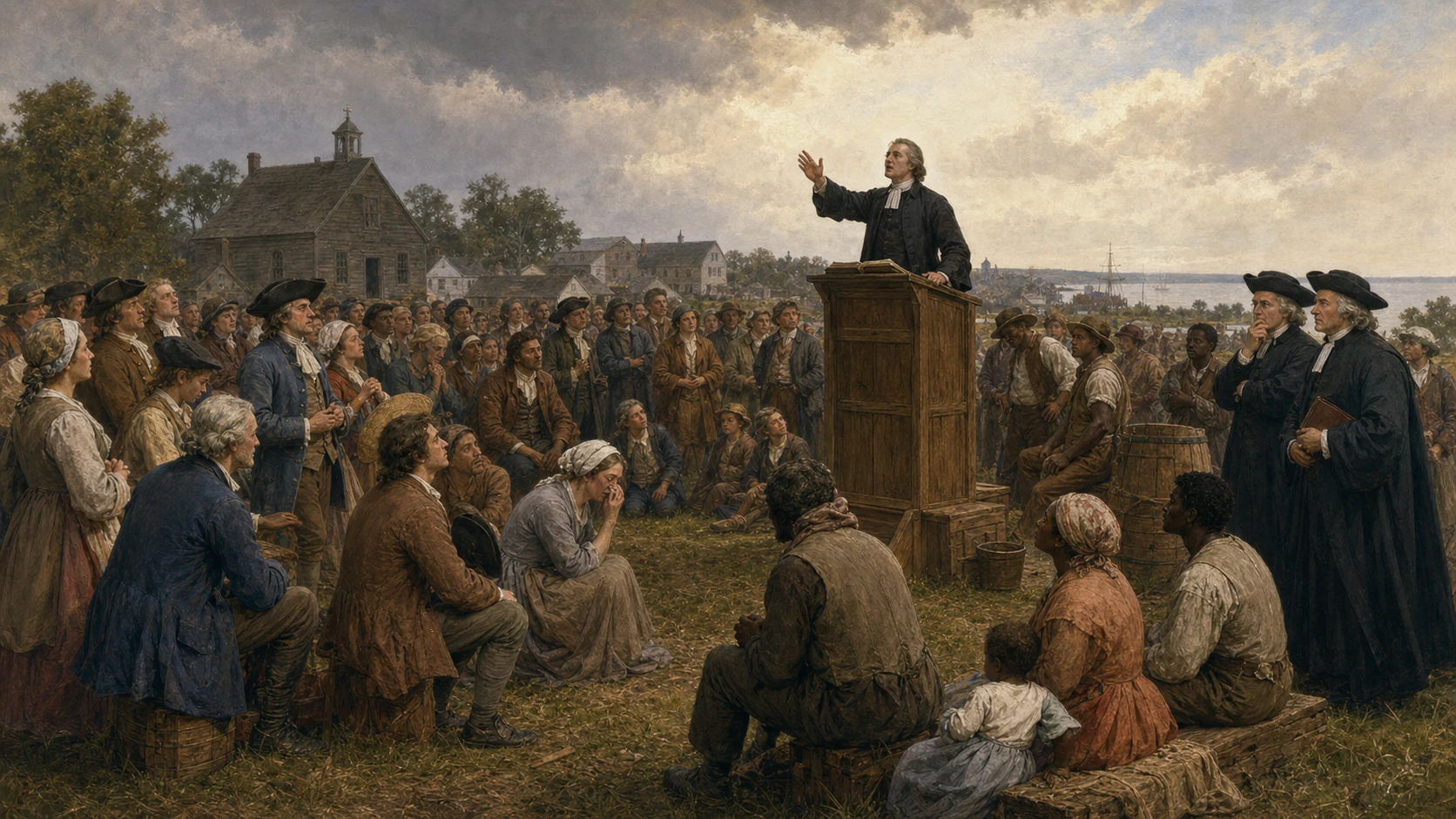
The First Great Awakening was a wave of Protestant evangelical revivals that moved through Britain and its colonies during the 1730s and 1740s. Preachers emphasized human sin, dependence on divine grace, and the transforming experience of a spiritual ‘new birth.’ Jonathan Edwards helped lead revivals in the Connecticut River Valley, while George Whitefield used dramatic itinerant preaching and print publicity to address enormous crowds across several colonies.
Revivalists invited listeners to judge whether ministers possessed genuine spiritual authority. Supporters known as New Lights or New Sides defended emotional conversion and itinerant preaching; Old Lights or Old Sides criticized disorder and challenges to educated clergy. Congregations divided, while Baptists and Presbyterians gained energy and new institutions trained revival ministers.
The Awakening created shared experiences across colonial borders and widened religious participation among ordinary colonists, women, and some Black and Native listeners and preachers. Yet it did not remove slavery, patriarchy, established churches, or social inequality. Whitefield himself enslaved people and promoted slavery in Georgia, illustrating the gap between spiritual appeal and structural equality.
Method
Itinerant sermons, outdoor meetings, emotional language, testimony, and print publicity carried revivalism beyond one congregation.
Authority
Conversion experience could compete with inherited status or formal clerical education as a claim to religious credibility.
Institutional effect
Church splits, evangelical denominations, and New Light colleges outlasted the peak revival years.
Exam limit
The Awakening contributed to habits of questioning authority; it was not a single or direct cause of the American Revolution.
Ideas 07
The Enlightenment elevated reason, observation, natural law, and debate over inherited authority
European Enlightenment writers argued that reason and observation could reveal principles governing nature and society. John Locke’s ideas about natural rights, consent, and legitimate resistance later became especially important to colonial political thought. Empiricism encouraged knowledge grounded in experience and experiment rather than unquestioned tradition.
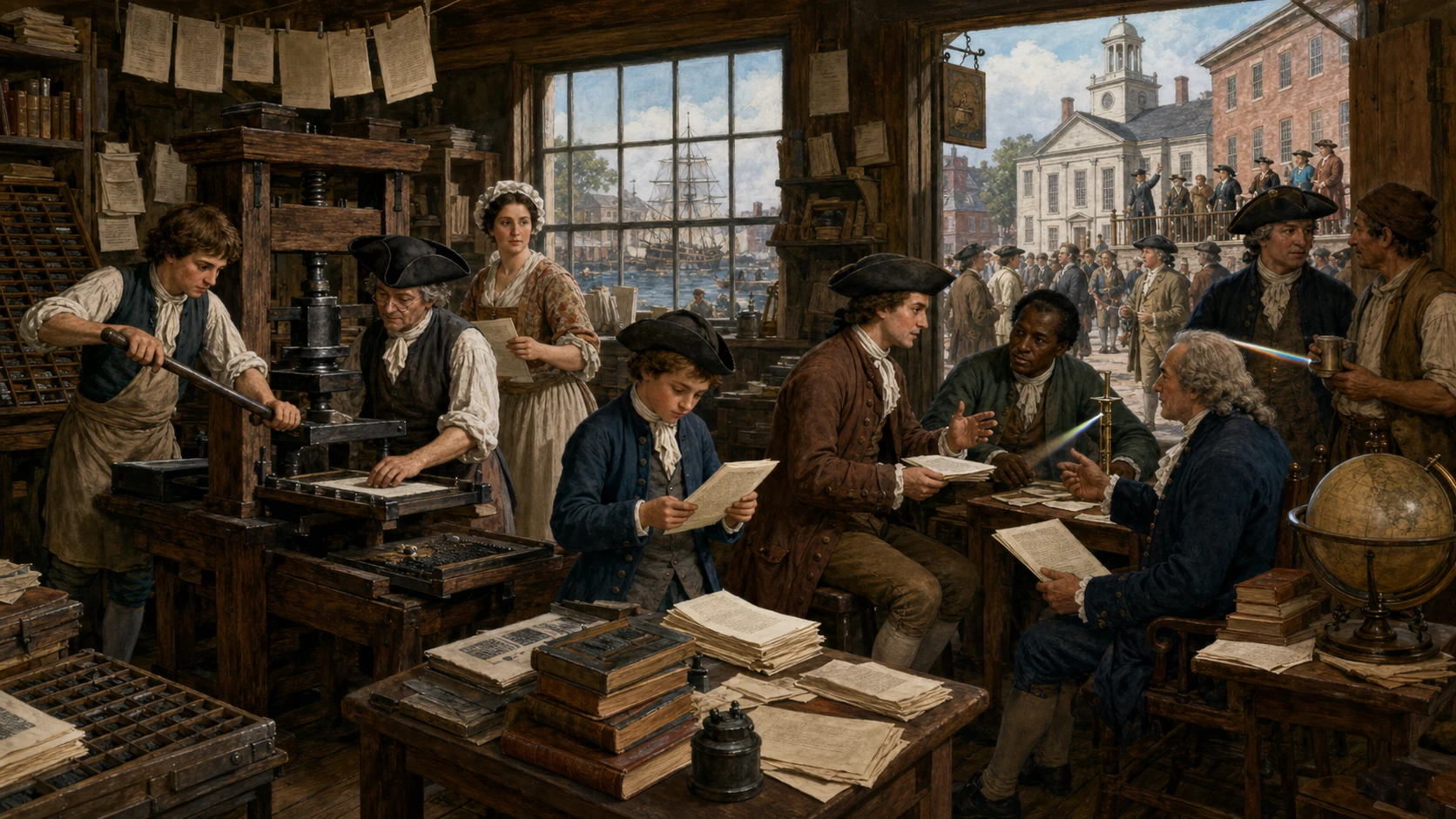
Colonists adapted rather than merely copied these ideas. Benjamin Franklin’s printing, civic projects, scientific experiments, and international correspondence embodied practical improvement and Atlantic intellectual exchange. Libraries, learned societies, colleges, almanacs, and newspapers circulated knowledge among readers who connected European concepts to local concerns.
Religion and Enlightenment thought were not simple opposites. Jonathan Edwards engaged contemporary philosophy, many ministers valued science, and numerous colonists combined providential belief with rational inquiry. Deism attracted a minority rather than replacing Protestant Christianity. Access also remained unequal because education, leisure, money, race, and gender shaped who could publish and hold recognized authority.
Communication 08
Print, education, postal routes, and meeting places created an expanding colonial public sphere
Printing connected local events to Atlantic debates. The Boston News-Letter began in 1704 as the first colonial newspaper to continue beyond one issue. By midcentury, newspapers, pamphlets, sermons, broadsides, and almanacs moved through postal routes, taverns, coffeehouses, churches, shops, and homes. Readers often shared texts aloud, extending print beyond the fully literate population.
Education developed unevenly. New England towns supported schools partly so residents could read scripture, and colleges trained clergy and civic leaders. Apprenticeship, household instruction, churches, and private tutors also transmitted knowledge. Enslaved people and many poor colonists faced deliberate or practical barriers, while women’s literacy rose without granting equal access to colleges, office, or authorship.
The 1735 acquittal of printer John Peter Zenger became a popular symbol of resistance to official censorship after his newspaper criticized New York’s governor. The verdict did not create a constitutional right to press freedom or erase seditious-libel law; its significance was political and cultural, demonstrating how a jury and public opinion might protect criticism of power.
Network effect
Reprinting let sermons, political arguments, advertisements, and overseas news cross colonial borders.
Shared forum
Taverns, churches, markets, and assemblies turned printed words into conversation, conflict, and collective judgment.
Unequal access
Literacy and publication expanded without becoming universal; law and social hierarchy still controlled recognized speech.
Zenger nuance
Treat the acquittal as a milestone in press culture, not as an immediate binding rule that truth could never be libel.
Politics and identity 09
Colonists used English political models to build local autonomy—and then defended that autonomy as an English right
Colonial assemblies, town meetings, county courts, vestries, juries, and local offices gave many property-holding white men repeated experience with taxation, budgets, roads, poor relief, militia, and legislation. New England town meetings involved relatively broad participation among eligible men, while southern county governments and assemblies were more strongly dominated by planter elites. Royal governors and imperial officials still possessed real authority.
Distance, slow communication, competing imperial priorities, and uneven enforcement allowed colonial institutions room to operate. Colonists often controlled governors through legislative appropriations and local cooperation. This was not independence: charters, royal instructions, English courts, trade regulation, and military protection tied colonies to empire.
The interests of imperial leaders and colonists sometimes diverged over trade enforcement, frontier defense, territorial settlements, impressment, and local rule. The 1747 Knowles Riot in Boston, sparked by naval impressment, showed how colonists could defend local liberty against imperial coercion while still identifying as British subjects.
Political participation was unusually extensive for the era but severely bounded. Property requirements excluded many men, and women, enslaved people, most free Black people, Native peoples, servants, and the poor had little or no formal power. AP arguments should call these institutions representative or participatory for eligible colonists, not democratic for everyone.
Comparison 10
Environment, migration, labor, and settlement produced distinct regional societies
Regional comparison works best when every region is evaluated with the same categories. The table identifies dominant patterns, not universal rules. Cities, backcountry settlements, Native borderlands, plantations, and small farms created substantial variation within each region.
| Category | New England | Middle Colonies | Chesapeake | Lower South |
|---|---|---|---|---|
| Settlement and demography | Compact towns, family migration, high natural increase | Diverse ports, farms, and immigrant communities | Dispersed tobacco plantations; improving family stability | Rice and indigo plantations; Black majorities in many Lowcountry districts |
| Religion | Congregational establishment; dissent and revival divisions | Quaker influence plus exceptional denominational pluralism | Anglican establishment with growing dissent | Anglican establishment; evangelical growth remained uneven before 1754 |
| Social power | Merchants, ministers, town and rural property holders | Merchants, proprietors, large landlords, farmers, artisans | Planter gentry dominated counties and assembly | Rice-planter elite held concentrated wealth and political power |
| Labor | Family farms, artisans, maritime labor, servants, enslaved labor | Family farms, tenants, artisans, servants, enslaved rural and urban labor | Tobacco increasingly dominated by enslaved labor | Large enslaved workforces under task and gang systems |
| Politics | Town meetings and elected assemblies for eligible men | Assemblies, county institutions, proprietor or royal government | Elected assembly and elite-dominated county courts | Elite-dominated assemblies and parishes backed by slave codes and patrols |
| Cultural pattern | Literacy, schools, print, congregational community | Multilingual exchange, commerce, religious diversity | Anglican and gentry ideals, dispersed plantation culture | Atlantic plantation culture shaped by African knowledge and Gullah Geechee development |
Synthesis 11
The Great Awakening and Enlightenment differed in method but both widened debate over authority
AP questions often pair these movements because both crossed the Atlantic and encouraged colonists to evaluate established authority. Their reasoning differed: revivalists emphasized revelation, grace, scripture, and conversion, while Enlightenment thinkers emphasized reason, evidence, natural law, and improvement. Neither movement reached everyone or automatically produced political revolution.
| Category | First Great Awakening | Enlightenment |
|---|---|---|
| Core concern | Personal salvation and the evangelical new birth | Knowledge, natural law, reason, rights, and improvement |
| Method | Itinerant preaching, emotional sermons, testimony, revival meetings | Observation, experiment, reading, correspondence, and rational debate |
| Key evidence | Jonathan Edwards, George Whitefield, New Lights and Old Lights | John Locke, Benjamin Franklin, libraries and scientific inquiry |
| Networks | Atlantic sermons, print publicity, traveling preachers, congregations | Books, newspapers, almanacs, colleges, societies, and letters |
| Authority challenged | Established clergy and inherited religious standing | Tradition or government unsupported by reason, evidence, or natural rights |
| Effects | Church division, evangelical growth, intercolonial religious experience | Civic projects, scientific culture, evolving political arguments about consent and liberty |
| Limits | Did not abolish slavery, patriarchy, or establishments | Access remained unequal; reason did not erase religion or hierarchy |
| Shared significance | Both enlarged transatlantic exchange, individual judgment, intercolonial networks, and criticism of authority |
Exam method 12
Build AP arguments with a development, mechanism, evidence, and limit
A strong response does not list ‘Great Awakening, Enlightenment, and Zenger.’ It explains a process: transatlantic print and migration carried ideas; colonial audiences adapted them; institutions and debates changed; unequal access limited the result. Use evidence as proof of a claim rather than as a name dropped into a paragraph.
For continuity and change, compare the persistent importance of British law, Protestant belief, patriarchy, and hierarchy with expanding pluralism, print, consumer access, revivalism, and self-government. For causation, connect migration and Atlantic networks to new institutions and identities. For comparison, use matched categories for regions or intellectual movements.
Always qualify political claims. Assemblies trained colonists in self-rule, but represented only eligible men. The Great Awakening questioned clerical authority, but did not cause independence by itself. The Zenger verdict encouraged press criticism, but did not immediately create modern constitutional protection.
High-yield review
Key developments
Atlantic pluralism
Voluntary migration from several European regions and forced African migration produced multilingual, multiethnic, and multireligious societies.
Gradual Anglicization
British goods, credit, fashions, common-law traditions, political models, and print tied colonists more closely to the empire.
First Great Awakening
Evangelical revivals emphasized new birth, itinerant preaching, and personal religious experience while dividing established churches.
Enlightenment exchange
Reason, empiricism, natural law, and political ideas circulated through books, colleges, societies, and correspondence.
Expanding print culture
Newspapers, almanacs, sermons, and pamphlets connected local readers to Atlantic news and a growing public sphere.
Autonomous political communities
Assemblies, town meetings, courts, juries, and local offices gave eligible colonists experience governing within English models.
Chronological reasoning
Timeline — key moments
House of Burgesses meets
Virginia’s elected assembly establishes an early precedent for representative government among eligible colonists.
Mayflower Compact
Male signers covenant to form a civil body politic, linking local consent to order under the English crown.
Harvard College founded
Massachusetts establishes a college primarily to train learned ministers and civic leaders.
Fundamental Orders of Connecticut
Connecticut towns formalize a representative framework grounded in local political practice.
Massachusetts education law
The colony requires towns of sufficient size to support schooling so children can read scripture and prepare for further study.
Maryland Toleration Act
Maryland protects worship for Trinitarian Christians, an important but limited form of colonial toleration.
Pennsylvania charter granted
William Penn’s colony develops around Quaker influence, immigration, representative institutions, and broad Christian toleration.
English rights and toleration expand
The English Bill of Rights and Toleration Act influence colonial expectations while retaining religious and political limits.
Salem witch trials
Fear, factionalism, gendered accusation, and judicial failure produce executions before authorities halt the proceedings.
Pennsylvania Charter of Privileges
The charter confirms an elected assembly and significant religious liberty, illustrating local self-government.
Boston News-Letter begins
The first colonial newspaper to survive beyond one issue strengthens a continuing print and news network.
Poor Richard’s Almanack begins
Benjamin Franklin combines practical information, wit, commerce, and print circulation for a broad reading public.
Zenger acquitted
A New York jury rejects seditious-libel charges against printer John Peter Zenger, creating a celebrated press-freedom milestone.
Whitefield tours the colonies
George Whitefield’s itinerant sermons and print publicity help make the Great Awakening an intercolonial event.
Knowles Riot in Boston
Crowds resist naval impressment, exposing conflict between imperial military demands and colonial ideas of local liberty.
Remember these
Vocabulary
- Anglicization
- The gradual strengthening or adoption of English and British cultural, legal, political, and consumer practices in the colonies.
- Pluralism
- The coexistence of multiple ethnic, cultural, linguistic, or religious communities within a society, not necessarily on equal terms.
- Toleration
- Legal or practical permission for specified beliefs or worship; narrower than full equality or universal religious liberty.
- Consumer revolution
- The eighteenth-century expansion of household demand for imported and locally produced goods, often purchased through Atlantic credit.
- Gentility
- Elite or aspirational standards of refined dress, manners, consumption, education, and social behavior.
- Credit
- Goods, money, or services supplied with payment deferred, linking colonial households and merchants to wider Atlantic markets.
- Gentry
- A wealthy landholding or mercantile elite whose property, family connections, and officeholding generated social and political influence.
- Middling sort
- Independent farmers, artisans, shopkeepers, and other households located between elites and the propertyless poor or bound laborers.
- Coverture
- The English legal doctrine under which a married woman’s separate legal identity and much of her property were absorbed by her husband.
- Established church
- A denomination supported or privileged by colonial law, taxes, office rules, or public authority.
- First Great Awakening
- The transatlantic evangelical revival movement of the 1730s and 1740s emphasizing conversion and the new birth.
- Evangelicalism
- Protestant Christianity emphasizing the authority of scripture, preaching, personal conversion, and spreading the gospel.
- New birth
- A transforming conversion experience that revivalists treated as central evidence of genuine Christian faith.
- Itinerant preacher
- A minister who traveled among communities rather than serving only one settled congregation.
- New Lights
- Supporters of Great Awakening revivalism, emotional conversion, and itinerant preaching, especially in Congregational contexts.
- Old Lights
- Critics of revival methods who defended established clergy, theological order, and more restrained worship.
- Enlightenment
- An intellectual movement stressing reason, inquiry, natural law, and the possibility of improving society and knowledge.
- Natural rights
- Rights understood as inherent in human beings rather than granted at the discretion of a ruler.
- Empiricism
- The view that knowledge should be grounded in observation, experience, and evidence.
- Print culture
- The production, circulation, reading, and discussion of newspapers, books, pamphlets, sermons, almanacs, and broadsides.
- Public sphere
- Social spaces and communication networks in which people exchanged news and debated matters beyond the private household.
- John Peter Zenger trial
- The 1735 New York seditious-libel case whose acquittal became a political symbol of the right to criticize officials.
- Colonial assembly
- An elected legislative body that represented eligible colonists while operating under a charter, proprietor, or royal government.
- Impressment
- The forced recruitment of men into naval service, a practice that provoked colonial resistance such as the Knowles Riot.
- Salutary neglect
- A later label for Britain’s uneven enforcement and limited supervision that gave colonial institutions practical room to govern.
Clear the confusion
Frequently asked questions
20 detailed answers to the questions students most often carry into Topic 2.7.
01What is the main idea of APUSH Topic 2.7?
Atlantic migration and exchanges of goods, religion, philosophy, print, and politics made British colonial society more diverse and interconnected. Colonists gradually Anglicized while building local institutions and identities. Those developments reinforced British ties but also expanded habits of judgment and self-government that could later support resistance.
02What does Anglicization mean in colonial America?
Anglicization means the gradual spread or reinforcement of English and British practices: common law, representative institutions, language, print, fashion, consumer goods, manners, and imperial identity. It was not complete cultural replacement. German, Dutch, African, Native, and regional traditions persisted and changed British models.
03How could colonists become more British and more independent-minded at the same time?
Colonists defended assemblies, juries, property, and local rule as English rights. Distance and uneven enforcement let them practice those rights with substantial autonomy. Their British identity therefore supplied both loyalty to empire and standards by which they judged imperial officials who appeared corrupt or coercive.
04Why did colonial society become more diverse by 1754?
Natural increase, English migration, German and Scots-Irish settlement, Dutch and other European communities, forced African migration, and continuing Native sovereignty produced complex populations. Ports and frontier districts intensified exchange. Diversity was greatest in some Middle Colonies, but every region contained cultural variation and unequal power.
05Does religious pluralism mean the colonies had complete religious freedom?
No. Pluralism means several faiths coexisted. Toleration usually protected only specified groups, while established churches received taxes or legal privileges and officeholding could depend on belief. Rhode Island and Pennsylvania were comparatively broad, but no colony provided modern, universal equality for every religion.
06How did social class work in the British colonies?
Wealthy planters, merchants, and officeholders formed regional elites; independent farmers, artisans, and shopkeepers made up a broad middle; tenants, servants, sailors, laborers, and the poor had less security; enslaved people were property under law. Land allowed mobility for some European men, but inequality increased and varied regionally.
07How did gender shape colonial life?
Patriarchal law gave men formal household and political authority. Coverture limited married women’s separate legal identity and property. Women nevertheless performed essential farm, shop, craft, reproductive, household, and market labor. Widows and single women sometimes owned property or businesses, but these opportunities did not establish gender equality.
08What was the colonial consumer revolution?
It was the expanding eighteenth-century purchase of tea, textiles, ceramics, books, metalware, and furnishings. British credit, shipping, advertising, and shopkeeping widened access, and goods displayed gentility. The system relied on unequal Atlantic production, including enslaved labor, and tied colonists more closely to British markets.
09What caused the First Great Awakening?
Concern about religious vitality, earlier local revivals, transatlantic evangelical networks, itinerant preaching, migration, denominational competition, and expanding print helped create the movement. No single sermon caused it. Revival leaders adapted shared Protestant ideas to colonial audiences through emotional preaching and publicity.
10What did Great Awakening preachers teach?
They emphasized human sin, dependence on divine grace, scriptural preaching, and a personal conversion or ‘new birth.’ The experience, rather than inherited standing or formal membership alone, demonstrated genuine faith. Methods varied, but revivalists invited listeners to evaluate the spiritual authority of ministers.
11Who were New Lights and Old Lights?
New Lights supported revival preaching, conversion testimony, and itinerant ministers. Old Lights criticized emotional excess, disorder, and attacks on educated settled clergy. The dispute split Congregational and Presbyterian communities and encouraged new congregations, denominations, and colleges.
12Did the First Great Awakening cause the American Revolution?
Not directly or by itself. It connected colonies, encouraged ordinary listeners to judge authority, and widened religious independence. Those habits later contributed to a culture of resistance, but imperial taxation, war, constitutional disputes, political organization, and Enlightenment arguments were also necessary. Avoid an inevitable-causation claim.
13How inclusive was the First Great Awakening?
Revival messages reached women, poorer colonists, and some enslaved and free Black and Native listeners more directly than many established churches did. Some became religious leaders. Yet revivals did not eliminate slavery, patriarchy, racism, or church establishments, and several leading revivalists accepted or promoted slavery.
14What was the Enlightenment in colonial America?
It was the colonial adaptation of Atlantic ideas emphasizing reason, observation, natural law, and improvement. Locke influenced later political arguments about rights and consent; Franklin represented practical experiment, printing, and civic inquiry. Colonists combined these ideas with local institutions and often with religious belief.
15Were the Enlightenment and religion opposites?
Not necessarily. Some thinkers criticized revelation or orthodox doctrine, and deists formed a small minority. Yet ministers engaged philosophy, believers practiced science, and colonists often combined providence with reason. Jonathan Edwards himself used contemporary intellectual methods. Treat the relationship as interaction and debate, not replacement.
16Why was colonial print culture important?
Newspapers, pamphlets, sermons, almanacs, and books moved news and arguments through Atlantic and intercolonial networks. Shared reading in taverns, homes, churches, shops, and streets extended influence beyond purchasers. Print promoted Anglicization, revivalism, Enlightenment inquiry, commerce, and criticism of officials.
17What did the Zenger trial establish?
The 1735 jury acquittal of printer John Peter Zenger became a celebrated political milestone for criticizing public officials and treating truth as a defense. It did not immediately create a binding constitutional right to press freedom or abolish seditious-libel law. Its strongest immediate importance was cultural and political.
18How democratic were colonial governments?
Elected assemblies and some town meetings gave eligible property-holding white men unusual experience with self-rule. Participation varied, and elite planters or merchants often dominated officeholding. Women, enslaved people, most free Black people, Native peoples, servants, and many poor men lacked formal political power, so ‘representative’ is more precise than universally democratic.
19What was salutary neglect?
It is a later term for Britain’s uneven enforcement and limited day-to-day supervision of parts of colonial government and trade. Distance, slow communication, imperial wars, administrative weakness, and local bargaining gave assemblies practical autonomy. It was never total neglect, and mercantilist laws, governors, courts, and military power remained.
20How can Topic 2.7 appear on the APUSH exam?
A question may use a sermon, diary, newspaper, almanac, consumer object, charter, assembly record, or riot account. Identify the development, source the author and audience, explain how Atlantic networks carried it, compare Awakening and Enlightenment carefully, and qualify claims about liberty, participation, and causation.
Use the knowledge
AP exam connections
- 1
Explain Anglicization and local autonomy as simultaneous processes rather than opposites.
- 2
Compare Great Awakening and Enlightenment with matched categories: authority, method, networks, effects, and limits.
- 3
Use the Boston News-Letter, Zenger trial, Whitefield tours, or Pennsylvania charter as evidence of expanding intercolonial communication and debate.
- 4
Qualify liberty claims by identifying who could vote, hold office, publish, own property, worship freely, or control labor.
- 5
When tracing later resistance, describe Topic 2.7 as a contributing foundation—not a direct or inevitable cause of independence.
Editorial trust
Sources and review
These notes are original OnlyPrepy content. The syllabus scope and historical framing were checked against the following authoritative sources on August 15, 2026.
- AP U.S. History Course and Exam Description, Effective Fall 2026College Board
- Religion in Eighteenth-Century AmericaLibrary of Congress
- The Joseph Bellamy House: The Great Awakening in Puritan New EnglandNational Park Service
- First Among Many: The Bay Psalm Book and Early Moments in American PrintingLibrary of Congress
- De Lancey and the Zenger CaseLibrary of Congress
- Cuming Sisters: ‘She-Merchants’ of BostonNational Park Service