The big picture
Compare how imperial goals, environments, migration, labor, Native diplomacy, Atlantic exchange, regional culture, and political institutions produced distinct colonial societies by 1754.
Exam focus 01
Comparison requires a shared category, specific evidence, and an explained relationship
Topic 2.8 asks students to compare the effects of colonial development across North American regions. A comparison is more than two descriptions. It identifies a common category—such as economic goal, settlement density, labor, political authority, religion, or Native relations—and explains how and why the cases were similar or different.
A defensible comparison claim should name both sides, state the relationship, and give a reason. For example: French and British colonies both depended on Native trade and alliances, but lower French settler density and a fur-trade economy usually made negotiated Indigenous relationships more central, while British family migration and land-intensive farming produced greater pressure for territorial dispossession.
Comparison is also argumentation. Evidence earns its value only when connected to the claim: encomienda supports an argument about Spanish labor and conversion; Quebec and the fur trade support a claim about New France; tobacco and the House of Burgesses support a Chesapeake argument; the Pueblo Revolt qualifies any claim that Europeans completely controlled colonial encounters.
Period synthesis 02
Between 1607 and 1754, small footholds became competing colonial systems tied to an Atlantic world
In 1607, European control north of Mexico remained limited and geographically uneven. Native nations controlled most territory, trade routes, and military power. By 1754, Spanish, French, Dutch-derived, and British institutions had created mission districts, trading networks, ports, farms, plantations, towns, assemblies, forts, and slave societies. European populations and imperial claims grew, but control remained contested, especially in borderlands.
Several continuities endured. Empires pursued wealth and strategic advantage; they claimed Native land; Christianity supported colonization; Indigenous nations negotiated, adapted, and resisted; Atlantic labor remained coercive; and colonial projects depended on imperial protection and markets. Change occurred in the scale of migration, plantation production, racial slavery, intercolonial trade, print, Anglicization, and local political institutions.
The best Period 2 argument connects environment to policy and human action. Rivers made trade possible but did not choose a fur economy. Climate supported tobacco or rice but did not create slavery. Lawmakers, merchants, planters, imperial officials, migrants, Native leaders, servants, and enslaved people made decisions within environmental and Atlantic constraints.
Empire comparison 03
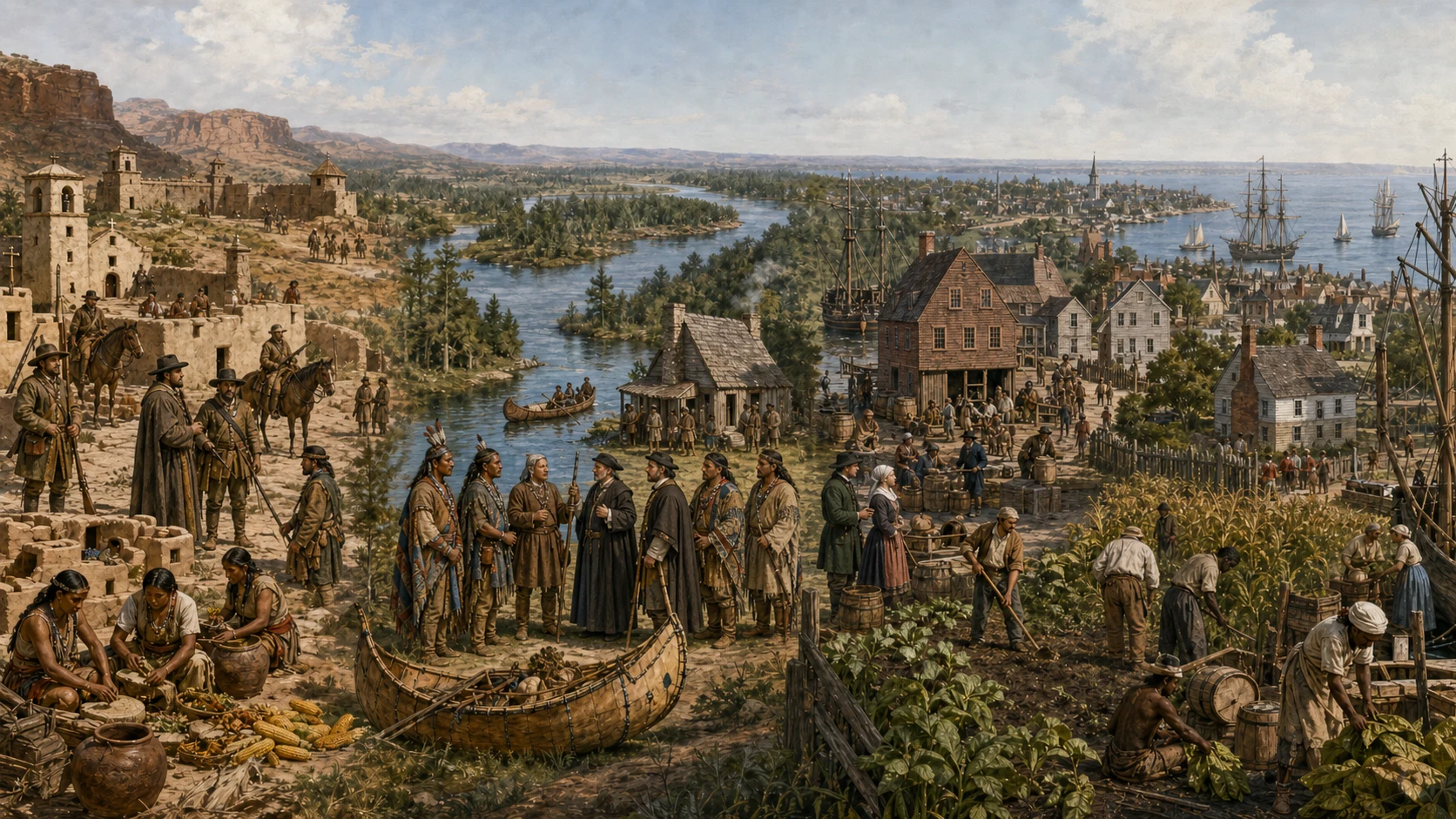
Spanish, French, Dutch, and British empires combined shared ambitions with different colonial methods
All four empires sought profit, strategic territory, and geopolitical advantage. Each depended on Native knowledge, diplomacy, trade, or labor and each produced violence and cultural change. Their differences arose from imperial goals, available resources, migration patterns, institutions, religion, and the relative power of Native nations in each region.
The table presents dominant patterns rather than absolute rules. New France included farming settlements and slavery; British colonies traded furs and formed Native alliances; Dutch settlers farmed; Spanish frontiers relied on diplomacy as well as coercion. A strong comparison identifies the pattern and then states an important qualification.
| Category | Spanish | French | Dutch | British |
|---|---|---|---|---|
| Primary goals | Royal power, Catholic conversion, tribute, labor, strategic frontier | Fur trade, alliance networks, Catholic mission, territorial reach | Corporate commerce, fur trade, port profit, strategic river corridor | Permanent settlement, land, staple crops, commerce, Protestant communities |
| Settlement pattern | Missions, presidios, pueblos, towns; relatively sparse northern frontier | St. Lawrence farms plus thin interior posts and missions | New Amsterdam port, Hudson posts, patroon estates | Dense Atlantic seaboard settlement with farms, towns, ports, and plantations |
| Labor | Encomienda and repartimiento tribute or labor, Native and African slavery, wage and household work | Family farming, trade labor, Native exchange, indenture, and slavery | Company labor, tenant farming, wage work, indenture, and African slavery | Family labor, indenture, wage work, Native and African slavery; plantation expansion |
| Religion | Franciscan missions sought Catholic conversion and cultural transformation | Jesuit and other missions accompanied trade and diplomacy | Dutch Reformed establishment with pragmatic commercial diversity | Regional Protestant establishments and dissent; growing pluralism |
| Native relations | Missionization, tribute, negotiation, intermarriage, alliance, coercion, and revolt | Trade and military alliances were indispensable; relationships remained reciprocal and contested | Commercial diplomacy supported trade, while land disputes and wars also grew | Trade and alliances mattered, but settler land demand generated recurring dispossession and war |
| Government | Crown officials, governors, missions, presidios, town councils | Royal officials, seigneurial institutions, military and trading posts | Dutch West India Company rule with limited local participation | Charter, proprietary, and royal colonies with elected assemblies for eligible men |
| High-yield evidence | Pueblo Revolt, encomienda, presidio-mission-pueblo | Quebec, coureurs de bois, Great Lakes alliances | New Amsterdam, patroonship, Dutch West India Company | Jamestown, House of Burgesses, tobacco, town meetings |
Causation 04
Environment influenced colonial development through settlement, demography, markets, and policy
Waterways structured movement. The St. Lawrence, Great Lakes, Mississippi, Hudson, and Atlantic estuaries connected interior trade to imperial ports. French and Dutch merchants built networks around rivers and furs; Chesapeake planters used navigable tributaries to ship tobacco directly; New England ports combined fishing, shipbuilding, commerce, and small farming.
Climate and soil encouraged different staple systems. Tobacco became profitable in the Chesapeake; tidal wetlands and African expertise supported Lower South rice; fertile Middle Colony soils favored wheat and mixed farming; New England’s shorter growing season and rocky soil encouraged diversified agriculture and maritime work. These were economic choices supported by law and labor coercion, not automatic products of nature.
Demography changed institutions. Family migration and lower mortality supported compact New England towns. Early Chesapeake migration was younger, more male, and more disease-prone before conditions improved. Lower South planters imported large numbers of enslaved Africans, creating Black majorities in many districts. New France’s smaller European population made alliance networks especially important.
River systems
Made trade, military movement, settlement, and imperial competition possible across enormous distances.
Staple zones
Connected regional ecology to Atlantic demand, land seizure, credit, and labor systems.
Population density
Affected diplomacy, settlement pressure, defense, family formation, and the reach of colonial government.
Human knowledge
Native navigation and agriculture, African rice expertise, and migrant skills shaped production and survival.
Regional comparison 05
The British colonies shared imperial ties but developed four distinct regional patterns
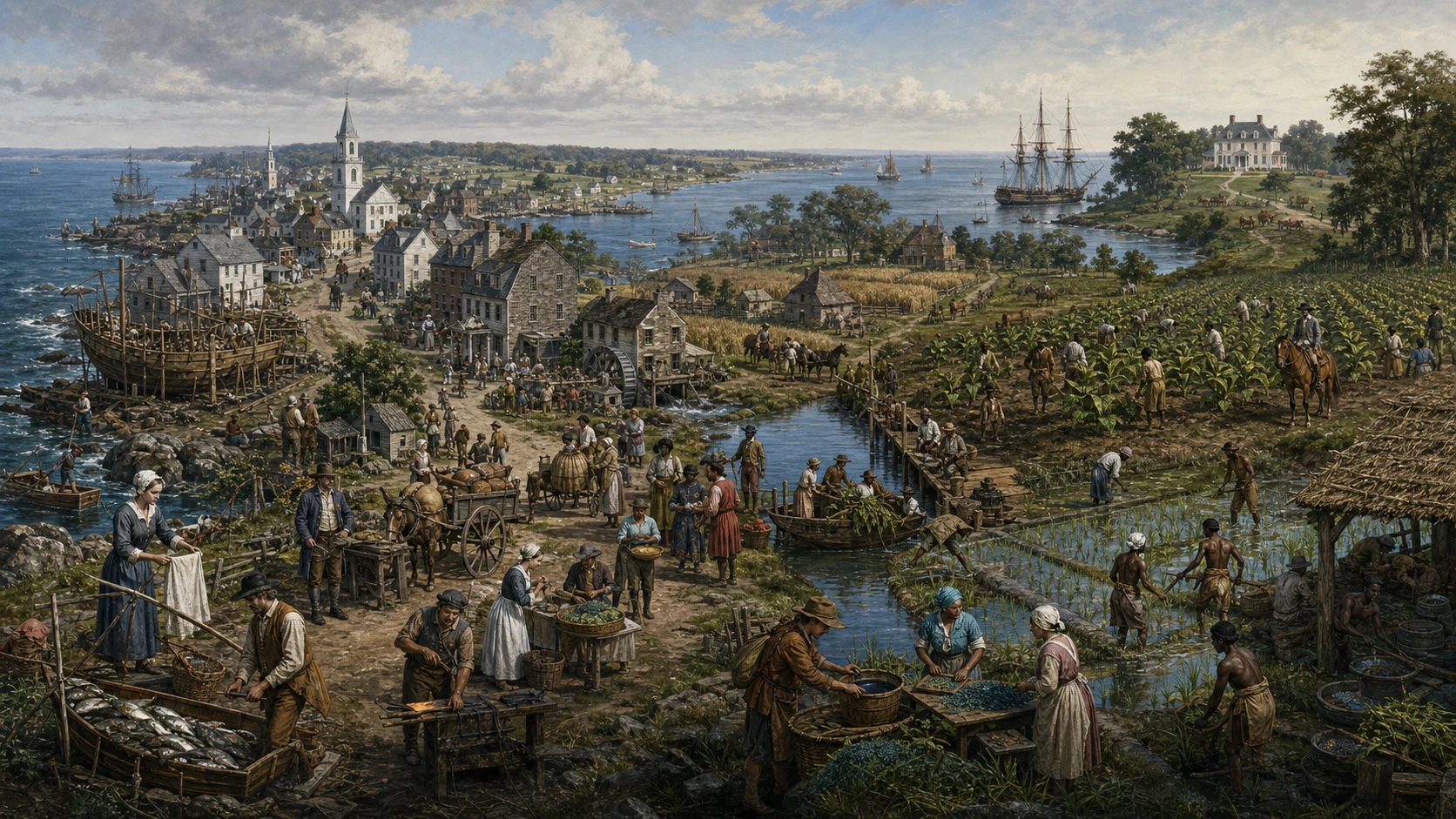
British colonies used English law, assemblies, Atlantic commerce, and multiple forms of bound labor, but their societies diverged. Founding purposes, migration, climate, staple production, religion, settlement density, and relations with Native nations produced regional patterns that remained visible by 1754.
Every region contained internal variation. Coastal merchants and backcountry farmers had different interests; cities differed from plantations; and Native borderlands did not conform to colonial map lines. Use the table as a structure for comparison, then add an exception or limit.
| Category | New England | Middle Colonies | Chesapeake | Lower South |
|---|---|---|---|---|
| Economy | Mixed farms, fish, timber, shipbuilding, commerce | Wheat and mixed farming, milling, ports and trade | Tobacco exports through river plantations | Rice and indigo plantations plus Charleston commerce |
| Settlement | Compact towns and family farms | Farms, market towns, estates, and diverse ports | Dispersed plantations and county centers | Lowcountry plantations, coastal port, and inland frontier |
| Demography | Family migration, high natural increase, longer life expectancy | Ethnically and religiously diverse immigration | Early male-heavy migration and high mortality; later family stability | Large forced African migration; Black majorities in many rice districts |
| Labor | Family, artisan, maritime, servant, and enslaved labor | Family farms, tenants, artisans, servants, and enslaved labor | Indenture gradually displaced by dominant chattel slavery | Large enslaved workforces; task system prominent in rice zones |
| Religion | Congregational establishment with dissent and revival divisions | Greatest denominational pluralism; Quaker influence in Pennsylvania | Anglican establishment with rising evangelical dissent | Anglican establishment; African and creolized religious traditions |
| Politics | Town meetings and elected assemblies for eligible men | Assemblies under proprietary or royal rule; urban and rural elite influence | Planter-dominated assembly and county courts | Concentrated planter power, parishes, assembly, and slave patrols |
| Native relations | Trade and diplomacy gave way to severe land wars in much of southern New England | Treaties, trade, and settlement expansion intersected in the Susquehanna and backcountry | Powhatan diplomacy and wars followed by accelerating territorial expansion | Deerskin and captive trades, shifting alliances, Yamasee War, and expansion |
Labor comparison 06
Colonial labor ranged from household production to contractual servitude and hereditary racial slavery
No colonial region relied on one labor form. Families worked farms and shops; wage workers, sailors, apprentices, tenants, and indentured servants produced goods; Native captives and tributary communities faced coercion; and enslaved Africans and their descendants labored throughout British America. The scale, duration, rights, and inheritability of labor status determined the degree of coercion.
The crucial contrast is legal. Indentured servants faced harsh discipline but held contracts with finite terms and eventual freedom. Chattel slavery made people saleable property, usually for life, and colonial law made status hereditary through the mother. Regional work routines differed, but task labor did not make Lowcountry slavery less oppressive than Chesapeake gang labor.
| System | Legal status and duration | Where especially important | Comparison significance |
|---|---|---|---|
| Family and household labor | Free status, but authority structured by age, gender, coverture, and household dependence | Farms, shops, fisheries, ports, and every region | Shows that production and patriarchy operated inside households, not only plantations |
| Indentured servitude | Contracted term with restricted freedom and expected release | Especially important in seventeenth-century Chesapeake; present elsewhere | Finite service differed fundamentally from hereditary slavery despite abuse and coercion |
| Tenant and patroon labor | Rent or service obligations without legal ownership of the person | Middle Colonies and Dutch-derived Hudson estates | Landholding patterns could limit opportunity even outside plantation slavery |
| Native coerced labor and captivity | Varied tribute, mission labor, repartimiento, warfare, and enslavement | Spanish borderlands and several colonial captive trades | European systems adapted existing practices while intensifying coercion through imperial demand |
| African chattel slavery | Lifelong, saleable, racialized, and hereditary status enforced by colonial law | Every colony; most concentrated in Chesapeake and Lower South | Regional tasks varied, but owners’ property claims and family vulnerability defined the shared institution |
Native agency 07
Native nations used trade, diplomacy, migration, alliance, and resistance to pursue sovereignty
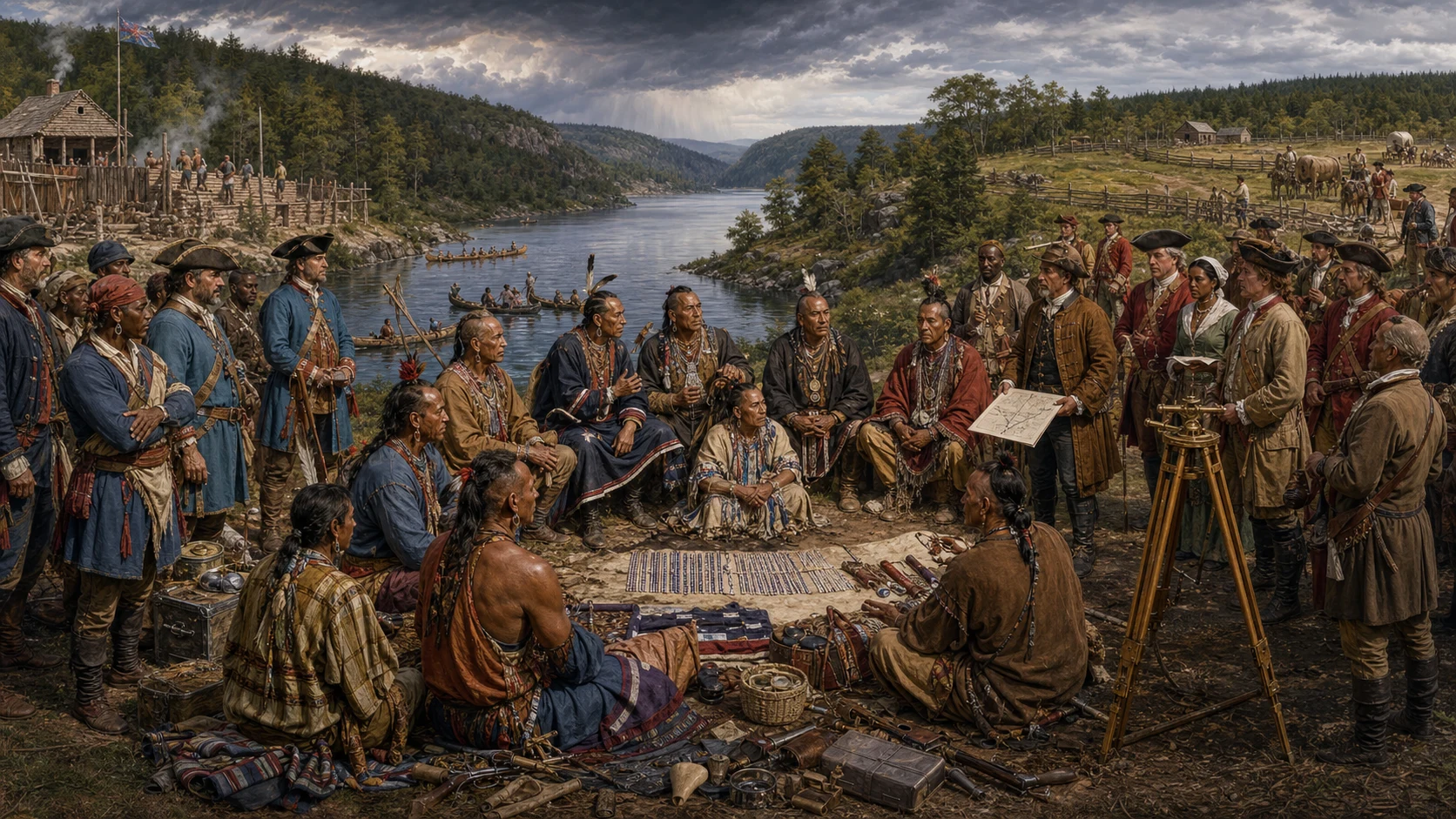
European empires did not act on an empty continent. Haudenosaunee, Wabanaki, Wendat, Anishinaabe, Lenape, Shawnee, Pueblo, Powhatan, Wampanoag, Yamasee, Cherokee, and many other nations pursued distinct goals. They exchanged goods, adopted selected technologies, negotiated treaties, balanced rivals, relocated communities, resisted missions, and fought to control land and trade.
Lower European population often made French and Dutch traders especially dependent on Native commercial and diplomatic networks. British colonists also depended on alliances, but high migration and land-intensive farming generated greater pressure in many eastern regions. Spanish missions pursued conversion and tribute while relying on Native food, labor, and settlement; the Pueblo Revolt proved that coordinated resistance could expel Spanish rule for twelve years and alter later policy.
Imperial competition created leverage and danger. Native nations could redirect trade or alliance toward a rival, while European weapons and markets changed regional power balances. Metacom’s War, the Yamasee War, and frontier conflict devastated communities. By 1754, British land claims and French trade-military networks collided in the Ohio Valley, but Native decisions remained central to the coming war.
Diplomacy
Councils, kinship, wampum, gift exchange, adoption, and treaty protocols structured political relationships.
Selective exchange
Communities incorporated goods or beliefs strategically rather than simply becoming European.
Resistance
Revolt, war, migration, trade refusal, cultural preservation, and alliance switching defended autonomy in different ways.
Comparative limit
No empire had one permanent ‘Native policy,’ and no Native nation had one fixed European ally.
Economic connection 08
Regional economies differed, but Atlantic trade connected all of them to empire and slavery
An Atlantic economy exchanged commodities, labor, people, credit, and information among Europe, Africa, the Caribbean, and mainland North America. Chesapeake tobacco, Lower South rice and indigo, Middle Colony grain, New England ships and provisions, French furs, Spanish frontier goods, and Caribbean sugar entered overlapping networks.
Mercantilist governments attempted to direct commerce toward imperial power. Britain’s Navigation Acts reserved trade and shipping advantages for the empire, but enforcement was uneven and colonists traded legally, intercolonially, and through smuggling. Customs officials, merchants, planters, consumers, shipbuilders, sailors, and enslaved workers all occupied different positions within the same system.
Northern colonies were not separate from slavery because they held smaller enslaved populations. Merchants financed voyages, built ships, insured cargo, distilled Caribbean molasses, sold plantation supplies, and consumed slave-produced goods. A complete regional comparison therefore distinguishes labor concentration while tracing shared economic connections.
Culture and identity 09
Pluralism and regional cultures expanded alongside Anglicization and intercolonial exchange
Migration carried English, German, Scots-Irish, Dutch, French Huguenot, Jewish, and other European traditions into the colonies, while forced African migration created new African American cultures from many societies. Native cultures persisted and changed through exchange and resistance. The Middle Colonies became especially plural, but diversity existed throughout British America.
At the same time, colonists Anglicized through British goods, credit, fashion, common law, representative models, and print. The consumer revolution allowed more households to display British material culture. Colonial identities were therefore layered: local, regional, ethnic, religious, imperial, and Atlantic affiliations coexisted.
The First Great Awakening used itinerant preaching and print to create a shared evangelical movement while splitting churches into revival supporters and critics. Enlightenment ideas emphasized reason, evidence, natural law, and improvement. Both enlarged debate over authority, but neither abolished slavery, patriarchy, establishments, or unequal access to education and publication.
Politics and power 10
British colonial self-government was unusually participatory for the era but neither independent nor inclusive
Colonial assemblies, town meetings, county courts, juries, vestries, and local offices gave many property-holding white men experience with taxation, law, budgets, militia, and public works. New England towns enabled relatively broad participation among eligible men; southern counties and assemblies were more heavily dominated by planter elites. Charter, proprietary, and royal governments placed different limits on local power.
Distance, slow communication, local bargaining, and uneven imperial enforcement gave assemblies practical autonomy. Colonists often used appropriations to influence governors. Yet charters, royal instructions, trade law, imperial courts, military protection, and the power to disallow statutes preserved British authority.
Spanish, French, and Dutch colonies generally gave settlers less representative control, though town councils, local custom, seigneurial courts, corporate petitions, and community negotiation still mattered. Comparison should not turn British government into universal democracy: women, enslaved people, Native peoples, most free Black people, servants, and many poor men lacked formal political power.
Historical reasoning 11
A change-and-continuity matrix turns Unit 2 evidence into an argument
Comparison and continuity/change reinforce one another. Ask which regional differences already existed in the seventeenth century, which widened by 1754, and which shared Atlantic processes drew colonies together. Then rank significance rather than listing every development.
| Theme | Major continuity | Major change by 1754 | Evidence pair |
|---|---|---|---|
| Empire | European states sought wealth, land, conversion, and strategic power | Permanent settlements and borderland competition expanded | Jamestown or Quebec → Ohio Valley rivalry |
| Native sovereignty | Native nations negotiated and resisted colonial demands | Population loss and settler expansion reduced autonomy in many eastern regions | Powhatan diplomacy → Metacom’s War; mission rule → Pueblo Revolt |
| Labor | Colonies used bound and coerced labor | African chattel slavery became more racial, hereditary, and regionally concentrated | Indenture → Virginia’s 1662 law and 1705 codes |
| Economy | Colonies depended on Atlantic markets | Trade volume, credit, consumer goods, and regional specialization increased | Early tobacco exports → mature Atlantic plantation and port networks |
| Government | Colonies remained inside European empires | British assemblies and local institutions accumulated practical experience and leverage | House of Burgesses → assembly control of appropriations |
| Culture | Religion and inherited traditions remained powerful | Pluralism, Anglicization, print, evangelical revival, and Enlightenment exchange grew | Regional establishments → Great Awakening and expanding print culture |
Exam method 12
Build the argument before choosing evidence
Start by defining the basis of comparison. If the prompt asks about colonial regions, choose two or three categories such as economy, labor, and political power. Write a thesis that makes a relationship and gives a reason. Then select evidence that proves each part: rice plus the task system for the Lower South; town meetings plus family migration for New England; tobacco plus chattel slavery for the Chesapeake.
Organize paragraphs by category rather than writing one paragraph about Region A and another about Region B. A category paragraph forces direct comparison: both regions used enslaved labor, but scale and crop organization differed because rice cultivation and African-majority Lowcountry districts created conditions unlike most New England farms and ports.
Add complexity by qualifying a generalization, identifying change over time, or connecting regional difference to an Atlantic similarity. A French trade-based alliance pattern still involved warfare; British settler colonies also depended on trade and diplomacy; northern commerce profited from plantation slavery; religious pluralism did not create full toleration.
Step 1 — Define
Choose a matched category and time/place boundary from the prompt.
Step 2 — Claim
State similarity or difference plus the reason for that relationship.
Step 3 — Prove
Use named, accurate evidence on both sides and explain how each example supports the claim.
Step 4 — Qualify
State an exception, limit, internal variation, or relevant continuity/change.
High-yield review
Key developments
Divergent imperial systems
Spanish missions, French alliance-trade networks, Dutch corporate commerce, and British settler colonies combined shared imperial ambition with different institutions.
British regional differentiation
Environment, migration, staple crops, religion, settlement, and labor produced New England, Middle, Chesapeake, and Lower South patterns.
Expansion of racial slavery
Colonial law made African slavery lifelong and hereditary as plantation demand and Atlantic trafficking increased.
Native diplomacy and resistance
Native nations used alliances, trade, mobility, treaty, cultural adaptation, and revolt to defend sovereignty in competing empires.
Atlantic integration
Mercantilism, shipping, commodities, credit, migration, print, and coerced labor connected regions to one another and to empire.
Colonial political and cultural evolution
Assemblies, local government, Anglicization, pluralism, revivalism, Enlightenment thought, and print shaped layered colonial identities.
Chronological reasoning
Timeline — key moments
Jamestown founded
The first permanent English settlement develops toward tobacco export, representative institutions, territorial expansion, and bound labor.
Quebec founded
Samuel de Champlain establishes New France’s central settlement and expands trade and alliance networks.
Santa Fe established
Spanish New Mexico develops around mission, presidio, town, tribute, labor, and contested Pueblo relations.
Burgesses and Africans in Virginia
An elected assembly meets while the documented arrival of Africans marks an early stage in English colonial slavery.
Plymouth settlement
Family and religious migration contributes to compact New England settlement and local covenant government.
Dutch West India Company and New Netherland
Corporate rule builds a Hudson-centered commercial colony linking New Amsterdam to the fur trade.
Massachusetts Bay migration
Large-scale Puritan family migration strengthens towns, congregations, schools, commerce, and settler expansion.
Maryland founded
A proprietary Chesapeake colony combines tobacco, Catholic leadership, religious conflict, indenture, and later slavery.
Maryland Toleration Act
Limited protection for Trinitarian Christians illustrates both growing diversity and the boundaries of toleration.
England captures New Netherland
New York retains Dutch commercial, ethnic, and landholding legacies under English rule.
Virginia racial slavery codified
Maternal inheritance and consolidated slave codes make bondage increasingly lifelong, racialized, and hereditary.
Metacom’s War
A devastating New England conflict demonstrates the consequences of land expansion, jurisdiction, and contested sovereignty.
Bacon’s Rebellion
Frontier war, land demands, taxation, and class tension expose conflict inside Virginia’s settler society.
Pueblo Revolt
Coordinated Pueblo resistance expels Spanish colonizers for twelve years and later changes colonial policy.
Yamasee War
Debt, fraud, captive trading, land pressure, and shifting alliances nearly destroy South Carolina.
Stono Rebellion
Enslaved people in South Carolina launch a major armed uprising, after which lawmakers intensify racial surveillance and control.
Great Awakening becomes intercolonial
George Whitefield’s tours and print publicity connect evangelical revival audiences across several British colonies.
Ohio Valley conflict begins
British land expansion, French fort networks, and Native diplomacy converge as the Seven Years’ War approaches.
Remember these
Vocabulary
- Comparison
- A historical reasoning process that identifies and explains similarities and differences through a shared category.
- Basis of comparison
- The common category—such as labor, religion, settlement, or government—used to evaluate two or more cases.
- Qualification
- A limit, exception, or refinement that makes a historical claim more precise without abandoning it.
- Imperial goal
- An objective such as profit, conversion, territory, labor, trade, or strategic advantage pursued by an empire.
- Borderland
- A contested zone where Native nations, empires, migrants, and local communities exercised overlapping power.
- Presidio
- A Spanish military fort that defended settlements, missions, routes, and imperial claims.
- Mission
- A religious institution used for conversion and often for colonial settlement, labor organization, cultural transformation, and defense.
- Encomienda
- A Spanish grant permitting tribute or labor demands from Native communities under an asserted duty of protection and Christianization.
- Repartimiento
- A Spanish system requiring specified periods of Native labor or labor in place of tribute.
- Coureur de bois
- A French trader who traveled through interior waterways and Native communities in the fur trade.
- Patroonship
- A large Dutch land grant whose patroon recruited tenants and exercised extensive economic and local authority.
- Settler colonialism
- Colonization based on permanent immigrant settlement and control of Indigenous land rather than trade or extraction alone.
- Mercantilism
- The use of colonies and regulated trade to increase an empire’s wealth and strategic power.
- Navigation Acts
- English laws designed to channel colonial shipping and commodities through imperial trade networks.
- Staple crop
- An agricultural commodity such as tobacco, rice, or indigo produced in large quantities for export.
- Indentured servitude
- A contract binding labor for a finite term in exchange for passage, maintenance, or another benefit.
- Chattel slavery
- A system treating enslaved people as transferable property, usually for life and across generations.
- Task system
- A labor arrangement assigning a defined daily task, especially associated with Lowcountry rice cultivation.
- Anglicization
- The gradual strengthening or adoption of English and British cultural, consumer, legal, and political practices.
- Pluralism
- The coexistence of multiple religious, ethnic, linguistic, or cultural communities without necessarily equal rights.
- First Great Awakening
- The transatlantic evangelical revival movement of the 1730s and 1740s emphasizing conversion and new birth.
- Enlightenment
- An intellectual movement emphasizing reason, evidence, natural law, and the possibility of human improvement.
- Colonial assembly
- An elected legislature representing eligible colonists within a charter, proprietary, or royal government.
- Town meeting
- A New England institution in which eligible local men debated and decided specified community affairs.
- Continuity and change
- Historical reasoning that identifies what persisted, what transformed, and why the balance mattered over time.
- Native sovereignty
- The political authority of Indigenous nations to govern their people, territory, diplomacy, and collective decisions.
Clear the confusion
Frequently asked questions
20 detailed answers to the questions students most often carry into Topic 2.8.
01What is the main goal of APUSH Topic 2.8?
The goal is to compare the effects of colonial development across North American regions from 1607 to 1754. Students must build an argument using specific evidence, explain similarities or differences through matched categories, and recognize how imperial goals, environment, migration, labor, Native agency, and Atlantic exchange shaped outcomes.
02What makes a comparison different from two descriptions?
A comparison uses one category for both cases and explicitly states their relationship. Describing French fur trade and then British tobacco is not enough. Explain that each pursued Atlantic profit but lower French settlement density encouraged alliance-centered trade, while British land-intensive agriculture increased permanent settlement and territorial pressure.
03What is a strong thesis structure for Topic 2.8?
Use concession, relationship, and reason: ‘Although Spanish and French colonizers both used Christianity and Native alliances to extend empire, Spanish missions imposed more direct tribute and community discipline, while French commercial dependence and lower settler density made negotiated trade alliances more central.’ Then prove each clause.
04How were Spanish, French, Dutch, and British colonization similar?
All sought wealth, territory, and strategic advantage; claimed Native homelands; depended on Native knowledge or diplomacy; participated in coercive labor; brought Christianity; and competed with rivals. Their settlement densities, institutions, leading commodities, labor demands, religious systems, and relationships with Native nations differed.
05How did Spanish colonization differ from French colonization?
Northern Spanish colonies emphasized missions, presidios, Catholic conversion, tribute, and labor among settled Native communities. New France emphasized furs, waterways, trading posts, missions, and military alliances across a thinly settled interior. Both required Native cooperation and used coercion, and both faced resistance.
06Was French colonization peaceful compared with British colonization?
French trade and lower settlement density often produced relationships different from British settler expansion, but ‘peaceful’ is too broad. French alliances could intensify Native wars, trade created dependency and disputes, missions sought cultural change, and French forces fought resisting nations. The accurate contrast is degree and pattern, not peaceful versus violent.
07What was distinctive about Dutch New Netherland?
The Dutch West India Company organized it primarily as a commercial venture centered on New Amsterdam, the Hudson corridor, and fur trade. Patroonships created large estates, while trade attracted diverse residents. Dutch law, property, architecture, commerce, and communities continued influencing New York after the English takeover in 1664.
08Why did British colonial regions develop differently?
Different environments, crops, founding purposes, migration streams, mortality, religious institutions, land systems, labor supplies, and Native relations interacted. Rocky New England farms encouraged diversification; Middle Colony soils supported grain; tobacco shaped the Chesapeake; tidal rice and forced African migration shaped the Lower South. None of those outcomes was environmentally automatic.
09How were New England and the Chesapeake different?
New England featured family migration, compact towns, mixed farming, maritime commerce, Congregational institutions, and higher life expectancy. The Chesapeake developed dispersed tobacco plantations, early high mortality and male-heavy migration, Anglican establishment, county government, and a transition from indenture toward dominant racial slavery. Both used bound labor and elected assemblies.
10How were the Middle Colonies and Lower South different?
Middle Colonies combined grain farming, ports, artisans, tenants, immigrants, and exceptional religious diversity. The Lower South concentrated wealth and power in rice and indigo plantations supported by large enslaved populations. Both participated in Atlantic trade, used enslaved labor, contained important ports, and included contested Native borderlands.
11How did indentured servitude differ from chattel slavery?
Indenture imposed a finite contractual term and anticipated release, despite violence and restricted freedom. Chattel slavery was generally lifelong, transferable, racialized, and hereditary through the mother. Enslaved people lacked secure legal control over labor, movement, marriage, children, and family unity. Work difficulty alone does not define the difference.
12How did slavery vary by British colonial region?
Chesapeake tobacco and Lower South rice or indigo created large plantation workforces, with task labor especially associated with Lowcountry rice. Northern and Middle colonies used smaller-scale farm, household, artisan, urban, and maritime slavery. All regions profited through production, shipping, credit, consumption, and slave trading.
13Why is Native agency essential to a Period 2 comparison?
Native nations controlled most territory at the period’s start and remained decisive in borderlands by 1754. They negotiated alliances, directed trade, relocated, adopted selected goods, maintained culture, resisted missions, fought wars, and balanced imperial rivals. Their choices explain why colonial systems developed differently and why European control remained incomplete.
14How did Native relations differ among empires?
French and Dutch trade networks often depended heavily on negotiated Native commerce. British settler agriculture produced intense land pressure even while alliances remained important. Spanish missions sought conversion, tribute, and labor while also negotiating with Native communities. These are patterns, not fixed policies; every empire experienced cooperation, coercion, and conflict.
15How did Atlantic trade connect otherwise different regions?
Ships, credit, insurance, merchants, labor, and commodities linked tobacco, rice, grain, fish, timber, furs, sugar, and imported manufactures. New England merchants provisioned plantations and trafficked slave-produced goods; Middle ports distributed imports; southern exports financed consumption. Print, migration, and religious ideas moved through many of the same routes.
16What role did mercantilism play in regional development?
Empires used trade regulation to direct colonial commodities and shipping toward imperial power. Britain’s Navigation Acts encouraged imperial shipping and customs administration, though enforcement was uneven. Colonists benefited from protected markets and credit while also smuggling or resisting restrictions, creating both stronger imperial ties and recurring tension.
17How should the Great Awakening and Enlightenment be compared?
Both were transatlantic movements spread through print and personal networks, and both widened debate over authority. The Awakening emphasized evangelical conversion, grace, and itinerant preaching; Enlightenment thought emphasized reason, evidence, natural law, and improvement. Neither automatically produced independence or eliminated colonial hierarchy.
18Were British colonies more democratic than other empires?
British assemblies and some town meetings gave eligible property-holding white men unusually extensive experience with representation and local taxation. Participation varied and elites often dominated. Women, enslaved people, Native peoples, most free Black people, servants, and many poor men were excluded, so ‘limited representative government’ is more accurate than democracy for all.
19What changed most from 1607 to 1754?
The scale of permanent settlement, Atlantic commerce, plantation slavery, racial law, regional specialization, migration, print, and local institutions expanded dramatically. European claims became stronger but remained contested. Native autonomy declined sharply in many eastern settler zones while remaining influential in interior borderlands. Rank change according to the prompt’s category.
20How can Topic 2.8 appear on the APUSH exam?
An SAQ, LEQ, DBQ, or stimulus question may ask students to compare empires, regions, labor systems, Native relations, or cultural movements. Define a shared category, use specific evidence for both sides, explain why the relationship existed, and qualify the claim with internal variation, Atlantic connection, or change over time.
Use the knowledge
AP exam connections
- 1
Organize comparison paragraphs by matched category—not one case at a time.
- 2
Use at least one precise piece of evidence for each side and explain how each supports the same claim.
- 3
Treat Native nations as strategic actors whose decisions shaped imperial development and borderland power.
- 4
Compare regional labor by legal status, scale, crop, demography, and work organization rather than job alone.
- 5
Add complexity by pairing regional difference with an Atlantic similarity or by stating an accurate exception to the pattern.
Editorial trust
Sources and review
These notes are original OnlyPrepy content. The syllabus scope and historical framing were checked against the following authoritative sources on August 16, 2026.
- AP U.S. History Course and Exam Description, Effective Fall 2026College Board
- Life in the Missions: Between Reality, Romance and RevoltNational Park Service
- The Legacy of Saint Croix Island — New FranceNational Park Service
- New Netherland: The Dutch Commercial ColonyNational Park Service
- Rise of the Colonial Plantation SystemNational Park Service
- Religion in Eighteenth-Century AmericaLibrary of Congress
- First Among Many: The Bay Psalm Book and Early Moments in American PrintingLibrary of Congress