The big picture
Compare how environment, migration, staple crops, labor, religion, settlement, and Atlantic markets produced distinct British colonial regions.
Exam focus 01
Topic 2.3 explains regional difference through interacting causes rather than isolated traits
British mainland colonies belonged to one empire but did not form one uniform society. New England, the Middle Colonies, the Chesapeake, and the Lower South developed different economies, settlement patterns, labor systems, religious cultures, and political institutions. These patterns grew from the interaction of climate and soil, migration goals, family structure, staple-crop demand, access to ports, Native relations, labor supply, and imperial policy.
AP questions usually ask for comparison plus causation. Name a similarity or difference, support it with evidence from both regions, and explain why it developed. For example, tobacco and rice were both export staples, but Chesapeake tobacco could be grown on smaller plantations than Lowcountry rice, while rice demanded expensive water control and specialized African knowledge; those conditions helped produce different concentrations of enslaved labor and wealth.
Causal framework 02
Migration, markets, labor, environment, and Native land shaped every colonial region
Who migrated mattered. Puritan family migration encouraged stable New England towns, while the early Chesapeake attracted many young male servants into an unhealthy tobacco frontier. Pennsylvania recruited Quakers, Germans, and other groups with promises of land and toleration. Carolina's founders drew on Barbados and other Caribbean plantation models, importing both planter capital and racial slavery.
Atlantic demand turned regional crops and resources into economic systems. Tobacco shaped dispersed Chesapeake plantations; rice and indigo concentrated Lowcountry wealth; grain and livestock supported Middle Colony farms and ports; and New England's mixed farming joined fishing, timber, shipping, and commerce. Native dispossession and African or indentured labor underwrote expansion in every region, although form and scale differed.
Environment
Growing season, soil, rivers, harbors, forests, and disease environments influenced crops, transport, settlement density, and health.
Migration
Family composition, religion, ethnicity, wealth, and purpose shaped demographics and community institutions.
Markets
Atlantic demand rewarded staple crops, shipping, grain, fish, timber, and artisan production.
Labor and land
Indenture, slavery, family labor, tenancy, and Native dispossession distributed opportunity and coercion unequally.
Region 03
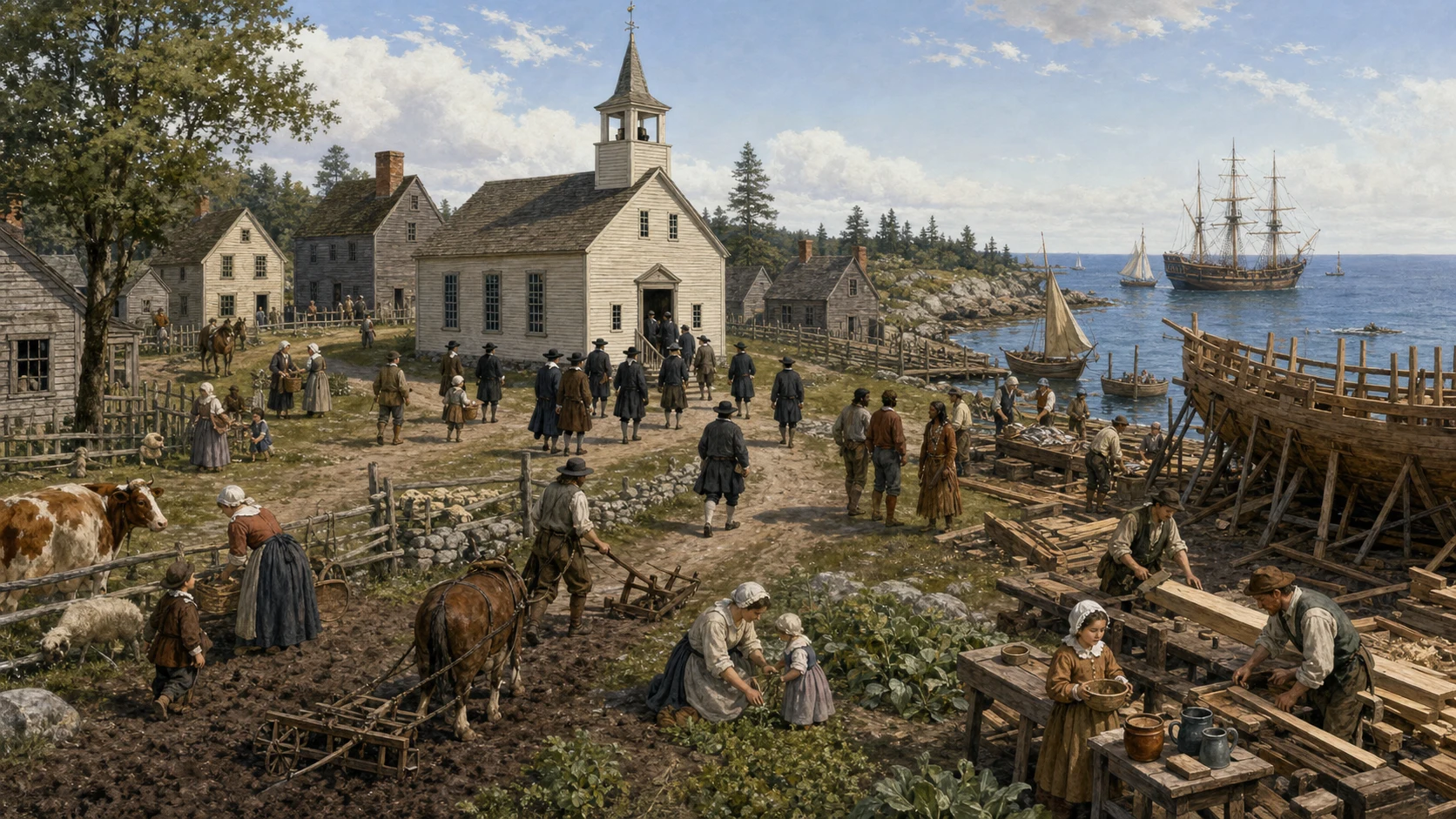
New England combined compact towns, family farming, Puritan institutions, and maritime commerce
Massachusetts, Connecticut, Rhode Island, and New Hampshire had rocky soil, a shorter growing season, forests, fisheries, and good harbors. Many Puritan migrants arrived in families during the Great Migration, creating a relatively balanced sex ratio and rapid natural population growth. Towns clustered homes, meetinghouses, schools, and common land near family farms.
Mixed agriculture rarely produced one dominant plantation staple. Fishing, timber, shipbuilding, coastal trade, distilling, and Atlantic commerce supplemented farms. Town meetings gave eligible male property holders local political experience, but women, servants, enslaved people, many poor men, dissenters, and Native people lacked equal power. Puritan covenants encouraged literacy for Bible reading while authorities punished dissent.
Expansion into Native homelands produced the Pequot War and King Philip's War. Trade and alliances remained important, but growing settler populations and permanent towns created intense land pressure. New England participated fully in Atlantic slavery through ownership, shipping, commerce, and provisioning even though plantations were less dominant than farther south.
Region 04
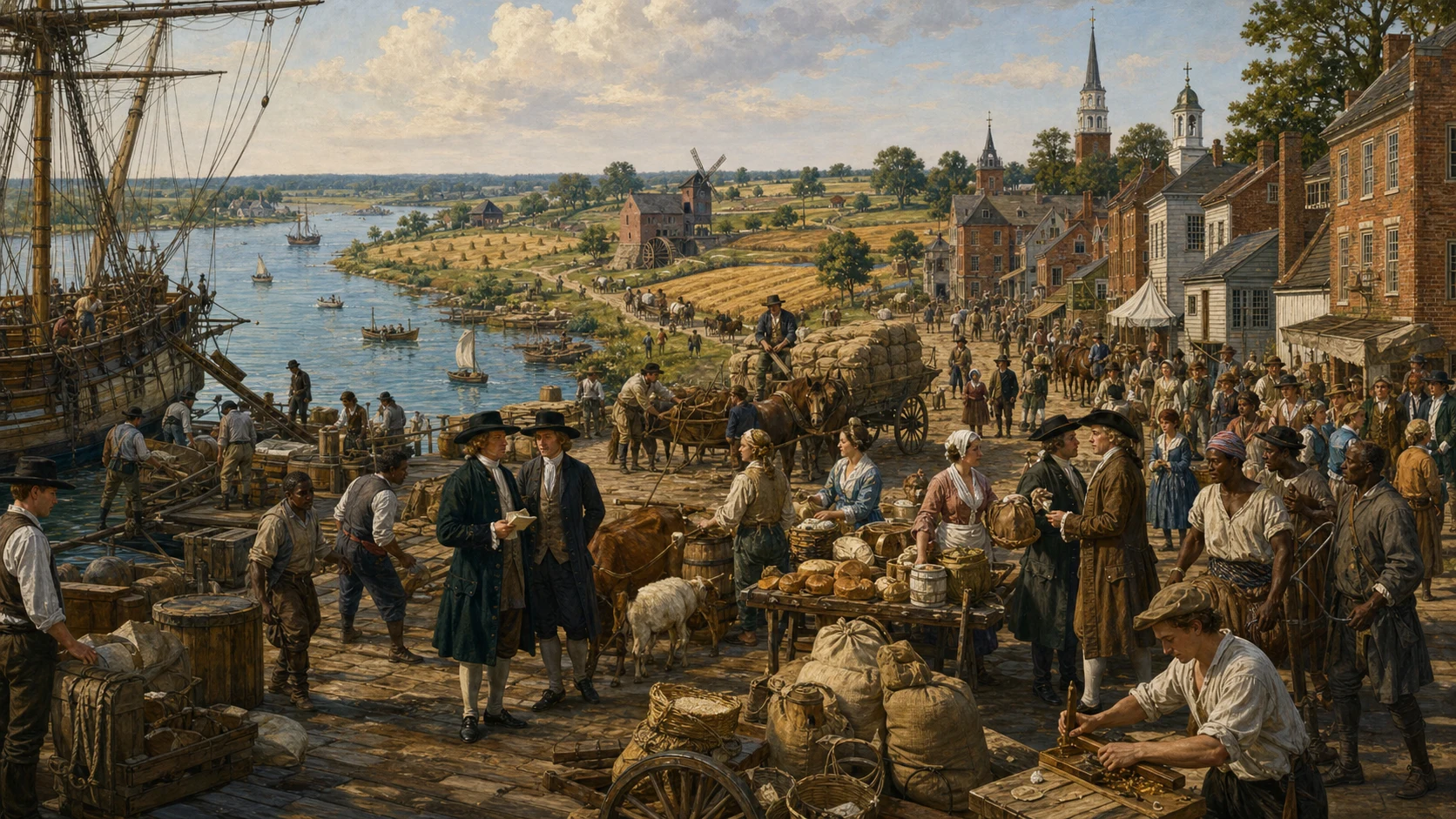
The Middle Colonies joined breadbasket agriculture, port commerce, diversity, and plural institutions
New York, New Jersey, Pennsylvania, and Delaware contained fertile soil, long growing seasons, and navigable rivers. Farms produced wheat and other grains for export, while mills processed flour and ports such as New York and Philadelphia linked the countryside to Atlantic markets. Artisan work, shipping, livestock, and commerce made the regional economy unusually varied.
Dutch, English, German, Scots-Irish, Swedish, Finnish, African, Jewish, Quaker, Lutheran, Reformed, and other communities created substantial ethnic and religious diversity. Pennsylvania offered comparatively broad toleration and attracted families, although toleration was incomplete and conflict over land persisted. New York retained Dutch property patterns and large estates after English conquest.
Labor included family members, tenants, wage workers, apprentices, indentured servants, and enslaved Africans. Diversity did not create equality: wealth varied sharply, slavery operated in farms, ports, and households, and colonial settlement displaced Lenape and other Native peoples through purchases, treaties, fraud, and expansion.
Region 05
The Chesapeake developed around tobacco, dispersed plantations, bound labor, and planter politics
Virginia and Maryland possessed navigable rivers and soils suited to tobacco. Plantations spread along waterways so growers could ship directly, producing dispersed settlement rather than compact towns. Tobacco profits encouraged headrights, migration, and continual demand for land, increasing conflict with Powhatan and other Native communities.
Early disease and high mortality created an unstable, male-skewed population. Indentured servants supplied much of the seventeenth-century workforce. As mortality declined, servant supply shifted, planters sought more permanent labor, and Atlantic slave trading expanded, colonial law increasingly made African slavery lifelong and hereditary. Bacon's Rebellion contributed to elite fears but did not alone cause this transition.
A planter elite dominated county courts and the House of Burgesses, while small farmers, servants, enslaved people, and frontier settlers possessed less power. The Anglican Church was established, yet scattered settlement limited parish reach. By the eighteenth century, family life was more stable, but wealth and racial inequality had deepened.
Region 06
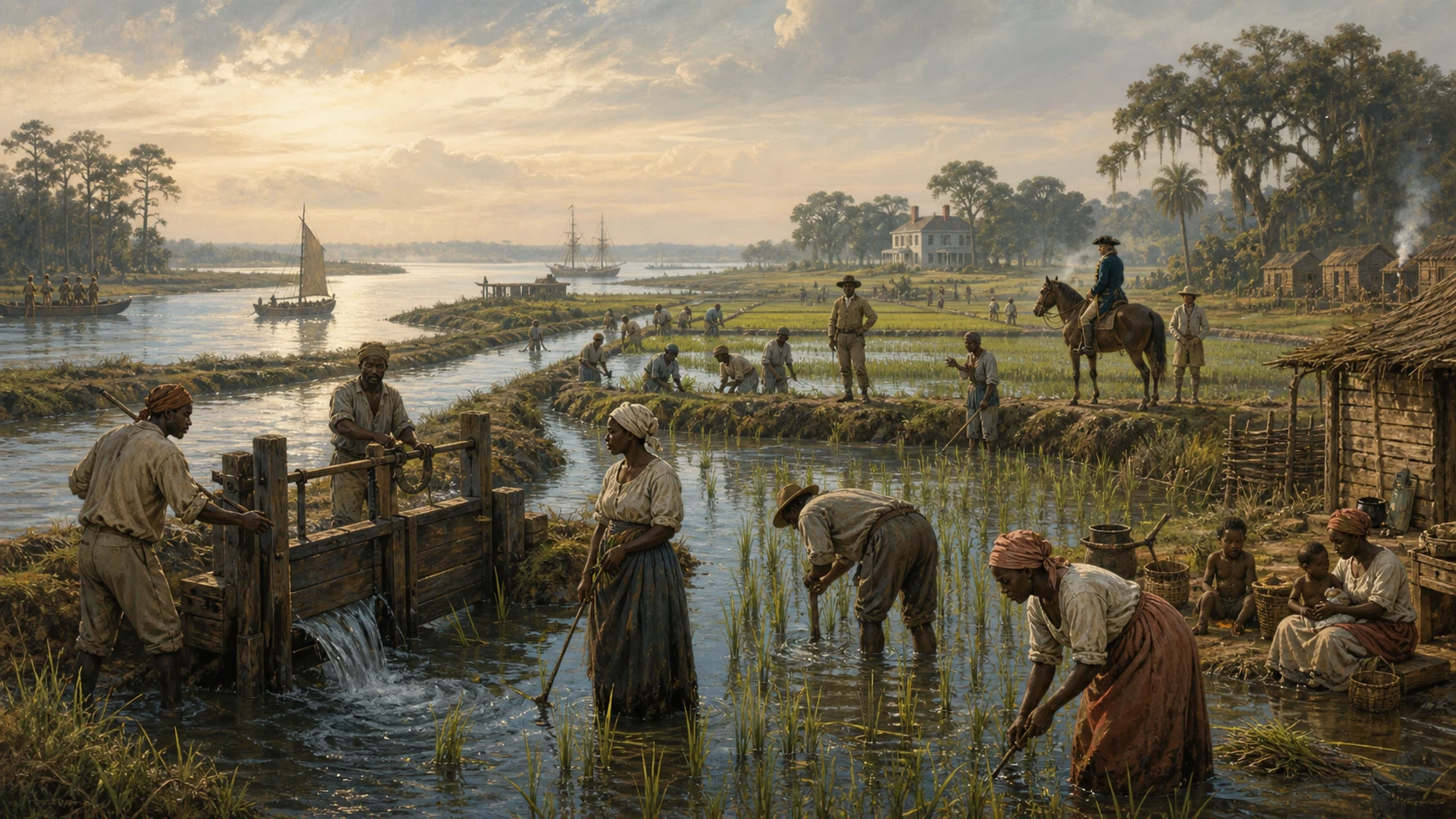
The Lower South built plantation wealth through rice, indigo, Caribbean connections, and African expertise
South Carolina and Georgia developed in a warm, humid coastal environment connected closely to Barbados and the Caribbean. Rice became the leading staple, followed by indigo. Charleston linked plantations, Native deerskin trade, enslaved people, manufactured goods, and Atlantic finance. Large plantations and high export profits concentrated land and political power among wealthy planters.
Rice cultivation required demanding tidal irrigation and labor. Enslaved West Africans brought knowledge of rice-growing regions, water management, food production, craft, and commerce that planters exploited. In parts of the Lowcountry, Africans formed a majority and sustained languages, kinship, religion, and Gullah Geechee culture while resisting through work slowdowns, escape, community, and revolt.
The task system sometimes assigned a defined amount of work rather than continuous gang labor, leaving limited time for personal production after tasks were completed; it did not make slavery less coercive. Georgia initially restricted slavery but legalized it in 1750, illustrating the regional power of plantation profit and neighboring slave societies.
Comparison table 07
Compare regions using the same categories before explaining why they diverged
Regional labels describe broad patterns, not rigid borders. Colonies contained towns and farms, free and bound labor, trade and agriculture. The most defensible comparison identifies a dominant pattern and then qualifies it with internal diversity.
| Region | Settlement and population | Economy | Labor, religion, and politics |
|---|---|---|---|
| New England | Compact towns, family migration, balanced sex ratio, rapid natural growth | Mixed farms, fishing, timber, shipbuilding, shipping | Family labor plus servitude and slavery; Puritan influence; town meetings with restricted participation |
| Middle Colonies | Diverse cities and countryside; family migration and large estates | Grain, milling, livestock, artisans, shipping, port trade | Family, tenant, wage, indentured, and enslaved labor; plural religions; assemblies and proprietary/royal rule |
| Chesapeake | Dispersed river plantations; early male skew and high mortality, later stable families | Tobacco export economy | Indenture followed by expanding racial slavery; Anglican establishment; planter-led counties and assembly |
| Lower South | Dispersed plantations, Charleston port, Caribbean influence, African-majority districts | Rice, indigo, deerskins, Atlantic commerce | Large enslaved workforce and African expertise; planter elite; Anglican establishment and strong racial control |
Exam method 08
Turn regional evidence into causal comparison and avoid common exam traps
A defensible thesis might argue that both New England and the Chesapeake participated in Atlantic commerce, but family migration and mixed farming encouraged compact New England institutions, while tobacco and servant migration created dispersed Chesapeake plantations and stronger planter dominance. Evidence earns value only when tied to that explanation.
| Evidence | What it helps explain | Common mistake to avoid |
|---|---|---|
| Puritan family migration | Stable towns, natural population growth, congregations, schools, and local institutions | Claiming all New Englanders were Puritan or religiously tolerant |
| Middle Colony grain and ports | Breadbasket exports, urban growth, artisan work, and diverse migration | Treating diversity as equality or forgetting slavery and tenancy |
| Chesapeake tobacco | River plantations, land hunger, indenture, slavery, and planter power | Saying climate alone created the economy or Bacon's Rebellion alone created slavery |
| Lowcountry rice | Tidal engineering, planter wealth, African-majority communities, and concentrated slavery | Erasing African expertise or romanticizing the task system |
| Native land pressure | Treaties, trade, dispossession, alliances, and warfare in every region | Writing as though British land was empty or colonists faced no Native political power |
High-yield review
Key developments
New England towns integrated institutions
Family migration, congregations, mixed farms, schools, meetings, and maritime work reinforced compact settlement.
Middle Colonies became a plural breadbasket
Grain farming, ports, mills, and migration created economic and religious diversity.
Tobacco organized Chesapeake society
Export demand produced river plantations, land pressure, bound labor, and planter dominance.
Rice concentrated Lowcountry slavery and wealth
Tidal land, Atlantic capital, and exploited African expertise supported profitable plantations.
Labor systems diverged but remained unequal
Family, tenant, wage, indentured, and enslaved labor appeared in different proportions across regions.
Every region developed on Native homelands
Trade, diplomacy, treaties, fraud, migration, and war shaped access to land across British colonies.
Chronological reasoning
Timeline — key moments
Jamestown begins Chesapeake settlement
Tobacco later turns a precarious company colony into an expanding land-and-labor economy.
Virginia assembly and African arrival
Representative government for some and an evolving bound-labor system develop together.
Plymouth founded
Separatist family settlement begins inside Wampanoag homelands.
Great Migration expands Massachusetts Bay
Puritan families establish towns, farms, congregations, and schools.
Rhode Island settlement broadens dissent
Roger Williams helps establish a colony with wider religious liberty than Massachusetts.
New Netherland becomes New York
English rule absorbs a diverse Dutch commercial colony in the Middle region.
Charles Town founded
Caribbean-connected settlers establish the leading Lower South port.
King Philip's War devastates New England
Settler land expansion produces a catastrophic regional conflict.
Bacon's Rebellion exposes Chesapeake tensions
Land, Native policy, taxation, inequality, and elite authority fuel rebellion.
Pennsylvania chartered
Quaker recruitment supports grain farming, family migration, and religious diversity.
Georgia founded
The newest mainland colony begins as a strategic buffer with early restrictions on slavery.
Stono Rebellion challenges Lowcountry slavery
Enslaved Africans resist South Carolina bondage, prompting harsher controls.
Georgia legalizes slavery
Pressure from plantation markets and neighboring colonies overturns the original restriction.
Imperial war reframes regional interests
The French and Indian War begins, drawing distinct colonies into a shared military crisis.
Remember these
Vocabulary
- Region
- An area sharing broad historical patterns; regional labels summarize tendencies without making every colony identical.
- Environmental determinism
- The mistaken claim that geography alone dictates social outcomes, ignoring human decisions, institutions, markets, and power.
- Great Migration
- The movement of thousands of English Puritans, often in families, to New England mainly during the 1630s.
- Covenant community
- A Puritan ideal of a society bound by collective religious and moral obligations.
- Town meeting
- New England local government in which eligible male property holders decided community matters.
- Mixed farming
- Production of several crops and livestock rather than dependence on one export staple.
- Breadbasket
- A region producing large grain surpluses for export, especially the Middle Colonies.
- Religious pluralism
- The coexistence of multiple religious communities, which did not necessarily create equal legal rights.
- Tenant farmer
- A farmer who works land owned by another person and pays rent through money, crops, or labor.
- Staple crop
- An agricultural commodity produced in large quantities for export, such as tobacco, rice, or indigo.
- Tobacco
- The Chesapeake export crop that drove land demand, labor migration, and planter wealth.
- Headright system
- A policy granting land for financing a migrant's passage, encouraging Chesapeake settlement.
- Indentured servant
- A worker bound for a fixed contractual term, commonly in exchange for Atlantic passage.
- Planter elite
- Wealthy landowners whose control of staple production, labor, and office gave them disproportionate power.
- Rice
- The labor-intensive Lowcountry staple produced through tidal irrigation and exploited African expertise.
- Indigo
- A plant processed into blue dye and exported profitably from the Lower South.
- Task system
- A labor system assigning enslaved workers defined daily tasks; completion could leave limited time but did not reduce enslaved status.
- Gullah Geechee
- A distinctive African American culture formed in the coastal Lowcountry through African continuities and American adaptation.
- Chattel slavery
- Lifelong, transferable, hereditary bondage increasingly tied by colonial law to African ancestry.
- Bacon's Rebellion
- The 1676 Virginia uprising involving land, Native policy, taxation, political exclusion, and elite power.
- Stono Rebellion
- A major 1739 uprising by enslaved Africans in South Carolina.
Clear the confusion
Frequently asked questions
20 detailed answers to the questions students most often carry into Topic 2.3.
01What is the main idea of APUSH Topic 2.3?
British colonies developed distinct regional patterns because environment interacted with migration, markets, labor, religion, settlement goals, and Native land. New England emphasized family towns and maritime work; the Middle Colonies combined grain and diversity; the Chesapeake centered tobacco; and the Lower South built rice and indigo plantations through enslaved African labor and expertise.
02What were the four main British colonial regions?
New England included Massachusetts, Connecticut, Rhode Island, and New Hampshire. The Middle Colonies included New York, New Jersey, Pennsylvania, and Delaware. The Chesapeake centered on Virginia and Maryland. The Lower South centered on the Carolinas and Georgia. Boundaries are analytical tools, and colonies contained internal variation.
03Did geography determine each region's development?
No. Climate, soil, rivers, and harbors influenced crops and transport, but migrants, capital, labor systems, Native relations, imperial policy, and Atlantic demand shaped decisions. Similar environments could produce different outcomes when institutions and power differed. Explain interaction rather than saying geography automatically caused society.
04Why did New England develop compact towns?
Puritan families often migrated in organized groups, formed congregations, and distributed farms around meetinghouses and common land. Mixed farming did not require large river plantations, and towns supported worship, schooling, defense, and local decisions. Expansion still displaced Native communities and generated war.
05Was New England isolated from slavery?
No. Enslaved Africans and Native people lived and worked in New England, and merchants, shipowners, distillers, and consumers participated in Atlantic systems supported by slavery. Plantation agriculture was less dominant than in the Lower South, but that regional difference should not become a claim of innocence.
06Why were the Middle Colonies called the breadbasket?
Fertile soil and a long growing season supported wheat and other grains. Rivers carried crops to mills and ports such as Philadelphia and New York, where flour and grain entered Atlantic markets. Livestock, crafts, shipping, and commerce diversified the economy beyond farming.
07Why were the Middle Colonies diverse?
Dutch settlement, Quaker recruitment, fertile land, ports, and comparatively broad toleration attracted English, German, Scots-Irish, Swedish, Jewish, African, and other communities. Diversity did not eliminate slavery, tenant conflict, inequality, or Native dispossession, so describe pluralism without assuming equal rights.
08Why did the Chesapeake depend on tobacco?
European demand and suitable soils made tobacco profitable. River access simplified export, and the crop encouraged dispersed plantations, headright migration, land expansion, and a large bound workforce. Its profits strengthened planter power while increasing conflict over Native land.
09Why did Chesapeake labor shift from servants toward slavery?
The change reflected plantation demand, declining mortality, shifts in servant supply and cost, planter preference for permanent labor, Atlantic slave trading, racial ideas, and laws making African bondage hereditary. Bacon's Rebellion contributed to elite fears of unrest but was not the sole cause.
10How did family life change in the Chesapeake?
Early disease, high mortality, and male-skewed migration disrupted family formation. As life expectancy increased and sex ratios became more balanced, families became more stable and population grew naturally. This change occurred alongside expanding slavery and deeper wealth inequality.
11Why did rice shape the Lower South differently from tobacco?
Rice required capital-intensive tidal engineering and demanding labor in a disease-prone environment. Large plantations and African-majority workforces became common in the Lowcountry. Tobacco supported dispersed plantations too, but its production and regional demographics differed in scale, technique, and timing.
12Why is African expertise important to Lowcountry rice?
Many enslaved West Africans came from rice-growing regions and possessed knowledge of cultivation, irrigation, processing, and food systems. Planters exploited that expertise while claiming profits. Centering knowledge restores African agency without disguising the violence and legal coercion of slavery.
13Did the task system make slavery less oppressive?
No. Assigned tasks sometimes left limited time for personal gardens, markets, or community after completion, but enslavers still controlled movement, family security, labor, punishment, and legal status. Compare labor organization without treating it as freedom.
14How did religion differ across regions?
Puritan Congregationalism strongly shaped much of New England; the Middle Colonies contained Quakers, Dutch Reformed, Lutherans, Anglicans, Jews, and others; and Anglican churches were established in the Chesapeake and Lower South. Every region contained dissent and variation, and toleration was never complete.
15How did government differ across regions?
New England towns used local meetings, Middle Colonies combined assemblies with proprietary or royal authorities, and southern counties and assemblies were often dominated by planters. In every region, governors and imperial structures mattered, while property, gender, race, religion, and legal status restricted participation.
16How did Native peoples shape regional development?
Colonies grew on Native homelands. Native nations traded, supplied food, negotiated, sold or contested land, formed alliances, relocated, and fought wars. English settlement patterns, roads, defense, and boundaries all responded to Native power. Regional history is incomplete if it includes only Europeans and Africans.
17What similarity connected all four regions?
All participated in Atlantic commerce, expanded onto Native land, used unequal labor, and developed representative institutions for a restricted population. The proportions differed: family labor was more visible in New England, grain in the Middle Colonies, tobacco in the Chesapeake, and enslaved plantation labor in the Lower South.
18What is the best way to compare New England and the Chesapeake?
Use matched categories. Family migration and mixed farming encouraged compact New England towns and local institutions, whereas servant migration and tobacco encouraged dispersed Chesapeake plantations and planter politics. Then add a similarity, such as Atlantic commerce, restricted political participation, or Native dispossession.
19How should I compare the Chesapeake and Lower South?
Both produced export staples through bound labor and developed planter elites. Chesapeake tobacco initially relied heavily on indentured servants before slavery expanded; Lowcountry rice drew on Caribbean capital and African expertise and produced African-majority districts. Explain differences in crop, environment, migration, and labor organization.
20How can Topic 2.3 appear on an SAQ, DBQ, or LEQ?
An SAQ may ask for one regional difference and its cause. A DBQ may use maps, advertisements, laws, church records, labor contracts, or trade data. An LEQ may compare regional economies or societies. Use matched evidence, explain mechanisms, and qualify generalizations with internal diversity and unequal power.
Use the knowledge
AP exam connections
- 1
Explain regional difference through the interaction of environment, migration, Atlantic markets, labor, Native land, and institutions—not climate alone.
- 2
Use matched comparison categories and paired evidence before explaining why the patterns diverged.
- 3
Connect staple crops to settlement, labor, wealth, politics, and conflict: tobacco and rice were economic systems, not just commodities.
- 4
Describe diversity, self-government, and toleration precisely by identifying slavery, dispossession, property limits, and other exclusions.
- 5
Center Native sovereignty and African knowledge while maintaining the distinction between agency and equal power.
Editorial trust
Sources and review
These notes are original OnlyPrepy content. The syllabus scope and historical framing were checked against the following authoritative sources on August 15, 2026.