The big picture
Compare why Spanish, French, Dutch, and English colonization developed differently and evaluate how land, labor, commerce, religion, Native sovereignty, and rivalry shaped their effects.
Exam focus 01
Topic 2.2 compares why European empires colonized and how their strategies changed North America
European colonization was not one uniform process. From 1607 to 1754, Spain defended and extended older borderlands, France built trade and alliance networks through the St. Lawrence and Mississippi watersheds, the Dutch organized a commercial colony around the Hudson, and England established increasingly populous settler colonies along the Atlantic coast. Each empire pursued wealth and strategic power, but differences in population, environment, finance, religion, labor, and Native power produced distinct colonial patterns.
The College Board objective requires both causes and effects. Causes included commercial opportunity, state rivalry, religious goals, land hunger, and migration, supported by charters, joint-stock investment, shipping, and Atlantic trade. Effects included Native dispossession and resistance, new exchange networks, permanent settlements, plantation economies, bound labor, racial slavery, cultural change, and repeated imperial wars.
On the exam, a strong comparison uses one category at a time and explains why the difference developed. Instead of writing that France traded while England settled, explain that France's smaller migrant population and profitable fur trade increased dependence on Native alliances, whereas large English settler migration and agricultural land demand generated more sustained territorial pressure.
Causes 02
Profit, rivalry, religion, and migration motivated colonization; charters, capital, and labor made it durable
European monarchies sought strategic territory, tax revenue, valuable commodities, and advantage over rival states. Merchants and investors pursued fish, furs, tobacco, land, shipping, and access to Atlantic markets. Catholic monarchies and missionaries promoted conversion, while many Protestant migrants sought communities organized around their beliefs. Individuals also migrated for land, work, family opportunity, or escape from religious and political pressure.
Motives did not build colonies by themselves. Monarchs issued charters defining authority; joint-stock companies pooled capital and risk; proprietors recruited migrants; and Atlantic ships carried people, tools, food, credit, and information. Colonies survived only when they secured reliable food, labor, exports, resupply, and relationships with Native nations. Several early ventures failed because promoters underestimated environment, disease, distance, and existing political control.
Colonization also changed over time. A commercial outpost could become a settler colony; a company colony could become royal; a mission could anchor ranching and settlement; and a trade alliance could become a military coalition. Distinguish the original goal from the institutions that developed after local conditions and conflicts forced adaptation.
Economic motives
Profitable commodities, land, trade routes, markets, shipping, and tax revenue attracted monarchies, companies, merchants, and migrants.
Geopolitical motives
Colonies defended sea lanes, blocked rivals, supported military claims, and extended imperial influence into contested regions.
Religious motives
Missionaries sought conversion, while some migrants attempted to build communities governed by Catholic, Puritan, Quaker, or other religious commitments.
Enabling institutions
Charters, joint-stock investment, proprietorships, Atlantic credit, maritime transport, and bound labor converted ambition into permanent settlement.
Spanish model 03
Spanish borderland colonization joined missions, settlements, labor demands, and military defense
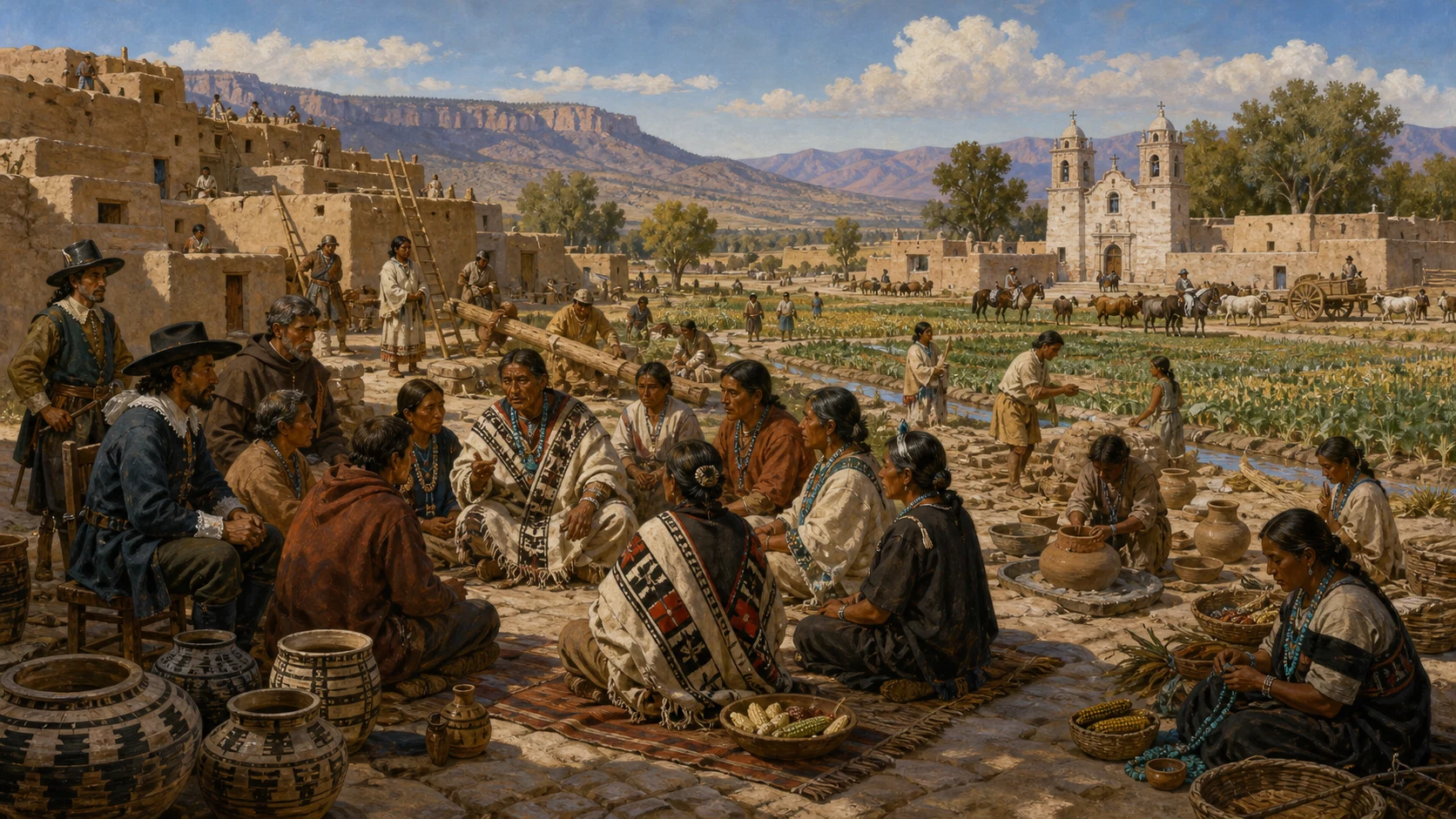
By 1607, Spain governed wealthy centers in Mexico, the Caribbean, and South America and defended older claims in Florida and New Mexico. In northern borderlands, missions sought to convert Indigenous communities while also organizing residence, agriculture, craft production, and labor. Presidios protected strategic routes and settlements, and ranching connected colonial towns and missions to wider markets. Sparse Spanish populations limited direct control across vast claimed territories.
Pueblo communities already possessed permanent towns, irrigation, agriculture, trade networks, and political and religious institutions. Spanish officials and missionaries demanded tribute and labor and attempted to suppress ceremonies, while disease and raids intensified pressure. Pueblo people negotiated, selectively adopted animals and tools, preserved religious practice, fled, and resisted. In 1680, coordinated Pueblo forces expelled Spanish colonists from New Mexico for more than a decade.
Spain returned beginning in 1692, but the revolt had changed the balance. Colonial authorities generally tolerated more Pueblo religious practice and worked through local alliances while rebuilding missions and settlements. Spanish domination remained real and unequal, yet the post-revolt order demonstrates that Indigenous resistance could force an empire to modify colonial practice.
Commercial models 04
French and Dutch colonies relied heavily on commerce, river networks, and Native alliances
New France centered on Quebec, the St. Lawrence River, the Great Lakes, and later Louisiana. Fisheries and the fur trade attracted merchants, missionaries, soldiers, and relatively small numbers of settlers. French traders and officials depended on Native knowledge, transport, hunting, diplomacy, and military partnerships. Alliances were genuine political relationships in which Native nations pursued their own security and commercial goals; they were not evidence of French control over allies.
French missionaries and traders learned Indigenous languages and sometimes lived within Native communities. Intermarriage created kinship and Métis communities that could connect trading worlds. Yet French expansion was not peaceful by nature. Trade competition, warfare, disease, mission pressure, slavery, and imperial rivalry affected Native societies, while alliances drew French forces into conflicts such as those involving Haudenosaunee power.
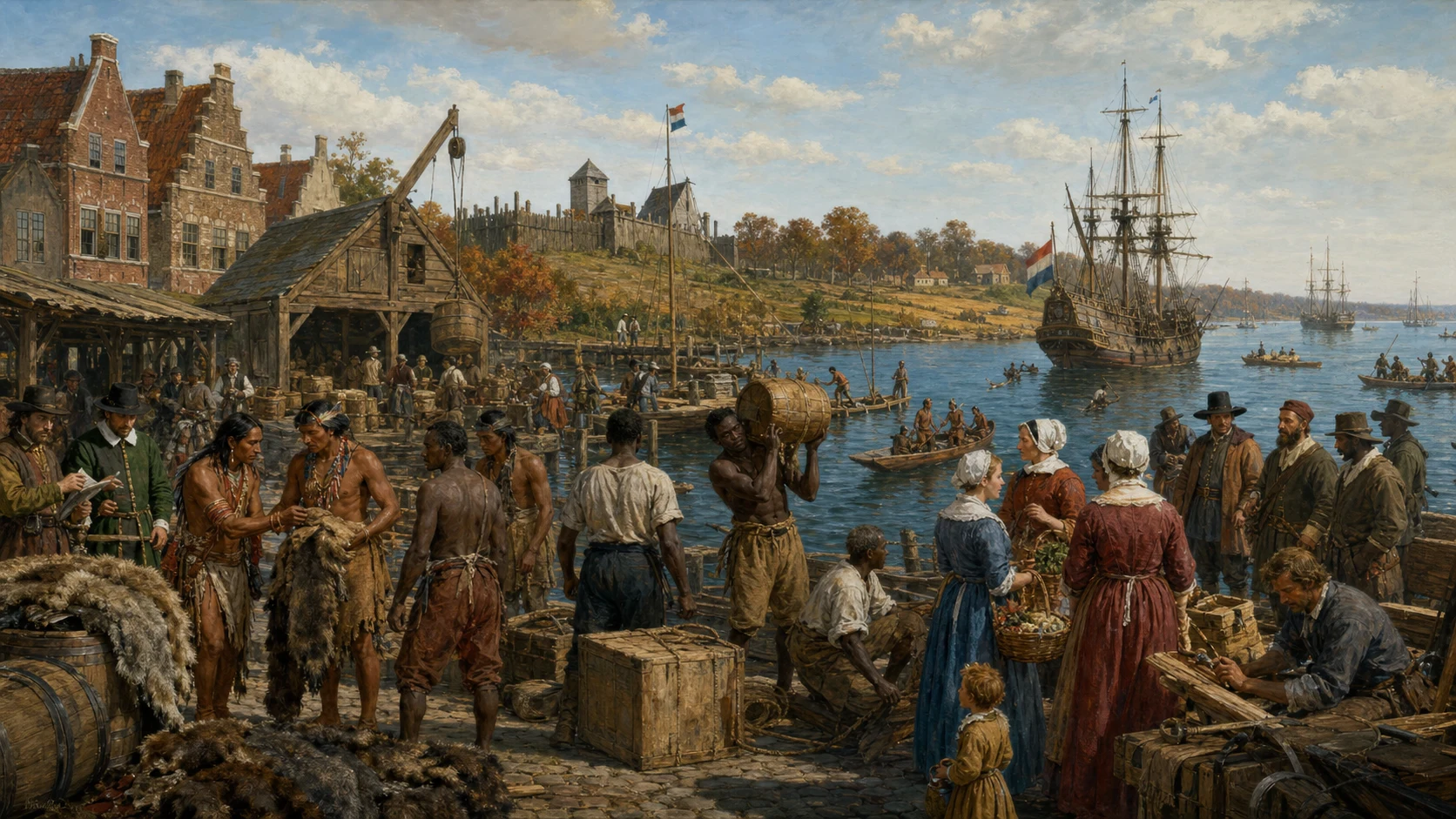
The Dutch West India Company established New Netherland around the Hudson River and New Amsterdam. The colony emphasized furs, shipping, finance, and Atlantic commerce and attracted a religiously and ethnically diverse population. Patroonships attempted to stimulate agricultural settlement. Commercial pluralism coexisted with slavery, unequal political authority, and contested land transactions. England captured the colony in 1664, turning New Amsterdam into New York while preserving many Dutch commercial and cultural influences.
English models 05
English colonization combined company investment, religious communities, proprietorships, and expanding settler agriculture
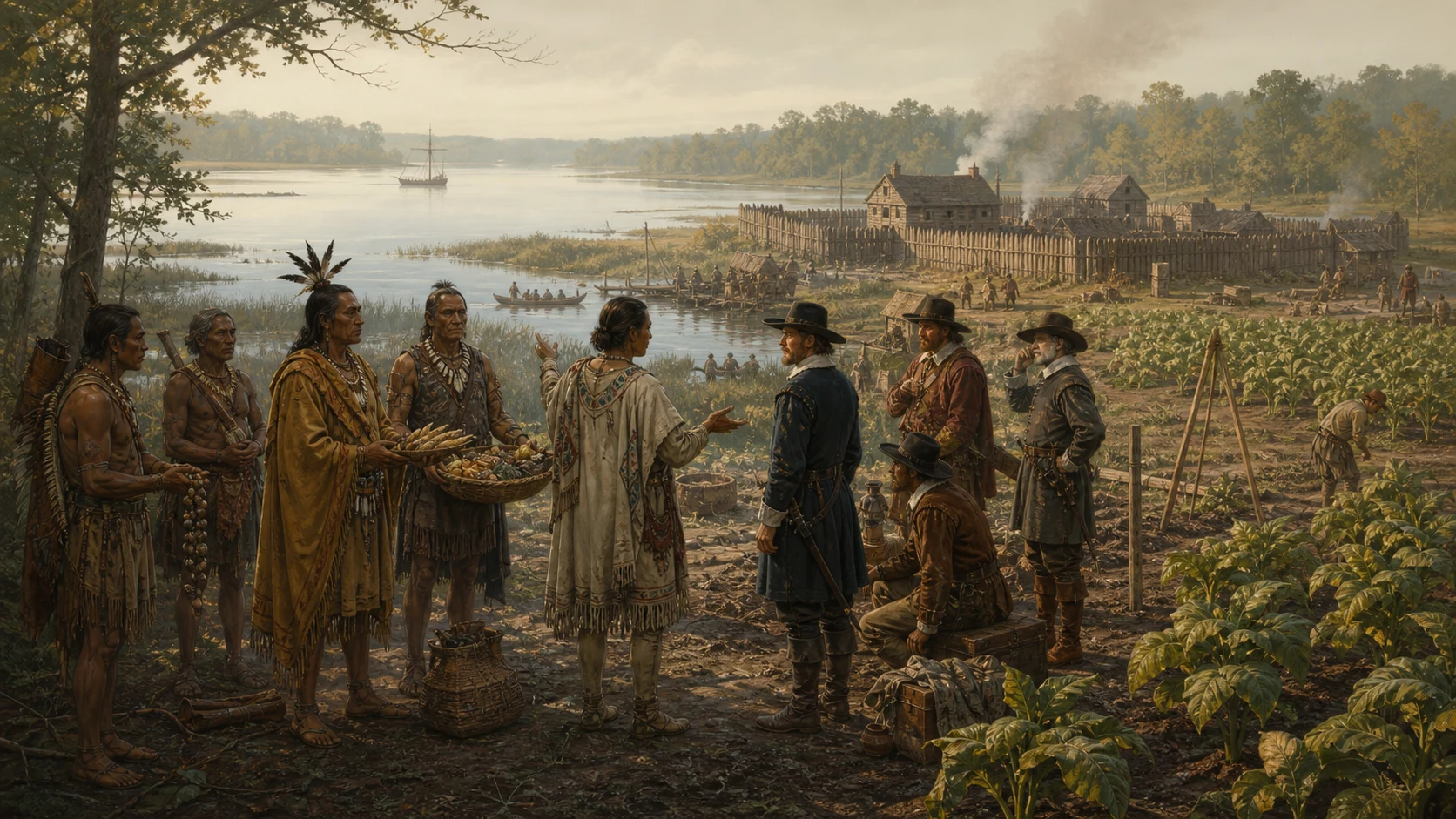
The Virginia Company founded Jamestown in 1607 hoping to generate profit and strategic advantage. Settlers entered the Powhatan political world without adequate food or knowledge of the environment. Powhatan communities supplied food and pursued diplomacy while attempting to contain English growth. John Rolfe's development of a profitable tobacco crop created export revenue, but it also increased demands for land and labor and contributed to recurring Anglo-Powhatan wars.
New England colonies developed through different migration patterns. Plymouth's Separatists and Massachusetts Bay's Puritans arrived in family groups and organized towns, congregations, schools, and mixed farms. Dense settlement and land expansion produced diplomacy, trade, and warfare with Wampanoag, Pequot, Narragansett, and other Native nations. Puritan community ideals did not produce full toleration; dissenters such as Roger Williams and Anne Hutchinson challenged religious and political authority.
Proprietary colonies extended English power through grants to individuals or groups. Maryland was designed partly as a refuge for English Catholics but developed a tobacco economy; Pennsylvania attracted Quakers and diverse migrants through land and comparatively broad toleration; Carolina drew heavily on Caribbean plantation experience and expanded rice production and African slavery. In every region, English population growth placed sustained pressure on Native land.
Corporate colony
A chartered company such as the Virginia Company initially financed and governed settlement for investors.
Covenant community
Puritan migrants understood Massachusetts Bay as a religious society governed by collective moral obligations, though dissent and exclusion remained.
Proprietary colony
The Crown granted authority to proprietors, as in Maryland, Pennsylvania, and Carolina, who recruited settlers and organized government.
Royal colony
The Crown directly appointed governors and supervised administration after taking control from a company or proprietor, as happened in Virginia in 1624.
Comparison table 06
Compare empires through population, economy, settlement, religion, and Native relations
Every empire sought wealth and strategic power, and every colony depended on Native knowledge, diplomacy, trade, land, or labor. The major differences were how many settlers arrived, which commodities generated profit, how much land colonists demanded, and which institutions—missions, companies, proprietorships, trading posts, or plantations—organized expansion.
The table presents broad patterns suitable for an exam thesis. Always qualify them. French colonists sometimes seized land, English colonists frequently traded and allied with Native nations, Dutch settlements included farms as well as ports, and Spanish borderlands changed by region and over time.
| Empire | Population and settlement | Economy and institutions | Native relations and major effect |
|---|---|---|---|
| Spanish | Older towns and sparse northern settlements connected by missions, presidios, ranches, and supply routes | Conversion, imperial defense, agriculture, ranching, tribute, and coerced labor | Mission pressure and labor demands encouraged accommodation and revolt; Pueblo resistance forced change after 1680 |
| French | Relatively few settlers across river and lake corridors from Canada toward Louisiana | Fur trade, fisheries, missions, military posts, and alliance networks | Dependence on Native trade and military partners increased diplomacy and intermarriage but also spread disease and intensified warfare |
| Dutch | Commercial port and Hudson River settlements with notable ethnic and religious diversity | West India Company, shipping, finance, fur trade, patroonships, and slavery | Trade partnerships coexisted with contested land purchases and conflict; English conquest ended Dutch rule in 1664 |
| English | Large and growing settler populations in towns, farms, ports, and plantations along the Atlantic coast | Joint-stock and proprietary settlement, family farms, tobacco, rice, trade, indentured servitude, and slavery | High land demand produced repeated dispossession and warfare despite diplomacy, trade, and Native alliances |
Cause and effect 07
Colonization reorganized land, labor, ecology, politics, and culture through linked processes
Colonial effects were interconnected. Tobacco profits encouraged English migration and land claims, which intensified war and increased labor demand. Fur profits drew French and Dutch traders deeper into Native networks, altering diplomacy, hunting patterns, and access to weapons. Missions attempted conversion while concentrating populations and organizing labor. Atlantic shipping moved commodities, settlers, indentured servants, enslaved Africans, pathogens, and ideas.
Native nations responded strategically. They traded, relocated, adopted useful technologies, built coalitions, used imperial rivalries, negotiated treaties, petitioned, maintained ceremonies, and fought wars. Africans—free and enslaved—worked as farmers, sailors, craftspeople, soldiers, interpreters, traders, and domestic laborers and created families, faiths, languages, and resistance networks. Agency changed outcomes without eliminating the unequal structures of colonization.
| Colonial development | Mechanism | Major effect | High-value evidence or qualification |
|---|---|---|---|
| English settler migration | Families and planters demanded farms, towns, timber, and political control over land | Dispossession, treaties, frontier expansion, and repeated Native–English warfare | Jamestown and tobacco; Pequot War; King Philip's War; Native alliances complicate a simple two-sided story |
| French and Dutch fur commerce | Traders depended on Native hunters, transport routes, diplomacy, and military partnerships | Alliance networks, new goods, changing hunting pressure, intensified rivalry, and cultural exchange | Great Lakes alliances and New Netherland; Native nations chose partners and pursued independent goals |
| Spanish missions and settlements | Missionaries and officials concentrated communities, demanded labor, and targeted religious practice | Conversion, syncretism, labor coercion, cultural preservation, flight, and revolt | Pueblo Revolt of 1680 and Spain's modified return demonstrate Indigenous power and change over time |
| Staple-crop expansion | Atlantic demand made tobacco, rice, and Caribbean sugar highly profitable and labor intensive | Plantation growth, land concentration, indentured migration, African forced migration, and racial slavery | Labor systems changed over decades; Bacon's Rebellion contributed but did not single-handedly cause slavery |
| Imperial competition | Empires armed allies, built forts, subsidized settlements, and contested strategic rivers and trade routes | Borderland warfare and diplomacy connected local Native conflicts to Atlantic imperial struggles | European armies remained dependent on Native military support; map claims exceeded effective control |
Exam method 08
Write a qualified comparison that connects one difference to a cause and an effect
A strong thesis establishes both a similarity and a difference or evaluates which difference mattered most. One model is: ‘Although French and English colonies both sought profit and relied on Native diplomacy, France's small settler population and fur-trade economy encouraged wider alliance networks, whereas English family migration and land-intensive agriculture produced greater territorial displacement.’ The thesis identifies categories, causes, and effects.
Use specific evidence in matched pairs: Quebec and Jamestown, a French fur alliance and an Anglo-Powhatan war, Spanish missions and Dutch trading posts, New Amsterdam and Massachusetts Bay. After naming evidence, explain how it proves the comparison. Do not award the evidence the work of reasoning merely by listing it.
Qualify the argument with variation or change over time. French–Native relations included war as well as alliance; English colonies used diplomacy as well as force; Spanish practice changed after the Pueblo Revolt; and Dutch pluralism coexisted with slavery. Qualification makes the thesis more accurate without erasing the main pattern.
Category
Choose settlement population, economy, labor, religion, political structure, or Native relations and keep the comparison consistent.
Evidence
Use one named development for each empire or colony, such as Quebec, New Amsterdam, Jamestown, Massachusetts Bay, or the Pueblo Revolt.
Reasoning
Explain why the pattern differed and what effect that difference produced.
Qualification
Acknowledge a regional exception, change over time, Native agency, or overlap between colonial strategies.
High-yield review
Key developments
Colonial motives became durable institutions
Commercial, geopolitical, religious, and migration goals operated through charters, companies, proprietorships, missions, forts, shipping, and labor systems.
Spanish borderlands remained contested
Missions and settlements extended Spanish claims, while Pueblo resistance, limited settler numbers, and distance restricted control.
French and Dutch commerce depended on Native networks
Fur-trade colonies relied on Native knowledge, hunters, transport, diplomacy, and military alliances while producing new pressures and cultural exchange.
English settler colonies expanded rapidly
Company, religious, and proprietary settlements drew migrants, developed staple crops, and pressed outward for agricultural land.
Atlantic labor systems hardened
Indentured servitude, Indigenous coercion, and African slavery supplied colonial labor, while English law increasingly made African bondage lifelong and hereditary.
Native and African agency shaped colonial outcomes
Diplomacy, alliance, skilled knowledge, cultural creation, relocation, petition, escape, and revolt altered the operation and limits of colonial power.
Chronological reasoning
Timeline — key moments
Jamestown establishes lasting English colonization
The Virginia Company creates a precarious settlement in Powhatan homelands that later survives through tobacco, migration, resupply, and coercive expansion.
Quebec anchors New France
The French establish a St. Lawrence center that links Atlantic commerce to Native fur-trade and alliance networks.
New Netherland fur-trade colony develops
Dutch commercial posts along the Hudson connect New Amsterdam, Atlantic shipping, and trade with Native nations.
Virginia institutions and labor expand
The House of Burgesses meets and captive Africans arrive in a colony whose labor system will increasingly develop racial slavery.
Plymouth founded in Wampanoag homelands
Separatist settlers depend on Native knowledge and diplomacy while establishing a permanent religious community.
Virginia becomes a royal colony
The Crown revokes the Virginia Company's charter, demonstrating how a corporate settlement could shift to direct royal administration.
Massachusetts Bay migration begins
Puritan family migration creates a network of towns, congregations, farms, and institutions in New England.
Pequot War intensifies settler expansion
English colonists and Native allies defeat the Pequot in a destructive struggle involving trade, territory, and regional power.
England captures New Netherland
New Amsterdam becomes New York, ending Dutch government while preserving commercial, cultural, and property influences.
King Philip's War devastates New England
Metacom's coalition fights English expansion in one of the most destructive conflicts per capita in colonial American history.
Bacon's Rebellion shakes Virginia
Frontier warfare, land demands, taxation, political exclusion, and elite power fuel rebellion and expose divisions within English colonial society.
Pueblo Revolt defeats Spanish rule
Coordinated Pueblo forces expel Spanish colonists and missionaries from New Mexico for more than a decade.
Spain returns to New Mexico
Spanish authorities restore colonial government but tolerate more Pueblo religious practice and rely on modified alliances after renewed conflict.
New Orleans strengthens French Louisiana
The Mississippi settlement supports French trade, military strategy, plantation development, and connections between Canada, the Gulf, and the Caribbean.
Ohio Valley conflict begins a new imperial war
Competing French, British, and Native claims trigger the French and Indian War and reveal the strategic importance of colonial alliances.
Remember these
Vocabulary
- Colonization
- The establishment of sustained political, economic, social, or religious control over another people's territory, often through settlement, institutions, and unequal power.
- Charter
- A legal grant from a monarch defining a company, proprietor, or colony's authority, territory, and obligations.
- Joint-stock company
- An enterprise in which investors pooled capital and shared risk, used by companies such as the Virginia Company and Dutch West India Company.
- Corporate colony
- A colony initially financed or governed by a chartered company acting under royal authority.
- Proprietary colony
- A colony granted by the Crown to an individual or group with broad authority to recruit settlers and organize government.
- Royal colony
- A colony under more direct Crown supervision, typically governed by a royal appointee and an elected assembly.
- Settler colonialism
- Colonization based on permanent migrant communities seeking control of Indigenous land, commonly producing displacement and sustained conflict.
- Borderland
- A contested zone where Native nations, empires, settlers, traders, and migrants interact and no power exercises complete control.
- Mission
- A religious institution intended for conversion that could also organize settlement, labor, agriculture, craft production, and imperial authority.
- Presidio
- A Spanish military fort built to defend settlements, missions, supply routes, or imperial claims.
- Pueblo Revolt
- The coordinated 1680 uprising that expelled Spanish colonists from New Mexico and defended Pueblo religion, labor, land, and political autonomy.
- New France
- France's North American empire centered on Canada and later Louisiana, organized through trade, missions, forts, settlements, and Native alliances.
- Fur trade
- The exchange of animal pelts for European goods through networks that depended on Native hunting, transport, diplomacy, and market knowledge.
- Métis
- Communities and people of mixed Indigenous and European ancestry, especially associated with French–Native kinship and trade networks.
- New Netherland
- The Dutch commercial colony along the Hudson River, including New Amsterdam, seized by England in 1664.
- Patroonship
- A large Dutch land grant intended to attract agricultural settlers and tenants to New Netherland.
- Virginia Company
- The English joint-stock company chartered to establish Jamestown and seek profit in Virginia.
- Powhatan political network
- The tributary alliance of Algonquian-speaking communities led by Wahunsenacawh when Jamestown was founded.
- Tobacco
- The profitable Chesapeake staple crop that financed English expansion while increasing land and labor demand.
- Headright system
- A policy granting land for financing a migrant's passage, used in Virginia to encourage settlement and labor migration.
- Indentured servitude
- A fixed-term labor contract commonly exchanged for passage; coercive and unequal, but legally distinct from hereditary chattel slavery.
- Chattel slavery
- A system making enslaved people transferable property for life, with colonial law increasingly making bondage inherited through the mother.
- Imperial rivalry
- Competition among empires for territory, trade, strategic routes, labor, and alliances that turned borderlands into zones of diplomacy and warfare.
Clear the confusion
Frequently asked questions
20 detailed answers to the questions students most often carry into Topic 2.2.
01What is the main idea of APUSH Topic 2.2?
European powers pursued wealth, territory, strategic advantage, and religious goals through different colonial systems. Spain relied on missions and borderland settlements, France and the Dutch emphasized commerce and Native alliances, and England developed populous settler colonies. Those strategies reshaped land, labor, diplomacy, ecology, and culture while Native and African actions limited and redirected colonial power.
02What caused European colonization after 1607?
Commercial opportunity, state rivalry, land hunger, Christian expansion, and migration all mattered. Charters, companies, proprietorships, ships, credit, labor, and resupply made colonies possible. The importance of each factor varied: investors prioritized profit, monarchs valued strategic claims and revenue, missionaries pursued conversion, and migrants sought land, work, family opportunity, or religious communities.
03How is colonization different from exploration?
Exploration gathers routes, geographic information, or claims and may be temporary. Colonization establishes sustained institutions and relationships through settlement, government, trade, missions, labor systems, or military presence. An expedition could enable colonization, but permanence required resupply, food, labor, political authority, and interaction with Native nations.
04Why did some colonies fail while others survived?
Survival depended on environment, food, health, leadership, resupply, finance, export revenue, migration, labor, and Native relations. Promoters often underestimated existing political control and local conditions. Jamestown nearly failed before tobacco and renewed migration created revenue, while Native provisions and diplomacy were crucial during its early years.
05What characterized Spanish colonization in North American borderlands?
Spanish colonization joined missions, presidios, ranching, towns, tribute, labor demands, and strategic defense. Northern settlements remained sparse compared with central Mexico. Missionaries attempted conversion and cultural reorganization, but Native nations negotiated, preserved beliefs, fled, and rebelled. The Pueblo Revolt revealed both the violence and limits of Spanish authority.
06Why was the Pueblo Revolt significant?
Pueblo communities coordinated resistance to mission suppression, labor demands, tribute, disease, and colonial rule and expelled Spain for more than a decade. The revolt demonstrates Indigenous sovereignty and intercommunity cooperation. When Spain returned, officials generally tolerated more Pueblo religious practice and relied on modified alliances, showing resistance could alter colonial policy.
07What characterized French colonization?
New France had relatively few settlers and stretched along the St. Lawrence, Great Lakes, and Mississippi corridors. Fur trading, fishing, missions, forts, and Native alliances were central. French colonists depended on Indigenous hunters, transport, diplomacy, and military support. Intermarriage and cultural exchange occurred, but so did disease, slavery, mission pressure, competition, and war.
08What characterized Dutch colonization?
New Netherland was a West India Company colony focused on furs, shipping, finance, and Atlantic commerce. New Amsterdam became diverse in ethnicity and religion, and patroonships encouraged farming. Yet commercial pluralism coexisted with slavery, unequal government, and disputed land transactions. England captured the colony in 1664 but retained many Dutch residents and practices.
09What characterized English colonization?
English colonization included corporate Jamestown, Puritan New England, and proprietary colonies such as Maryland and Pennsylvania. Large numbers of settler families and land-intensive farming distinguished many English colonies. Tobacco, rice, commerce, religious community building, indentured servitude, and African slavery shaped development, while expanding settlement repeatedly displaced Native peoples.
10Why did France generally rely more on Native alliances than England?
France had fewer settlers spread over vast trade corridors and depended on Native hunters, transport, knowledge, and military partners. England received larger settler migrations and developed more land-intensive agriculture, increasing pressure for permanent territory. This is a relative comparison: English colonies also formed alliances, and French colonists also caused conflict and dispossession.
11How did tobacco change Virginia?
Tobacco supplied the export revenue Jamestown's investors had sought. Its expansion increased demand for riverfront land and labor, encouraged migration through the headright system, strengthened planter wealth, and intensified Anglo-Powhatan conflict. Early planters relied heavily on indentured servants, while African slavery expanded and became more legally entrenched later in the century.
12How did religion shape colonization?
Spanish and French missionaries tied conversion to imperial expansion. Puritans and Separatists built English communities around Protestant covenants, while Quakers promoted comparatively broad toleration in Pennsylvania. Religion could motivate migration and institutions, but it also justified control, excluded dissenters, reorganized Native communities, and became a target of Indigenous resistance.
13Did trade make Native–European relations peaceful?
No. Trade could build alliances and provide useful goods, but it also changed hunting patterns, spread disease, intensified rivalries, produced debt, and encouraged competition over routes and land. Native nations used trade strategically, and relations could shift between alliance and warfare. Economic exchange did not remove unequal colonial goals.
14How did Native nations exercise agency during colonization?
Native nations selected trading partners, formed and broke alliances, supplied or withheld food, controlled geographic knowledge, negotiated treaties, relocated, adopted useful technologies, preserved ceremonies, petitioned, and fought wars. Agency means meaningful action within constraints. It does not imply that colonial violence or demographic disruption was minor.
15How did Africans shape European colonies?
Free and enslaved Africans worked in agriculture, shipping, crafts, trade, domestic labor, military service, and interpretation. They brought agricultural knowledge, languages, religious practices, foodways, skills, and Atlantic experience and created families and communities. Enslaved people resisted through negotiation, cultural preservation, work resistance, escape, and revolt.
16Were indentured servitude and slavery the same?
No. Both could involve severe coercion, violence, and restricted freedom, but indentures generally ended after a contractual term and did not ordinarily make children inheritable property. Chattel slavery became lifelong, transferable, hereditary, and increasingly tied by law to African ancestry. Precise comparison matters on APUSH questions.
17How did imperial rivalry affect colonization?
Rivalry encouraged monarchs to charter companies, subsidize settlements, build forts, claim river valleys, regulate trade, and seek Native allies. Local conflicts could therefore become part of larger Atlantic wars. Native nations used competition among empires for trade and security, although alliances could also draw communities into destructive imperial struggles.
18Did European maps show actual political control?
Usually not. Maps projected imperial claims across lands controlled by Native nations. Effective power depended on settlers, forts, supply routes, alliances, trade, and the ability to enforce decisions. Across interior and borderland regions, European authority remained incomplete and negotiated throughout Period 2.
19How should I compare European empires on the exam?
Choose one consistent category: population, settlement, economy, religion, labor, or Native relations. Name evidence from each empire and explain the cause and effect of the difference. Then qualify the pattern. A strong answer might compare French fur alliances with English settler agriculture and explain how relative population and land demand produced different territorial pressures.
20How can Topic 2.2 appear on an SAQ, DBQ, or LEQ?
An SAQ may ask for one cause or effect of an empire's strategy. A DBQ may use charters, maps, mission accounts, trade records, laws, or Native petitions to compare colonization. An LEQ may ask for similarities and differences among empires. Answer the dates, use specific paired evidence, explain mechanisms, and qualify broad claims with Native agency or regional variation.
Use the knowledge
AP exam connections
- 1
Separate motives from enabling institutions: profit, rivalry, religion, and migration explain why colonization occurred; charters, capital, labor, shipping, and diplomacy explain how colonies endured.
- 2
Compare empires with matched categories and explain differences through settler population, land demand, commodity choice, religious institutions, and dependence on Native alliances.
- 3
Treat Native nations as sovereign actors whose trade, diplomacy, food, land control, military power, and resistance determined the reach and limits of colonies.
- 4
Link colonial economic growth to labor and law: tobacco, rice, furs, and Atlantic commerce reorganized migration, indenture, slavery, land, and political authority.
- 5
Qualify every imperial model with variation and change over time; no empire was uniformly peaceful, tolerant, coercive, commercial, or land-hungry in every place.
Editorial trust
Sources and review
These notes are original OnlyPrepy content. The syllabus scope and historical framing were checked against the following authoritative sources on August 15, 2026.