The big picture
Trace the movement of plants, animals, people, diseases, and ideas across the Atlantic—and evaluate its unequal human and environmental consequences.
Exam framework 01
Topic 1.4 connects biological exchange to Spanish exploration and conquest
The College Board asks students to explain both the causes of the Columbian Exchange and its effects on Europe and the Americas after 1492. The required framework links American crops and mineral wealth to European population and economic change, maritime technology and organized trade to expanding Atlantic economies, and Spanish conquest to epidemic disease and introduced plants and animals.
Treat the topic as a system rather than a vocabulary list. Sustained voyages connected ecosystems that had developed largely apart for thousands of years. Organisms, people, commodities, technologies, and ideas then moved through imperial routes created by exploration, conquest, settlement, trade, and forced migration. Those movements generated benefits for some groups while imposing catastrophic costs on others.
Process 02
The Columbian Exchange was continuing, multidirectional, and inseparable from empire
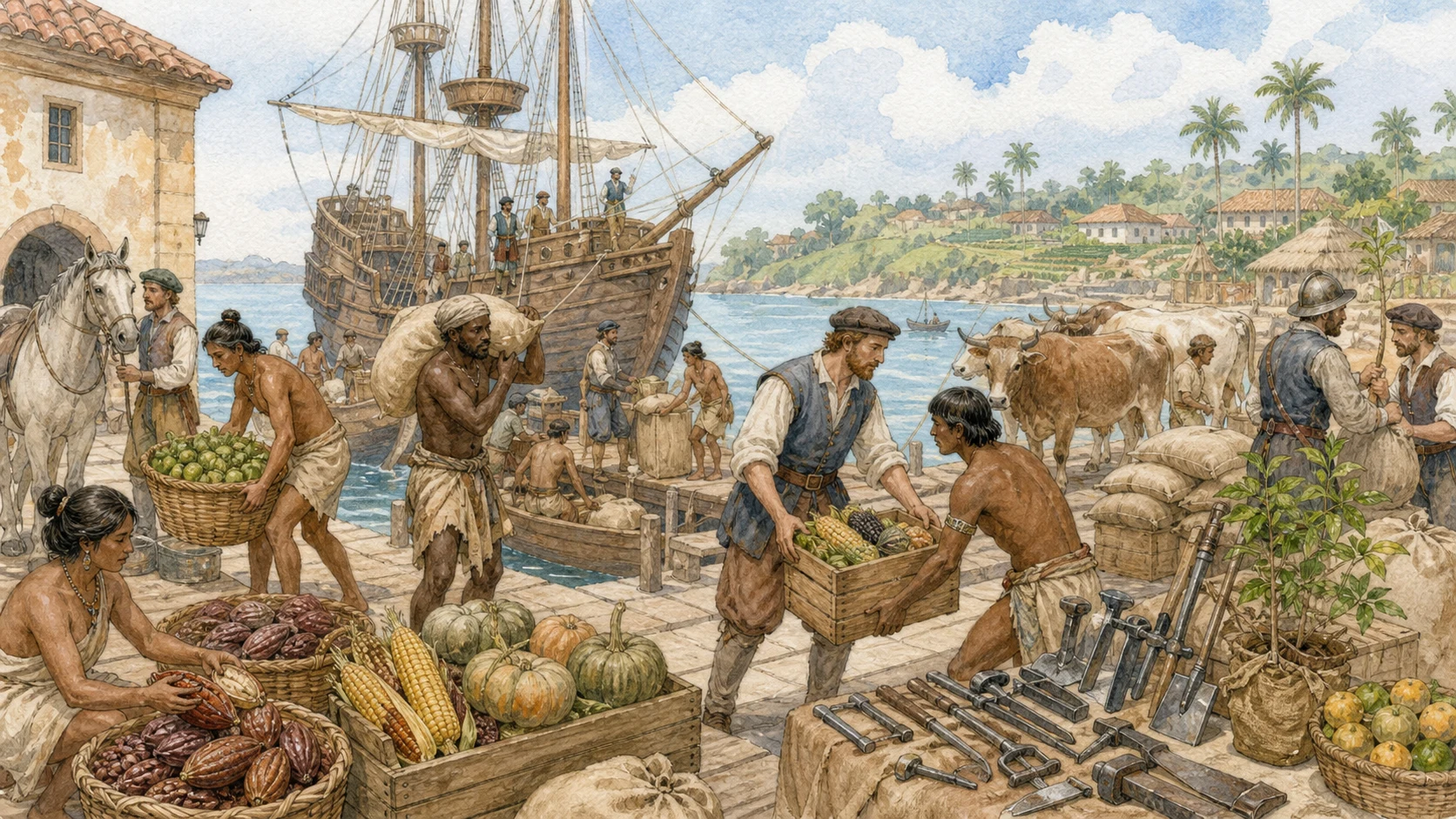
The exchange began with sustained Atlantic contact, not with a single shipment. Some transfers were intentional: colonists carried seeds, livestock, tools, settlers, and missionaries, while merchants exported American crops and metals. Other transfers were unintended: pathogens traveled with people and animals, weeds spread into disturbed land, and grazing animals escaped colonial control.
Maritime technology, regular shipping, imperial ports, charters, and organized investment made repeated movement possible. The Atlantic Ocean became a corridor linking Europe, Africa, and the Americas. Because these routes were embedded in conquest and unequal power, the word “exchange” must not imply voluntary or balanced trade.
Intentional transfers
Crops, livestock, settlers, missionaries, tools, weapons, commodities, and enslaved laborers moved through planned voyages and imperial policy.
Unintentional transfers
Pathogens, invasive plants, pests, and escaped animals traveled beyond the control or knowledge of those who carried them.
Coerced transfers
Indigenous captives and forcibly transported Africans were moved through systems of conquest, enslavement, and labor exploitation.
Continuing transfers
The process expanded across decades and centuries as colonies, markets, plantations, mines, and migration networks grew.
Comparison 03
Transfers moved in both directions, but their consequences were profoundly unequal
American crops such as maize and potatoes eventually supported population growth in parts of Europe, Africa, and Asia. Cacao, tobacco, tomatoes, peppers, and other products transformed diets, consumption, and trade. American silver entered European and global commercial networks, supplying crowns and merchants with new sources of wealth.
Afro-Eurasian animals and crops changed American landscapes and economies. Horses created new possibilities for mobility, hunting, trade, and warfare; cattle, pigs, and sheep supplied food and materials but could damage Indigenous fields and habitats. Wheat and sugarcane supported colonial settlement and export systems. Epidemic diseases produced the most devastating and unequal transfer.
| Category | Americas → Afro-Eurasia | Afro-Eurasia → Americas | Major effects |
|---|---|---|---|
| Food crops | Maize, potatoes, tomatoes, beans, squash, cacao, peppers, peanuts | Wheat, sugarcane, rice, citrus, bananas, coffee | New diets and markets; population growth in parts of Afro-Eurasia; plantation expansion and altered land use in the Americas |
| Domesticated animals | Turkeys and a limited number of other domesticated species | Horses, cattle, pigs, sheep, goats, chickens | New transport, labor, food, hides, hunting, and warfare; grazing and free-ranging animals transformed landscapes |
| Disease organisms | No transfer comparable in demographic effect during the period | Smallpox, measles, influenza, typhus, and other pathogens | Catastrophic Indigenous mortality, social disruption, political instability, and greater opportunities for imperial conquest |
| Metals and commodities | Silver, gold, tobacco, cacao, dyes and other export goods | Iron tools, weapons, manufactured goods and coin-based commercial practices | Greater European and global commerce; intensified mining, extraction, taxation, and competition for labor |
| People and labor | Indigenous captives, envoys, knowledge, and coerced migrants | European settlers and missionaries; forcibly transported Africans | New colonial societies, racialized labor systems, cultural mixture, violence, resistance, and demographic change |
| Ideas and technologies | Indigenous agricultural knowledge, foods, medicines, and geographic information | Christianity, written legal systems, metal tools, firearms, and new sailing networks | Cultural exchange and syncretism alongside suppression, missionization, legal domination, negotiation, and selective adoption |
Unequal consequence 04
Epidemic disease caused catastrophic demographic and political disruption
Indigenous populations had experienced long separation from many Afro-Eurasian disease environments and therefore lacked prior community exposure to smallpox, measles, influenza, and other pathogens. Repeated epidemics caused devastating mortality. Disease could move through existing Indigenous trade and communication networks ahead of direct European settlement, making its geographic reach larger than the area colonizers physically controlled.
Mortality alone does not describe the full effect. The loss of leaders, elders, farmers, healers, craftspeople, and knowledge keepers weakened food production, diplomacy, defense, and cultural transmission. Epidemics interacted with warfare, enslavement, forced relocation, hunger, ecological disruption, and colonial violence. Avoid monocausal claims: disease was extraordinarily important, but colonial systems intensified vulnerability and loss.
Conquest 05
Spanish victories depended on epidemics, Indigenous allies, and local political conditions
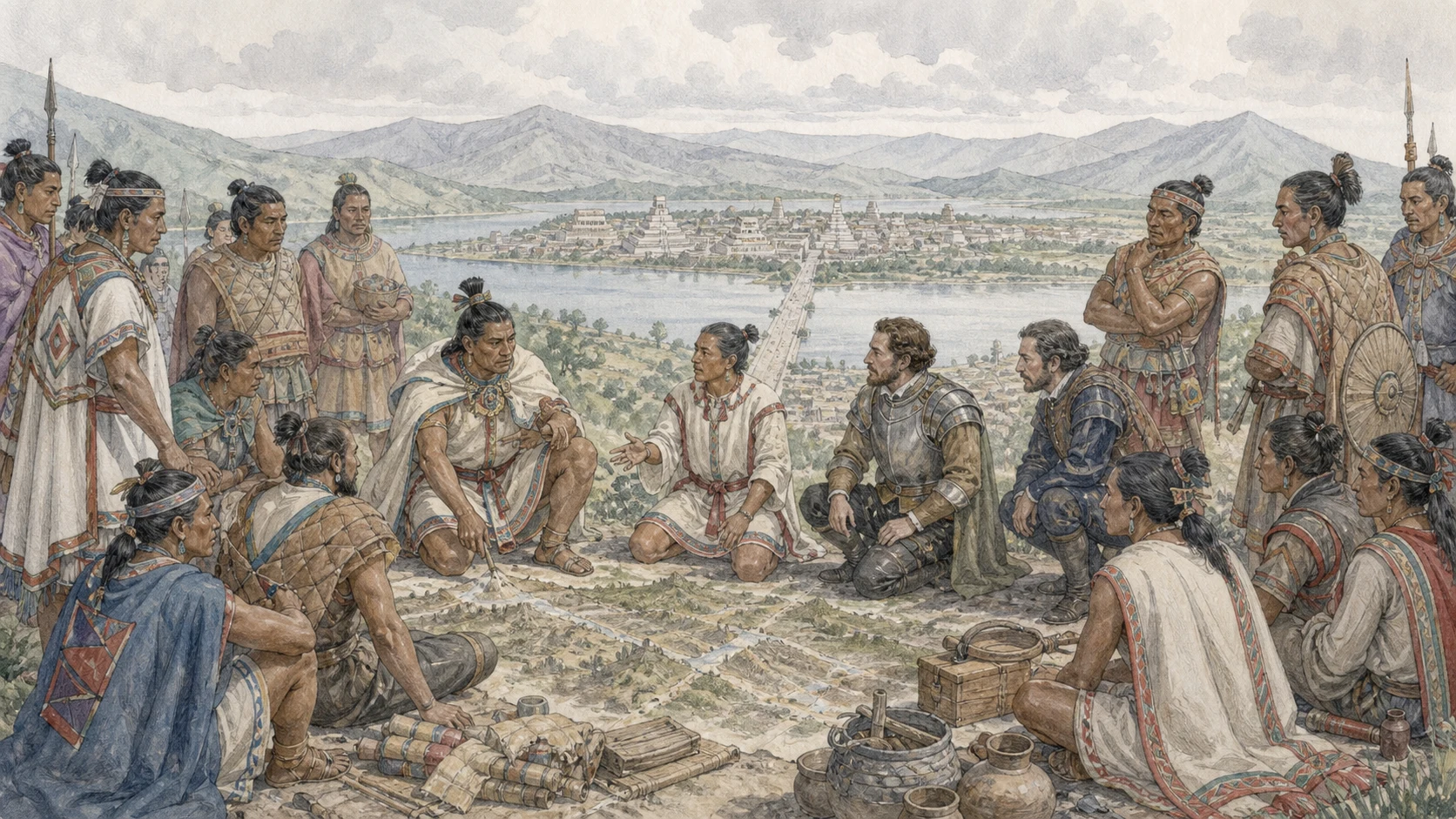
Spanish conquistadors arrived with steel weapons, firearms, horses, maritime supply routes, and ambitions for wealth and status. Those advantages mattered, but small expeditionary forces could not conquer large empires alone. Hernán Cortés relied on interpreters and tens of thousands of Indigenous allies who opposed Mexica power. Spanish forces exploited existing rivalries, siege conditions, and the political disruption caused by epidemic disease.
The conquest of the Inca Empire followed a different local chronology but also involved epidemic disruption, political division, surprise, coercion, and Indigenous participation. Spanish victories therefore resulted from a combination of technology, pathogens, alliances, leadership decisions, and circumstances—not from an inherent cultural or racial superiority.
Epidemic disruption
Disease reduced populations, removed leaders, strained food systems, and destabilized political authority.
Indigenous alliances
Native nations pursued their own rivalries and goals; their soldiers, supplies, intelligence, and local knowledge made Spanish campaigns possible.
Military and logistical advantages
Steel, firearms, horses, ships, siege tactics, and resupply could provide leverage, though none guaranteed victory by itself.
Political conditions
Internal conflicts, tributary resentments, succession disputes, and strategic choices created openings that conquistadors attempted to exploit.
Economic change 06
Mineral wealth and export production accelerated Atlantic commerce and coerced labor
American gold and especially silver supplied European states and merchants with new wealth. Mining centers such as Potosí became nodes in global commerce, while extracted metals strengthened imperial finance and expanded market exchange. In the College Board framework, American crops and minerals helped facilitate Europe’s broader movement from feudal economic relationships toward capitalism.
Mines, ranches, and sugar plantations demanded labor. Spanish colonizers imposed tribute and coerced Indigenous labor through systems such as encomienda and repartimiento. As Indigenous populations declined and plantation production expanded, Europeans increasingly relied on the transatlantic trafficking and enslavement of Africans. These systems linked biological exchange to racialized exploitation and the growth of an Atlantic economy.
Agency and environment 07
Indigenous peoples adapted introduced species and technologies while resisting colonial control
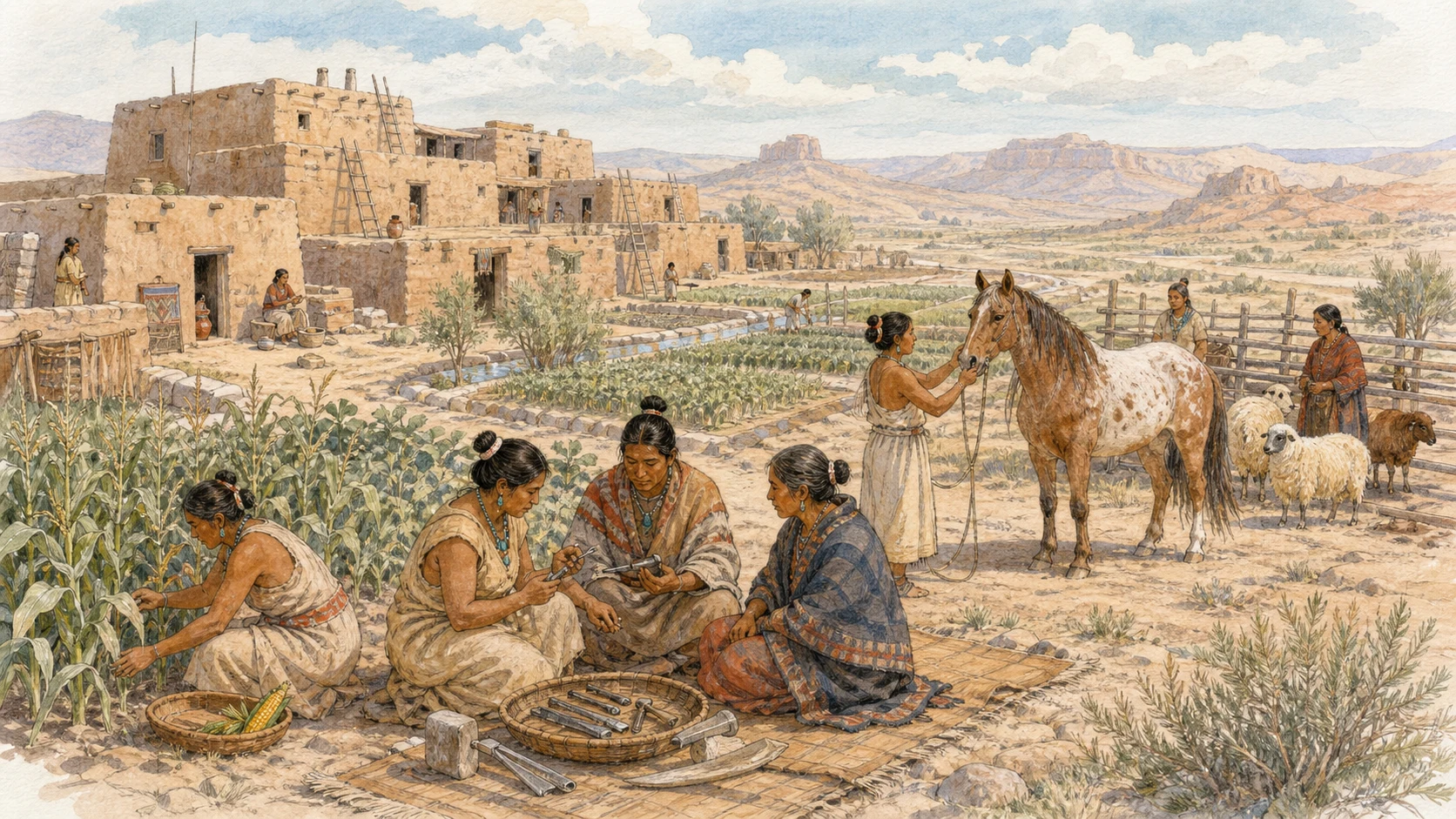
The Columbian Exchange did not make Indigenous peoples passive recipients of change. Communities evaluated new animals, crops, metals, weapons, and trade goods and selectively incorporated useful elements. Horses eventually transformed mobility, hunting, exchange, and warfare for many Plains nations. Other communities adopted fruit, wheat, sheep, cattle, or metal tools in locally specific ways.
Adoption did not erase conflict. Free-ranging livestock damaged fields, grazing changed vegetation, and colonial ranches and farms claimed land. Missions attempted to reorganize religion, labor, residence, and family life. Indigenous nations responded through negotiation, strategic accommodation, selective adoption, cultural preservation, migration, revolt, and armed resistance.
Exam method 08
Use evidence to build causal chains, comparisons, and continuity-and-change arguments
For causation, begin with a mechanism and trace more than one step. For example: sustained Spanish settlement carried smallpox into Indigenous networks; epidemics weakened communities and political authority; that disruption increased opportunities for conquest and labor coercion. Avoid treating correlation as a complete explanation by naming how each link operated.
For continuity and change, identify both transformation and persistence. Atlantic contact radically altered population, ecology, commerce, and power, while Indigenous nations continued diplomacy, trade, cultural practice, environmental knowledge, and resistance. For source analysis, examine who produced an image or account, what audience it targeted, and how imperial purpose shaped what it displayed or omitted.
High-yield review
Key developments
Sustained intercontinental exchange
Regular voyages connected previously separated American and Afro-Eurasian ecosystems through imperial shipping, settlement, commerce, and forced migration.
American crops and mineral wealth
Maize, potatoes, tomatoes, cacao, tobacco, silver, and other American products entered wider diets, markets, and financial networks.
Epidemic demographic catastrophe
Old World pathogens caused repeated mass mortality and disrupted Indigenous political authority, food production, defense, and cultural transmission.
Coalition-based Spanish conquest
Spanish campaigns combined weapons and horses with epidemic disruption, interpreters, Indigenous allies, local supplies, and existing political rivalries.
Atlantic extraction and coerced labor
Mining, ranching, and plantation production encouraged Indigenous labor coercion and the expanding forced migration and enslavement of Africans.
Indigenous adaptation and resistance
Native nations selectively adopted introduced animals, crops, tools, and trade goods while negotiating, preserving culture, relocating, and resisting colonial control.
Chronological reasoning
Timeline — key moments
Sustained Atlantic contact begins
Columbus’s first voyage connects American and Afro-Eurasian ecosystems through continuing Spanish voyages and imperial settlement.
Spain launches a large colonizing expedition
Columbus’s second voyage carries settlers, livestock, seeds, and supplies, expanding both intentional and unintentional biological transfers.
Enslaved Africans are transported to Hispaniola
African forced migration becomes part of the emerging Atlantic labor system as colonizers seek workers for mines and plantations.
Spanish and Indigenous allied forces attack the Mexica Empire
Cortés’s campaign relies on Native coalitions, interpreters, siege warfare, and political rivalries rather than Spanish soldiers alone.
Smallpox spreads through central Mexico
The epidemic causes mass death and political disruption during the struggle for Tenochtitlan, demonstrating how disease furthered conquest.
Spanish forces seize the Inca ruler and capital
Pizarro’s campaign exploits succession conflict and epidemic disruption while using surprise, coercion, and Indigenous participation.
Coronado’s expedition crosses the Southwest and Plains
The search for wealth brings violence, animals, goods, and new disease risks into additional Indigenous homelands.
Silver extraction expands at Potosí
The mining center connects coerced Indigenous labor and American mineral wealth to Spanish and global commerce.
Spain establishes St. Augustine
The permanent Florida settlement supports imperial trade routes and introduces additional livestock, crops, missions, and colonial land use.
Oñate leads a colonizing expedition into New Mexico
Settlers, missionaries, wagons, horses, cattle, and crops extend New Spain into Pueblo homelands through negotiation, coercion, violence, and exchange.
Remember these
Vocabulary
- Columbian Exchange
- The continuing post-1492 movement of organisms, people, commodities, technologies, and ideas between the Americas and Afro-Eurasia.
- Epidemic
- The rapid spread of an infectious disease through a population at levels substantially above normal expectations.
- Demographic collapse
- A severe and sustained population decline produced by interacting forces such as disease, warfare, displacement, hunger, and exploitation.
- Conquistador
- A Spanish expeditionary conqueror who pursued territory, wealth, status, and royal service in the Americas.
- Indigenous alliance
- A strategic agreement in which Native nations pursued diplomatic or military goals with one another or with European powers.
- Encomienda
- A Spanish grant allowing a colonist to demand Indigenous tribute or labor while claiming responsibility for protection and Christian instruction.
- Repartimiento
- A Spanish colonial system that required Indigenous communities to supply rotating drafts of paid but coerced labor.
- Coerced labor
- Work extracted through force, legal compulsion, threat, debt, captivity, or other conditions that prevent meaningful consent.
- Cash crop
- A crop grown primarily for sale and export rather than direct local consumption.
- Plantation system
- Large-scale export agriculture organized around concentrated landownership and controlled labor.
- Transatlantic slave trade
- The forced transportation and sale of enslaved Africans across the Atlantic into colonial labor systems.
- Atlantic world
- The interconnected societies and economies of Europe, Africa, and the Americas formed through Atlantic movement and exchange.
- Ecological transformation
- Long-term change to environments caused by introduced species, land use, settlement, extraction, and altered resource systems.
- Potosí
- A major silver-mining center in the Andes that connected coerced Indigenous labor to Spanish and global commercial networks.
- Joint-stock company
- A business organization in which investors pool capital and share financial risk and potential profit.
- Capitalism
- An economic system centered on private investment, markets, profit, wage or coerced labor relations, and the accumulation of capital.
- Cultural syncretism
- The creation of new cultural forms through the selective blending and reinterpretation of different traditions.
- Indigenous agency
- The capacity of Indigenous individuals and nations to make choices and shape events within changing and often coercive conditions.
Clear the confusion
Frequently asked questions
20 detailed answers to the questions students most often carry into Topic 1.4.
01What was the Columbian Exchange?
The Columbian Exchange was the continuing transfer of plants, animals, pathogens, people, commodities, technologies, and ideas between the Americas and Afro-Eurasia after sustained Atlantic contact began in 1492. It occurred through exploration, conquest, settlement, trade, missionization, migration, and forced movement rather than through one voyage.
02Why did the Columbian Exchange begin after 1492?
Earlier contacts did not create durable intercontinental networks. Columbus’s voyages were followed by repeated state-sponsored expeditions, colonies, shipping routes, ports, and commercial systems. Those sustained connections allowed organisms and people to move continually between previously separated ecosystems.
03Was the Columbian Exchange a balanced or voluntary exchange?
No. Movement occurred in multiple directions, but its power relationships and consequences were deeply unequal. Many transfers were planned, while pathogens and invasive species moved unintentionally. Indigenous captives and enslaved Africans were transferred through force, and colonial institutions directed land, labor, and commodities toward imperial goals.
04Which American crops had the greatest effects in Afro-Eurasia?
Maize and potatoes were especially important because their productivity and adaptability supported population growth in parts of Europe, Africa, and Asia. Tomatoes, peppers, beans, cacao, tobacco, peanuts, and other products also transformed diets, markets, consumption, and regional agriculture.
05Which animals did Europeans introduce to the Americas?
Introduced animals included horses, cattle, pigs, sheep, goats, and chickens. They supplied transportation, traction, food, hides, wool, and military advantages, but grazing and free-ranging herds also damaged fields, altered vegetation, spread weeds, and intensified colonial claims to land.
06Why were Old World diseases so destructive in the Americas?
Indigenous populations had been separated from many Afro-Eurasian disease environments for thousands of years and lacked previous community exposure to pathogens such as smallpox and measles. When repeated epidemics arrived, high mortality combined with hunger, warfare, displacement, labor demands, and social disruption.
07Did disease alone cause Indigenous demographic collapse?
No. Epidemic disease was a central cause, but its effects interacted with colonial violence, enslavement, forced relocation, food-system disruption, ecological change, and warfare. A strong historical explanation shows how these pressures compounded one another rather than attributing every loss to a single factor.
08How did epidemic disease help Spanish conquest?
Epidemics killed or incapacitated leaders, soldiers, farmers, and knowledge keepers, creating political and logistical crises. In central Mexico, smallpox spread during the struggle for Tenochtitlan. Disease weakened resistance and disrupted authority, but Spanish success still required Indigenous allies, supplies, interpreters, weapons, and strategic decisions.
09Why were Indigenous allies essential to Spanish conquest?
Spanish expeditionary forces were small and unfamiliar with local geography, languages, and politics. Native allies provided large armies, food, intelligence, interpreters, routes, and logistical support while pursuing their own grievances and ambitions. Their participation makes conquest a coalition conflict rather than a simple Europe-versus-America war.
10Did guns, steel, and horses make Spanish victory inevitable?
No. These technologies could provide tactical advantages and psychological surprise, but they did not guarantee conquest. Outcomes depended on alliances, epidemic conditions, supply, leadership, siege tactics, local rivalries, geography, and the choices of Indigenous nations.
11How could relatively few Spaniards defeat large American empires?
They did not act alone. Spanish commanders inserted themselves into existing political conflicts and fought alongside very large Indigenous coalitions. Epidemics destabilized societies, while capture of leaders, siege warfare, steel, horses, interpreters, and local supplies created additional advantages. No single factor explains the result.
12What was the encomienda system?
Encomienda was a royal grant allowing a colonist to demand Indigenous tribute or labor while claiming duties of protection and Christian instruction. In practice it enabled severe exploitation. It did not transfer legal ownership of Indigenous people, but the coercive power it created often produced conditions resembling slavery.
13How did American silver affect Europe and the wider world?
Silver enriched the Spanish monarchy and merchants, expanded coin-based exchange, financed imperial competition, and entered global trade through European and Pacific routes. Mining centers such as Potosí depended on coerced labor. The College Board connects this new mineral wealth to Europe’s broader movement toward capitalism.
14How did maritime technology and joint-stock companies relate to Topic 1.4?
Ships, navigation, recorded route knowledge, and regular ports made repeated Atlantic transfers possible. Joint-stock companies pooled investor capital and distributed risk, helping organize later commerce and colonization. They were enabling institutions that expanded economic connections rather than biological items being exchanged.
15How did horses change Indigenous societies?
Over time, many Indigenous nations selectively adopted horses and used them to expand travel, hunting, trade, diplomacy, and warfare. The effects varied by region and developed gradually after European reintroduction. Horse use demonstrates Indigenous innovation and agency rather than passive acceptance of European culture.
16How did the Columbian Exchange alter American environments?
Livestock grazing, pigs, plantation crops, mining, logging, European weeds, colonial farms, and new settlement patterns transformed vegetation, soils, waterways, animal populations, and Indigenous food systems. Environmental change could create new opportunities while also damaging fields and supporting colonial dispossession.
17What role did Africa play in the Columbian Exchange?
Africa was a central part of the Atlantic world, not a secondary participant. African crops, knowledge, merchants, and communities shaped exchange, while European plantation and mining demand accelerated the forced transportation and enslavement of Africans. Enslaved people carried agricultural skills, languages, religions, and cultures that transformed American societies.
18What changed and what continued after the Columbian Exchange began?
Population, ecology, commerce, labor systems, and political power changed dramatically. Yet Indigenous nations continued diplomacy, trade, spiritual and cultural practice, environmental knowledge, adaptation, and resistance. Continuity does not mean conditions remained equal or unchanged; it identifies practices that persisted through transformation.
19How should I analyze a source about Spanish conquest or exchange?
Identify the creator, audience, purpose, and historical situation. A Spanish account might emphasize conversion, wealth, royal service, or military bravery while minimizing Indigenous allies and violence. A map or image may display imperial claims as if they equaled control. Explain how purpose shaped what the source included and omitted.
20How can Topic 1.4 appear on an SAQ, DBQ, or LEQ?
An SAQ may ask for one transfer and one effect or one factor in Spanish conquest. A DBQ may require analysis of explorer accounts, maps, images, or labor records. An LEQ may ask you to evaluate the causes or effects of Atlantic exchange or explain continuity and change in Indigenous–European relations.
Use the knowledge
AP exam connections
- 1
Trace one crop, animal, pathogen, or commodity through direction, mechanism, affected population, and at least two consequences.
- 2
Explain demographic catastrophe through epidemic disease plus interacting pressures such as warfare, hunger, displacement, and coerced labor.
- 3
Analyze Spanish conquest as a multi-causal coalition process involving Indigenous allies, epidemics, technology, local politics, and logistics.
- 4
Connect American crops and mineral wealth to European population growth, commerce, imperial finance, and the broader development of capitalism.
- 5
Use continuity and change to show Indigenous cultural persistence, selective adoption, diplomacy, and resistance alongside ecological and political transformation.
Editorial trust
Sources and review
These notes are original OnlyPrepy content. The syllabus scope and historical framing were checked against the following authoritative sources on August 15, 2026.
- AP U.S. History Course and Exam Description, Effective Fall 2026College Board
- Europe Claims America: The Atlantic JoinedLibrary of Congress
- The Columbian ExchangeU.S. National Park Service
- New Mexico and Texas: El Camino Real de Tierra AdentroU.S. National Park Service
- Spanish Colonial CultureU.S. National Park Service