The big picture
Analyze how Spanish colonization connected Indigenous tribute and coerced labor, African chattel slavery, mineral and plantation wealth, and an unequal caste hierarchy.
Exam focus 01
Spanish wealth depended on linked systems of labor and social control
The College Board asks students to explain how the growth of the Spanish Empire in North America shaped social and economic structures over time. The required chain is direct: conquest created Spanish claims to land and resources; colonial authorities mobilized Indigenous labor through encomienda and related drafts; colonists imported enslaved Africans for plantation agriculture and mining; and officials ranked a diverse population through caste categories.
Do not study encomienda, African slavery, and caste as three unrelated vocabulary items. They reinforced one another. Labor produced tribute, crops, and precious metals; colonial wealth strengthened landholders, merchants, officials, and the Crown; and legal or social classifications helped determine who owed labor, tribute, taxes, or service and who could claim privilege.
Economic structure 02
Mines, plantations, farms, workshops, and towns created enormous demand for labor
Spanish expeditions sought precious metals, tribute, land, converts, and royal advancement. After conquest, colonists needed workers to mine gold and silver, cultivate sugar and other market crops, raise livestock, build towns and churches, transport supplies, make textiles, and provide household or skilled labor. Preexisting Indigenous tribute networks made it possible for the Spanish to redirect goods and work toward colonial purposes.
Epidemic disease, warfare, hunger, displacement, and exploitation caused catastrophic Indigenous population loss. Rather than ending colonial labor demands, demographic collapse intensified pressure on surviving communities and encouraged colonists to combine multiple labor systems. Indigenous people remained the majority of the workforce in many regions, while the forced migration of Africans expanded and became central to plantation and mining economies.
Extraction
Gold, silver, agricultural surpluses, textiles, and tribute were directed toward colonists, colonial cities, the Crown, and Atlantic or Pacific trade.
Compulsion
Officials and colonists used grants, taxes, labor drafts, captivity, debt, and violence or its threat to reduce workers’ ability to refuse.
Adaptation
Spanish rule often appropriated existing Indigenous tribute institutions, local leaders, roads, and knowledge instead of building an entirely new economy.
Unequal gains
Encomenderos, mine owners, merchants, and royal officials captured much of the surplus, while workers and their communities bore mortality, displacement, family separation, and lost production time.
Comparison 03
Colonial labor systems differed in law, duration, and inherited status
All coerced labor was exploitative, but the systems were not legally identical. APUSH answers earn precision by naming who controlled the worker, whether the obligation was temporary or permanent, whether status passed to children, and what economic activity the labor supported.
The categories also overlapped in practice. A community might owe tribute through encomienda, send rotating workers through repartimiento, sell goods for cash, and face additional mission or local demands. Enslaved Africans could work beside Indigenous laborers in mines or cities while remaining legally treated as property under chattel slavery.
| Labor system | People compelled | Legal structure | Major work and purpose | Central consequence |
|---|---|---|---|---|
| Encomienda | Indigenous communities assigned to an encomendero | A royal grant to collect tribute or labor; it did not legally grant ownership of land or people | Mining, plantation agriculture, transport, construction, and tribute production | Transferred Indigenous surplus to colonists and enabled severe abuse while preserving the Crown’s claim that Native people were free vassals |
| Repartimiento / colonial mita | Rotating drafts selected from Indigenous communities | A government-administered, supposedly limited and paid labor obligation | Especially mines, farms, workshops, and public projects | Spread labor demands across communities; wages and time limits did not make the draft meaningfully voluntary |
| African chattel slavery | Africans and their descendants held in bondage | People were treated as transferable property, generally for life, with status inherited by children | Plantations, mines, ranches, ports, homes, workshops, and skilled trades | Created permanent hereditary bondage and tied Spanish America to the expanding transatlantic slave trade |
| Wage, tribute, and dependent labor | Free or legally free Indigenous, African, mixed-ancestry, and European workers | Payment or tenancy existed, but taxes, debt, land loss, status, and local power could sharply restrict choice | Seasonal farm work, artisan production, transport, markets, domestic service, and urban labor | Shows that colonial economies mixed free and unfree work rather than operating through one universal labor system |
Indigenous labor 04
Encomienda transformed tribute into colonial wealth; repartimiento reorganized the draft
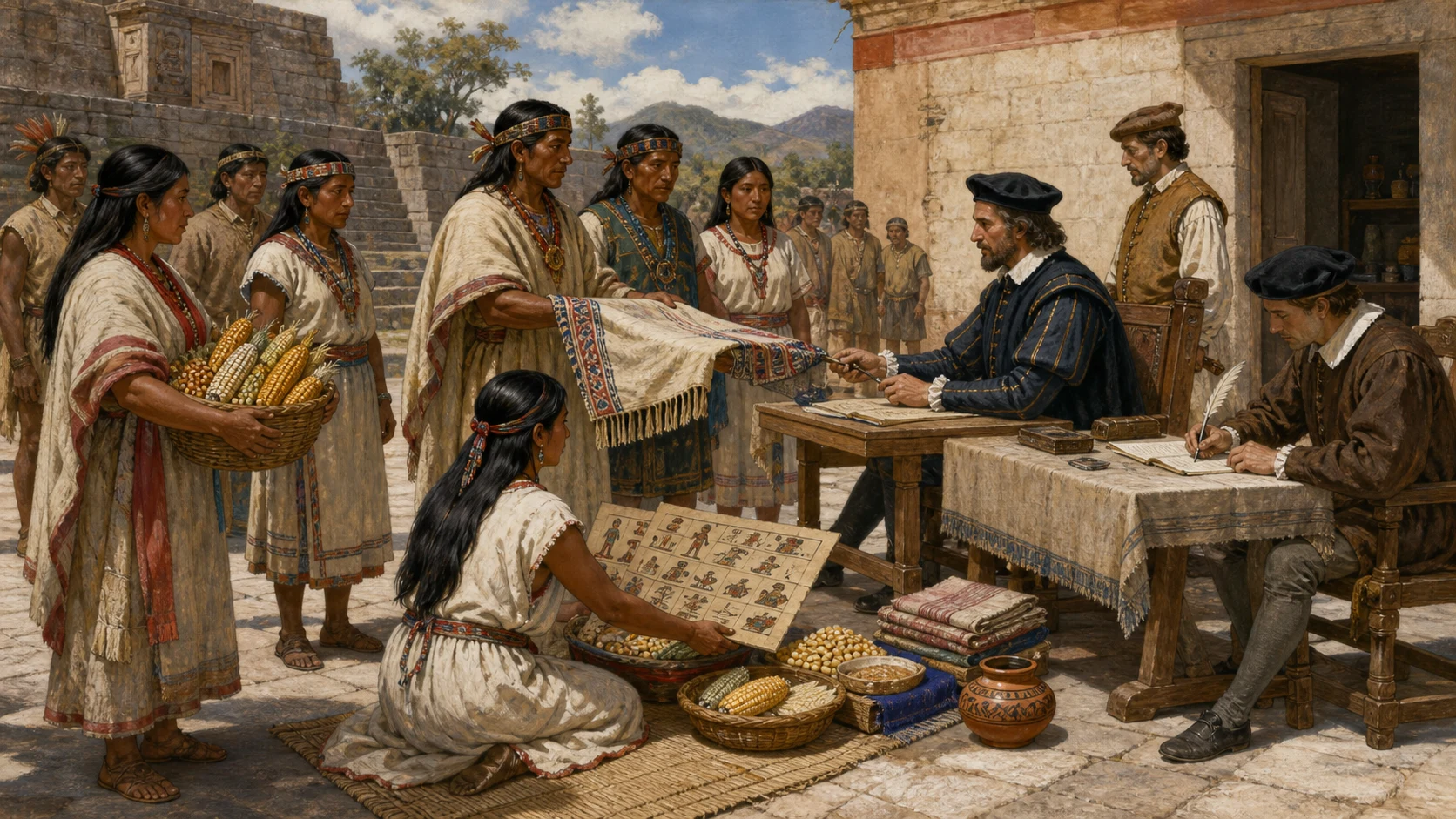
Under encomienda, the Crown entrusted an encomendero with the right to collect tribute or labor from a designated Indigenous community. The grantee was supposed to provide protection and Christian instruction. In practice, the system rewarded conquerors, concentrated local power, and exposed communities to extreme demands in mines, fields, transport, and construction. Indigenous people were not legally owned by the encomendero, but that distinction rarely protected them from coercion or violence.
The Spanish monarchy tried to limit private power through measures such as the Laws of Burgos (1512) and the New Laws (1542). Reform reflected religious criticism, reports of abuse, Indigenous petitions and lawsuits, and the Crown’s desire to prevent encomenderos from becoming an inherited aristocracy. Enforcement was uneven and colonial resistance was strong, so coercion continued even when a particular legal form was restricted.
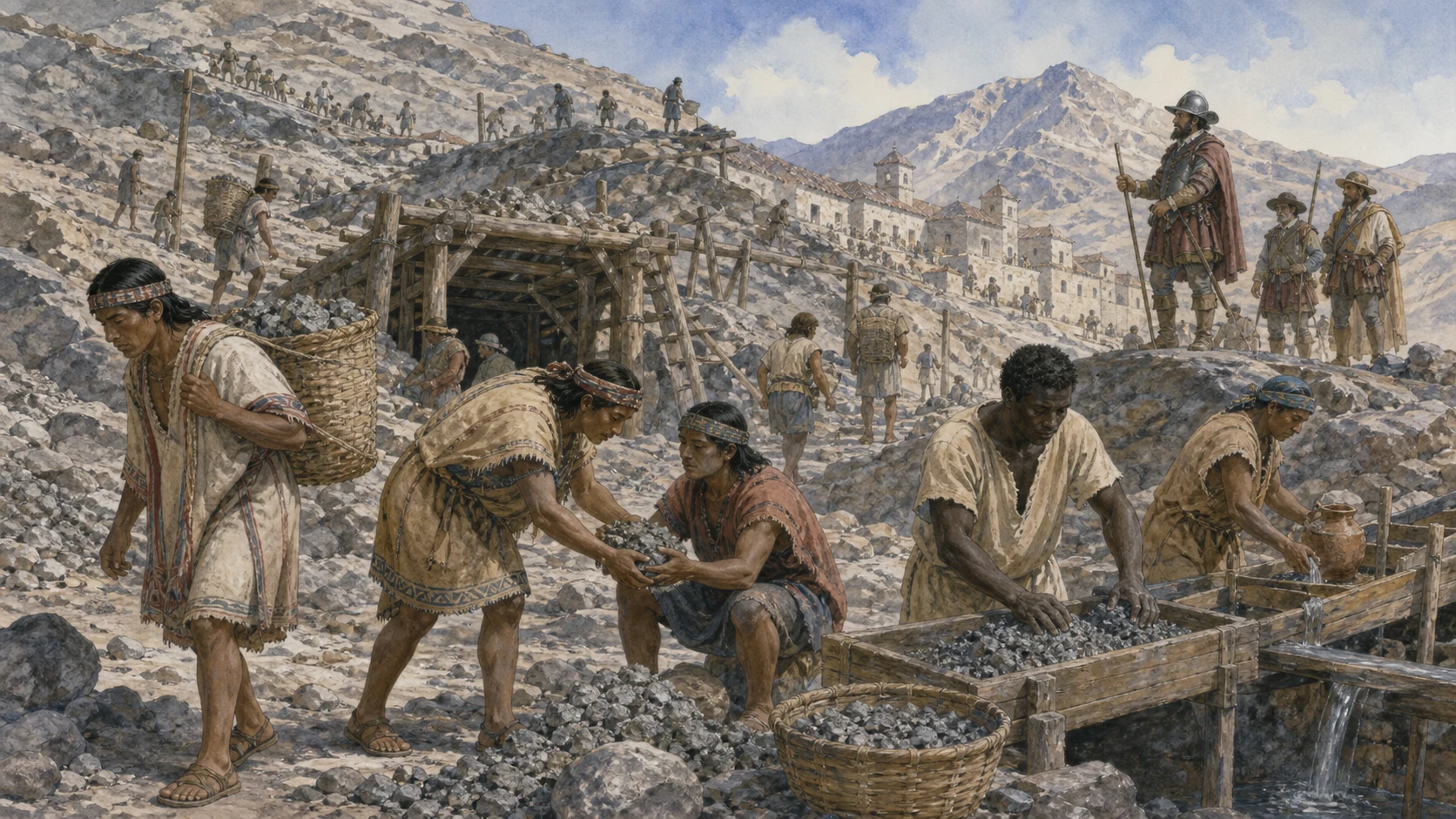
Repartimiento required Indigenous communities to provide workers for rotating, time-limited drafts administered by colonial officials. In the Andes, Spaniards adapted the Inca mita for silver mining. Draftees might receive wages on paper, yet compulsory selection, dangerous work, travel, and lost time in community agriculture made the system deeply coercive. The shift therefore changed who administered labor without ending extraction.
Atlantic labor 05
African chattel slavery expanded early and reached far beyond plantation fields
Spanish and Portuguese traders participated in an expanding Atlantic system that forcibly transported Africans to the Americas. European buyers worked with some African rulers and merchants involved in enslavement and sale, but European colonial demand enlarged the trade and converted captives and their descendants into permanent, inheritable property. The system devastated individuals, families, and communities in West and Central Africa.
Spanish colonists imported enslaved Africans for sugar plantations and mines, the two activities emphasized in the AP framework. Enslaved people also worked on ranches, docks, construction sites, ships, in households, and as artisans, vendors, interpreters, soldiers, or skilled laborers. Some Africans arrived free, and some enslaved people gained freedom through purchase, legal action, military service, escape, or manumission. These possibilities did not make slavery less violent; they show that Black life in Spanish America was varied and cannot be reduced to one occupation or status.
Indigenous population decline increased colonial demand for African labor, but Africans did not simply ‘replace’ Indigenous workers everywhere. Both populations labored simultaneously under different legal arrangements, sometimes at the same mine, estate, or town. Regional crops, available workers, transport networks, law, resistance, and capital shaped the particular mix.
Hereditary status
Chattel slavery generally made bondage permanent and passed enslaved status to descendants, distinguishing it from a rotating labor draft.
Atlantic scale
Forced migration joined African capture and sale, European shipping and finance, American labor demand, and the export of colonial commodities.
Skilled and urban work
Enslaved and free Africans contributed knowledge and labor in agriculture, mining, crafts, trade, navigation, military service, language, and domestic economies.
Resistance and community
Africans resisted through flight, rebellion, work slowdowns, negotiation, litigation, cultural preservation, kinship, religious practice, and the creation of free communities.
Social hierarchy 06
Caste classifications ranked a diverse society—but never described every life perfectly
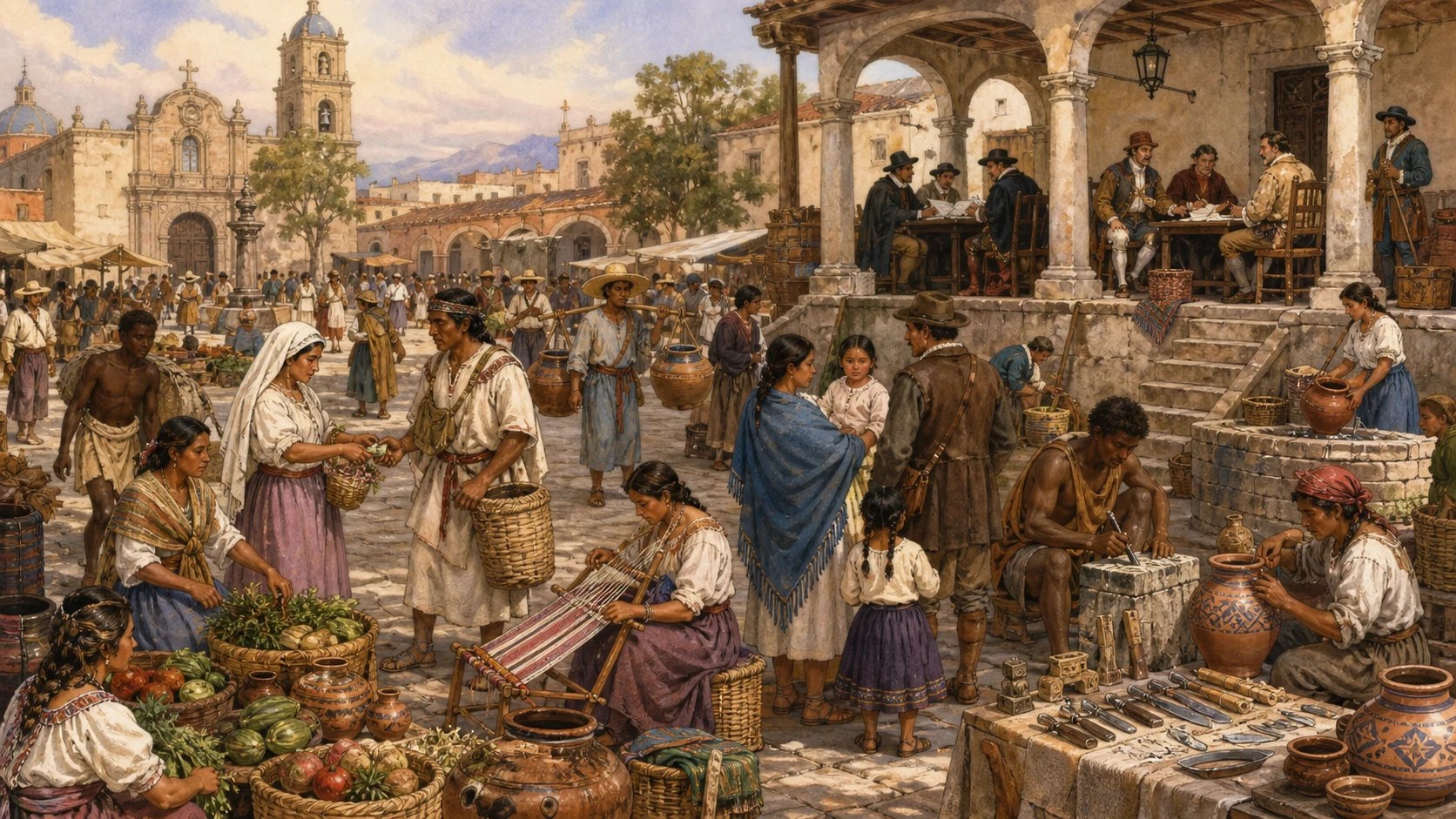
Spanish colonial society associated ancestry and birthplace with honor, taxation, occupation, legal treatment, and access to political or religious office. Peninsulares, people born on the Iberian Peninsula, generally claimed the highest official prestige. Criollos, American-born people of Spanish ancestry, could possess wealth and local influence but were often ranked below peninsulares. Indigenous and African ancestry was typically associated with heavier obligations and lower status.
Colonial records used terms such as mestizo for Spanish–Indigenous ancestry and mulato for African–European ancestry. Those are historical labels imposed within a discriminatory system; they should not be treated as neutral biological facts. Officials generated many additional casta terms as populations mixed, revealing an attempt to make social inequality appear orderly and inherited.
The hierarchy was powerful but not perfectly rigid. Classification could vary with appearance, documentation, wealth, occupation, reputation, gender, freedom, marriage, location, and the decisions of priests or officials. Individuals petitioned courts, changed communities, purchased status, formed families across categories, and sometimes gained economic or military authority. On frontiers with fewer Spanish settlers, practice could diverge from metropolitan rules. A precise answer therefore describes caste as an unequal organizing ideal with locally variable enforcement.
Peninsulares
Iberian-born Spaniards who commonly held the most prestigious imperial offices and claimed superior status based on birthplace.
Criollos
American-born people of Spanish ancestry who could be wealthy and influential yet faced preference for Iberian-born officials.
Indigenous communities
Legally treated as Crown vassals and corporate communities but subjected to tribute, labor drafts, mission demands, land pressure, and paternalistic regulation.
Africans and castas
Enslaved and free people of African or mixed ancestry occupied varied positions, but racialized classification exposed them to bondage, taxation, prejudice, and restricted opportunity.
Power and response 07
Crown law and Christian debate challenged abuses without dismantling colonial extraction
Spanish rulers and clergy debated the treatment and legal status of Indigenous peoples. Bartolomé de las Casas condemned conquest and encomienda abuses and argued that Indigenous people were free subjects capable of Christian conversion. The 1542 New Laws attempted to restrict Indigenous enslavement and prevent encomiendas from becoming permanently hereditary. Colonial opposition weakened implementation, and reform remained tied to the Crown’s goals of conversion, revenue, and centralized authority.
The Requerimiento of 1513 claimed to announce Spanish and Christian authority before conquest, even when read in Spanish to people who could not understand it. For AP source analysis, that contradiction exposes the distance between an empire’s legal-religious justification and the coercive conditions on the ground. A law can reveal official ideals without proving that those ideals were enforced.
Indigenous and African peoples were not merely acted upon. Communities preserved languages, agriculture, kinship, and worship; adapted colonial courts and Christianity to local purposes; petitioned against tribute; fled labor drafts or enslavement; negotiated with officials; and organized revolt. Agency does not erase the imbalance of power—it explains how people made consequential choices within it.
Exam method 08
Build answers through connections, comparison, and a qualified causal chain
For a Making Connections question, link economy and society explicitly: the pursuit of silver and plantation crops increased demand for controlled labor; labor systems concentrated wealth and power; and a caste hierarchy helped justify unequal rights and obligations. Use at least one named institution—encomienda, repartimiento, or chattel slavery—as evidence.
For comparison, establish a shared category before explaining difference. Encomienda and chattel slavery both extracted labor under coercion, but encomienda granted claims to Indigenous tribute while chattel slavery treated persons as inheritable property. Repartimiento and the colonial mita were state labor drafts that were officially limited, rotating, and paid, although workers could not freely refuse.
For causation, avoid a single-factor claim that epidemic disease ‘caused slavery.’ A stronger chain is that conquest and commercial extraction created labor demand; demographic catastrophe reduced and destabilized Indigenous communities; colonists expanded African slavery while continuing Indigenous drafts; and law plus caste classifications helped organize the resulting unequal society. Qualify the argument by noting regional variation and resistance.
High-yield review
Key developments
Encomienda redirected Indigenous tribute
Royal grants allowed colonists to demand tribute or labor from designated communities while claiming duties of protection and conversion.
Repartimiento preserved coerced drafts
Government-administered rotations replaced or supplemented private encomienda claims without making work genuinely voluntary.
African chattel slavery expanded
Spanish colonial demand for plantation and mining labor enlarged the forced Atlantic transportation and hereditary enslavement of Africans.
Silver and crops connected local labor to empire
Workers produced minerals, food, sugar, textiles, and transport that supported cities, royal revenue, and intercontinental commerce.
Caste hierarchy ranked colonial populations
Birthplace, ancestry, legal status, and honor shaped taxation, work, officeholding, and everyday treatment in a diverse society.
Law, resistance, and local conditions complicated control
Royal reforms, religious debate, Indigenous petitions, African resistance, mixed families, and frontier needs prevented the system from operating uniformly.
Chronological reasoning
Timeline — key moments
Colonization of Hispaniola intensifies
Columbus’s second voyage brought settlers, animals, and plans for permanent colonization; Spanish tribute and labor demands on Taíno communities expanded.
Enslaved Africans arrive in Hispaniola
Early authorized transport placed Africans in Spanish Caribbean society, beginning a forced migration that would grow with colonial labor demand.
Laws of Burgos issued
The Crown attempted to regulate Indigenous labor and conversion while formally embedding encomienda within colonial rule.
Requerimiento promulgated
Spanish expeditions used a legal-religious declaration to demand submission, exposing how imperial ideology attempted to justify conquest and labor control.
Conquest of the Mexica Empire
Spanish-led coalition victory opened central Mexico’s tribute networks, lands, and labor to colonial redirection.
Huejotzingo community records tribute abuses
The Huejotzingo Codex documented goods and services demanded by colonial officials and supported an Indigenous legal complaint.
New Laws restrict encomienda abuses
Charles V sought to curb Indigenous enslavement and hereditary encomiendas, though colonial resistance weakened enforcement.
Potosí silver discovered
The Andean mining center became a major site of global silver production supported by coerced Indigenous drafts and other labor.
Valladolid debate
Spanish theologians and officials debated conquest and Indigenous status, showing that moral criticism existed within an empire that continued extracting labor and wealth.
Spanish colony established in New Mexico
Juan de Oñate’s expedition extended Spanish settlement, tribute, missionization, and labor demands into Pueblo homelands before Period 1 ended.
Remember these
Vocabulary
- Encomienda
- A Crown grant permitting a colonist to collect Indigenous tribute or labor while claiming duties of protection and Christian instruction; it did not legally transfer ownership of people or land.
- Encomendero
- The holder of an encomienda who benefited from the tribute or labor obligations assigned by the Crown.
- Repartimiento
- A government-administered system requiring Indigenous communities to supply rotating groups of supposedly paid, time-limited workers.
- Mita
- An Inca labor obligation that Spanish colonial officials adapted into a coercive draft, especially for Andean silver mining.
- Tribute
- Goods, money, or labor required from a subject community as an acknowledgment of authority and a source of colonial revenue.
- Coerced labor
- Work obtained through law, force, threat, captivity, debt, or conditions that prevent meaningful refusal.
- Chattel slavery
- A system that legally treated human beings as transferable property, usually for life, and made enslaved status inheritable.
- Transatlantic slave trade
- The commercial network that forcibly transported enslaved Africans across the Atlantic and connected African capture, European shipping, and American labor demand.
- Plantation
- A large agricultural enterprise producing market or export crops through a concentrated and tightly controlled labor force.
- Potosí
- A major silver-mining center in the Andes whose colonial production relied heavily on coerced Indigenous labor and entered global trade.
- Casta system
- A Spanish colonial framework that ranked people through ancestry and status categories, shaping privilege and obligation while varying by time and place.
- Peninsular
- A Spaniard born on the Iberian Peninsula, generally associated with the highest prestige and preferred access to imperial office.
- Criollo / Creole
- In Spanish America, a person of Spanish ancestry born in the Americas; criollos could be wealthy but were often ranked below Iberian-born peninsulares.
- Mestizo
- A colonial classification usually applied to a person of combined Spanish and Indigenous ancestry.
- Mulato
- A historical colonial label usually applied to a person of African and European ancestry; the term is now outdated or offensive in many contexts and should be used analytically, not as a present-day identity.
- Limpieza de sangre
- The Iberian idea of ‘purity of blood,’ originally tied to Christian ancestry, that influenced claims to honor and exclusion in Spanish colonial society.
- New Laws of 1542
- Royal measures intended to restrict Indigenous enslavement and encomienda inheritance while increasing Crown control over colonial rule.
- Manumission
- The legal release of an enslaved person from bondage, sometimes obtained through purchase, an owner’s decision, service, or court action.
Clear the confusion
Frequently asked questions
20 detailed answers to the questions students most often carry into Topic 1.5.
01What is the main idea of APUSH Topic 1.5?
Spanish imperial growth produced connected economic and social structures. Encomienda and repartimiento mobilized Indigenous tribute and labor; colonists imported enslaved Africans for plantation agriculture, mining, and other work; and caste categories ranked Europeans, Africans, Indigenous people, and their descendants. The exam skill is to explain connections among those developments.
02Why did Spanish colonists need so much labor?
Colonists sought silver, gold, sugar, food, textiles, livestock products, buildings, transport, and household service. Mines and plantations were especially labor-intensive, while towns, missions, ranches, and ports required continuous work. Imperial profit therefore depended on controlling workers and directing community surpluses toward colonial markets and taxes.
03What exactly was the encomienda system?
Encomienda was a royal grant allowing an encomendero to collect tribute or labor from a designated Indigenous community. The grantee was supposed to protect and Christianize the people entrusted to him. It was not legally a grant of land or ownership of people, but in practice it concentrated coercive power and enabled grave exploitation.
04Was encomienda the same as slavery?
No, although both extracted labor through coercion. Encomienda claimed rights to Indigenous tribute or labor while the Crown legally treated Indigenous people as free vassals. Chattel slavery treated enslaved persons as transferable property, generally for life, and made status inheritable. A strong comparison states both the shared coercion and the legal difference.
05How did repartimiento differ from encomienda?
Encomienda placed a tribute or labor claim in the hands of a private grantee. Repartimiento was a government-administered draft that rotated workers for limited periods and nominal wages. Because communities had to supply workers and individuals could not meaningfully refuse, repartimiento remained coerced labor even though its administration and legal language differed.
06What was the colonial mita?
The Inca state had required communities to contribute labor for public purposes. Spanish officials adapted that institution into a colonial draft, especially at Potosí. Communities had to send rotating workers into dangerous mines and processing work, redirecting an existing Andean obligation toward Spanish silver extraction and global commerce.
07Why did African slavery expand in Spanish America?
Colonial mines, plantations, towns, and ports created sustained labor demand while epidemic disease and exploitation devastated Indigenous populations. European merchants also had access to Atlantic trading networks that trafficked African captives. These forces expanded African slavery, but did not eliminate Indigenous labor drafts; multiple systems operated at the same time.
08Who participated in the transatlantic slave trade?
European traders, shipowners, financiers, and colonial buyers worked with some African rulers and merchants who captured or sold people through wars, raids, punishment, or debt. European plantation and mining demand dramatically enlarged the trade and transformed captives and descendants into hereditary property. Responsibility should be explained without treating Africa as a single society or minimizing European colonial demand.
09Did Africans in Spanish America work only on plantations?
No. Plantation agriculture and mining are the College Board’s required examples, but enslaved and free Africans also worked on ranches, docks, ships, construction, in households, markets, workshops, skilled trades, interpretation, and military service. Occupation and legal status varied by region, sex, skill, and local need.
10What makes chattel slavery distinct?
Chattel slavery treated a person as property that could be bought, sold, inherited, or mortgaged. Bondage was ordinarily lifelong, and colonial law made enslaved status descend to children. That permanence and inheritability distinguish chattel slavery from temporary labor drafts, even when those drafts were also violent and coercive.
11What was the Spanish colonial caste system?
It was a ranked framework that associated ancestry, birthplace, freedom, and honor with different rights and obligations. Peninsulares generally claimed the highest official prestige; criollos could hold wealth but ranked below them; and Indigenous or African ancestry was associated with heavier burdens and discrimination. Numerous casta terms attempted to classify mixed-ancestry populations.
12Was the caste hierarchy completely rigid?
No. The hierarchy shaped law, taxes, occupation, marriage, reputation, and officeholding, but classification could change or be disputed. Wealth, appearance, documentation, gender, freedom, military service, location, and an official’s judgment mattered. Frontier labor needs also bent formal rules. Describe it as powerful and unequal, not perfectly fixed.
13What is the difference between a peninsular and a criollo?
A peninsular was born in Spain or elsewhere on the Iberian Peninsula; a criollo was of Spanish ancestry but born in the Americas. Both could possess privilege, yet the Crown often preferred peninsulares for top imperial offices. This birthplace distinction later contributed to criollo resentment, though that later independence context lies beyond Period 1.
14How should I use the terms mestizo and mulato?
Use them as historical categories created within Spanish colonial society, not as timeless biological facts. Mestizo usually referred to Spanish–Indigenous ancestry; mulato usually referred to African–European ancestry. Definitions and treatment varied, and ‘mulato’ is outdated or offensive in many present-day contexts, so it belongs only in careful historical analysis.
15Besides ancestry, what affected a person’s status?
Birthplace, legal freedom, wealth, land, occupation, gender, marriage, religious reputation, language, clothing, community membership, and relationships with officials could all matter. Enslavement was a decisive legal condition. These intersections explain why two people assigned the same casta label might have different opportunities and why classifications could be contested.
16Did the Spanish Crown and Church oppose colonial abuse?
Some clergy and officials condemned abuses, and the Crown issued reforms such as the Laws of Burgos and New Laws. Motives included Christian ethics, Indigenous advocacy, and the monarchy’s desire to restrain powerful colonists. Enforcement was inconsistent, colonial resistance was strong, and reform preserved imperial conversion, revenue, and labor goals rather than ending colonial domination.
17Why are Bartolomé de las Casas and the Valladolid debate important?
Las Casas publicized violence against Indigenous peoples and argued that they were free, rational subjects who should be converted peacefully. The 1550–1551 Valladolid debate examined the morality of conquest and Indigenous status. It reveals real disagreement within Spain, but it did not halt colonization, tribute, or coerced labor.
18How did Indigenous and African people resist these systems?
Resistance included revolt, flight, work slowdowns, hiding production, negotiation, petitions, lawsuits, alliance building, cultural preservation, religious adaptation, and forming autonomous communities. Some people used colonial courts or military service strategically. Naming these actions demonstrates agency without denying the severe limits created by violence and law.
19How can I compare the labor systems in an APUSH answer?
Choose the same categories for each system: who supplied labor, who administered it, duration, payment, inherited status, economic use, and ability to refuse. Then state one similarity and one difference. For example, encomienda and chattel slavery were coercive, but only chattel slavery legally made persons and their descendants property.
20How can Topic 1.5 appear on an SAQ, DBQ, or LEQ?
An SAQ may ask you to explain a connection between Spanish extraction and caste or compare encomienda with slavery. A DBQ may provide tribute records, laws, religious criticism, or casta images for sourcing. An LEQ may ask how empire shaped social and economic structures. Build a causal chain and qualify it with reform, resistance, or regional variation.
Use the knowledge
AP exam connections
- 1
Connect economic extraction to social hierarchy: labor produced wealth, wealth concentrated authority, and caste helped assign unequal rights and obligations.
- 2
Compare encomienda, repartimiento, and chattel slavery using control, duration, payment, inherited status, and ability to refuse.
- 3
Use a multi-causal chain for African slavery: colonial labor demand, demographic catastrophe, Atlantic trade networks, law, and regional economies all mattered.
- 4
Source colonial laws critically: explain what a law reveals about official goals, then avoid assuming that the rule was enforced uniformly.
- 5
Qualify broad claims with Indigenous and African agency, local variation, free Black life, mixed labor systems, and the gap between caste ideals and lived society.
Editorial trust
Sources and review
These notes are original OnlyPrepy content. The syllabus scope and historical framing were checked against the following authoritative sources on August 15, 2026.
- AP U.S. History Course and Exam Description, Effective Fall 2026College Board
- Europe Claims America: The Atlantic JoinedLibrary of Congress
- Beginnings: African Immigration and RelocationLibrary of Congress
- Bartolomé de las Casas Statement of Opinion, 1542Library of Congress
- Traditional Groups along El Camino Real de Tierra AdentroU.S. National Park Service