The big picture
Examine how divergent ideas about religion, land, family, gender, and power produced misunderstanding, selective cultural exchange, diplomacy, resistance, and debate.
Exam focus 01
Topic 1.6 is about how contact changed perspectives, strategies, and cultures
The College Board asks you to explain how and why European and Native American perspectives of one another developed and changed from 1491 to 1607. The required content centers on divergent worldviews about religion, gender roles, family, land use, and power; early misunderstandings and selective cultural adoption; Indigenous diplomacy and military resistance; and European debates about how Native Americans and Africans should be treated.
Contact was neither a single meeting nor a simple story of European influence. Native nations made decisions based on their own interests, rivalries, spiritual beliefs, and political traditions. Africans arrived both free and enslaved and shaped exploration, labor, defense, language, religion, foodways, and family life. Europeans also disagreed among themselves. The result was conflict, exchange, accommodation, racialization, and new blended practices developing at the same time.
Encounter 02
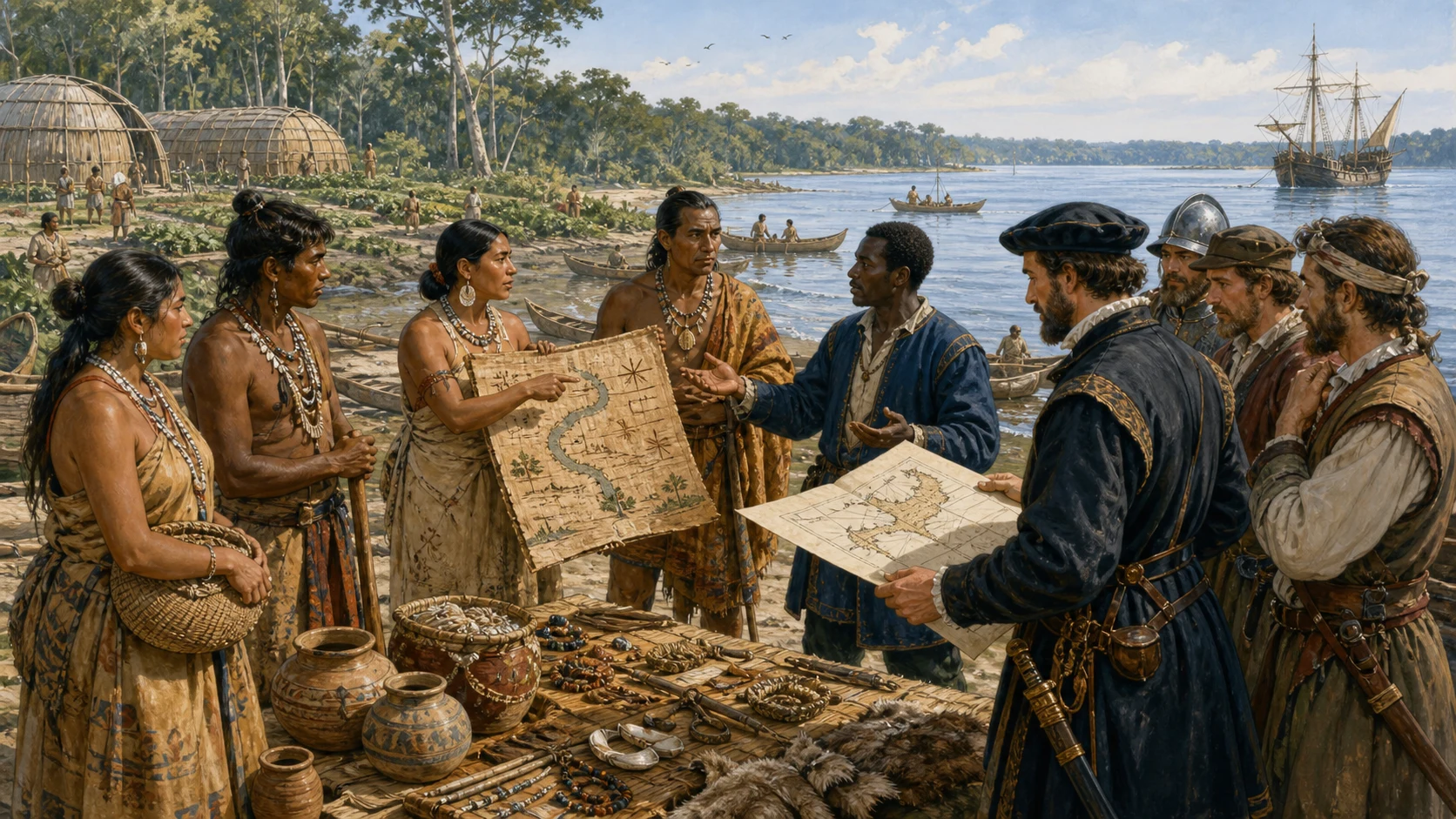
Mutual misunderstanding grew from different languages, expectations, and political systems
European newcomers entered territories governed by existing Indigenous nations, confederacies, towns, kinship networks, and diplomatic protocols. Europeans often mistook seasonal mobility for an absence of ownership, village hospitality for submission, or agreements with one leader as control over an entire region. Indigenous peoples likewise had to interpret unfamiliar ships, animals, weapons, religious claims, written documents, and demands from small expeditionary groups whose real power was not immediately clear.
Neither side observed the other neutrally. Interpreters, previous experience, rumors, trade goods, warfare, and strategic needs shaped perception. A Native nation might welcome an alliance to gain an advantage against a rival without accepting European sovereignty. A European commander might describe an exchange as tribute or submission even when Indigenous participants understood it as reciprocal diplomacy.
Misunderstanding did not prevent learning. Native communities evaluated metal tools, weapons, horses, textiles, crops, and Christian ideas, adopting what served local goals. Europeans relied on Indigenous geographic knowledge, food, medicine, canoe technology, agriculture, diplomacy, and alliances. Africans with multiple languages and Atlantic experience sometimes served as interpreters, scouts, sailors, soldiers, artisans, or intermediaries.
Language
Translation depended on multilingual intermediaries, gestures, repeated contact, and chains of interpreters that could alter meaning.
Diplomatic protocol
Gifts, ceremonies, hostages, feasts, and alliances carried different expectations about reciprocity, obligation, and authority.
Written claims
European maps, papal decrees, and proclamations asserted authority that Indigenous nations neither created nor necessarily recognized.
Strategic learning
Each group gathered information about allies, rivals, trade routes, resources, technology, and military capacity before choosing cooperation or resistance.
Comparison 03
Divergent worldviews made ordinary exchanges politically consequential
The comparison below describes broad patterns, not universal rules. Europe contained competing kingdoms, churches, classes, and local customs; Indigenous North America contained hundreds of distinct nations. Use specific nations and encounters whenever a prompt provides them, and treat these patterns as starting points for explanation rather than fixed cultural traits.
The AP exam rewards the consequence of a difference. Do not stop at ‘Europeans believed X and Native Americans believed Y.’ Explain how the contrast shaped a treaty, mission, trade relationship, dispute over land, change in gender authority, diplomatic alliance, or act of resistance.
| Dimension | Common European imperial assumptions | Examples among Indigenous societies | Why conflict or misunderstanding developed | Adaptation or response |
|---|---|---|---|---|
| Religion | Christianity was exclusive truth; monarchs and missionaries linked conversion to imperial authority | Spiritual life was diverse and often connected community, ancestors, diplomacy, and particular homelands | Europeans could label Native ceremonies as idolatry, while missions threatened religious authority and practice | Conversion, refusal, hidden practice, selective adoption, and syncretic worship all occurred |
| Land use | Written title, fixed boundaries, improvement, and Crown grants supported exclusive possession | Many nations held territory collectively while families or groups possessed recognized rights to use particular fields, hunting areas, or resources | Europeans often interpreted mobility or shared use as vacancy and treated agreements as permanent land transfers | Communities negotiated access, moved, defended territory, petitioned, or redefined settlement and resource use |
| Gender and family | Patriarchal Christian law emphasized male household authority, monogamy, and patrilineal property | Systems varied; some nations were matrilineal, women controlled agriculture or property, and clan ties structured politics and diplomacy | Missionaries and officials tried to reorganize marriage, labor, inheritance, and authority around European norms | Families preserved, concealed, adjusted, or combined practices; women used kinship and trade roles strategically |
| Power and sovereignty | Monarchies claimed territory through discovery, conquest, Christianity, and agreements with selected leaders | Authority was distributed differently among councils, clans, towns, confederacies, chiefs, and consensus systems | Europeans could mistake a negotiator for a monarch with power to surrender land for everyone | Native nations formed alliances, played empires against one another, limited access, rejected claims, or fought |
| Trade and reciprocity | Merchants sought profit, monopoly, tribute, and reliable commodity flows under imperial regulation | Exchange often carried diplomatic, social, spiritual, and reciprocal obligations as well as material value | Each side could interpret gifts, prices, dependency, and exclusivity through different expectations | Repeated bargaining created new trade protocols, hybrid goods, intermediaries, and shifting alliances |
Religion and culture 04
Missions pursued conversion and colonial order, while communities reshaped Christianity
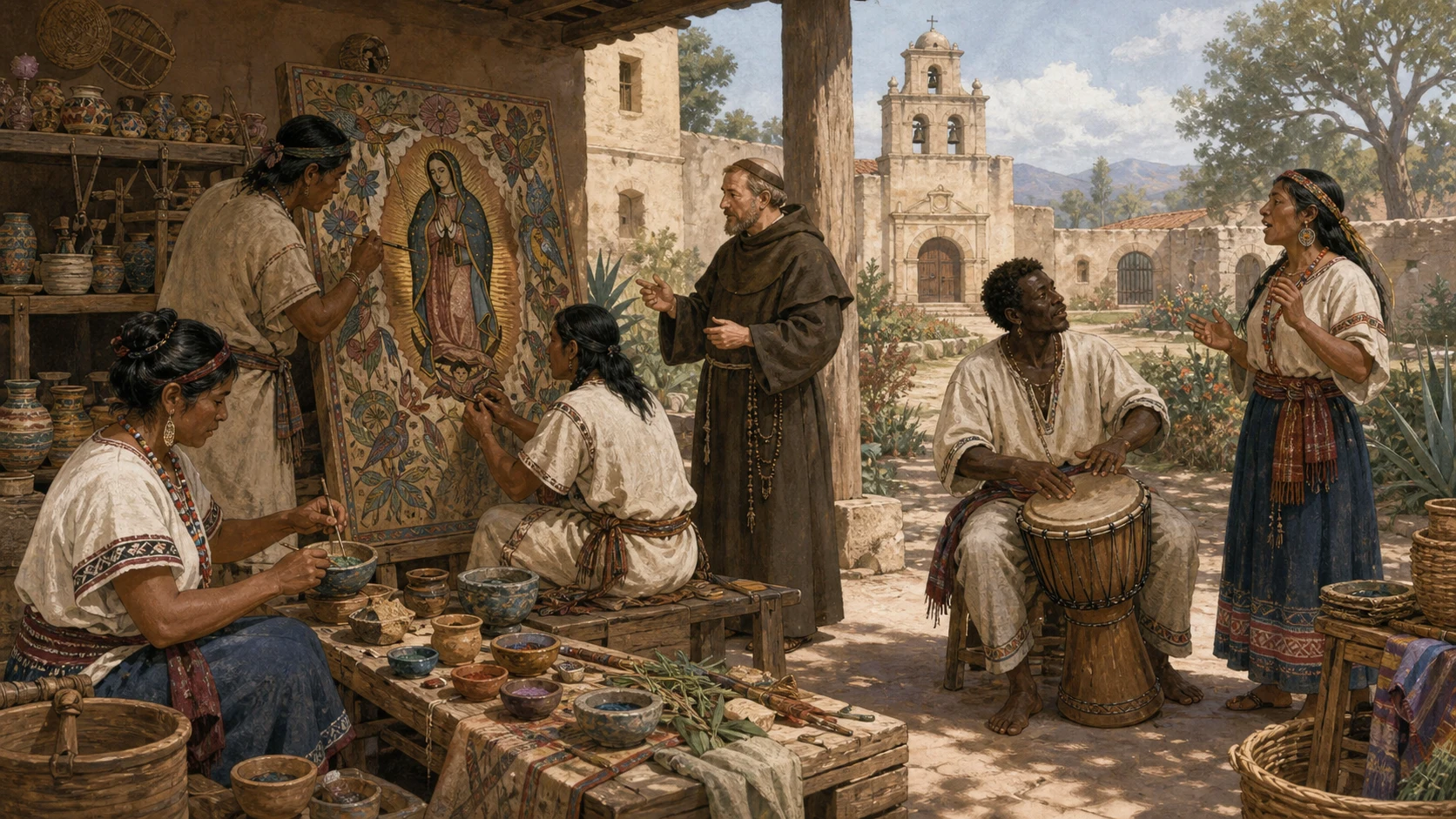
Spanish missionaries generally believed Christianity was universally true and conversion would save souls. Missions were therefore religious institutions, but they also supported imperial settlement, labor, food production, language instruction, surveillance, and defense. Baptism could bring a person under new expectations about residence, work, marriage, gender, worship, and obedience to Church and Crown.
Conversion did not have one meaning. Some people rejected missionaries; some entered missions for food, security, trade, political alliance, or genuine religious interest; and some adopted Christian figures or rituals while maintaining Indigenous understandings. Communities could attend Mass and continue ceremonies outside missionary control. This selective reinterpretation produced syncretism—new cultural forms created from multiple traditions—without proving that the colonial relationship was equal or voluntary.
African Christianity, Islam, and diverse West and Central African spiritual traditions also entered the Americas. Enslaved and free Africans formed kinship and religious networks, contributed music, foodways, language, healing knowledge, craft practices, and military traditions, and adapted Catholic sacraments or brotherhoods to build community. Cultural creation continued despite enslavement and racial prejudice.
Mission goal
Create Christian subjects whose settlement, labor, and loyalty supported both Church and imperial government.
Indigenous choices
Refusal, strategic participation, flight, hidden ceremony, selective conversion, and reinterpretation existed along a spectrum.
African contributions
Free and enslaved Africans carried knowledge and practices that shaped worship, music, language, food, crafts, defense, and family life.
Syncretic result
New traditions developed through unequal contact, but they cannot be reduced to either pure survival or complete assimilation.
Worldviews 05
Land, gender, family, and power were connected—not separate cultural details
Land disputes involved more than property law. A homeland could sustain sacred places, ancestors, clan identity, hunting, farming, water access, and diplomatic relationships. European colonists increasingly used written deeds, fences, livestock, farms, mines, missions, and Crown grants to make exclusive claims. When colonists damaged fields, restricted access, or demanded labor, they threatened economic survival and political sovereignty together.
European observers frequently judged Indigenous gender systems by Christian patriarchal standards. In several agricultural and matrilineal societies, women controlled crops, households, property, clan identity, or the selection of leaders. Missionaries and officials sought to impose male household authority, monogamous marriage, European work divisions, and new sexual rules. These changes could weaken established sources of women’s authority, though effects differed by nation and circumstance.
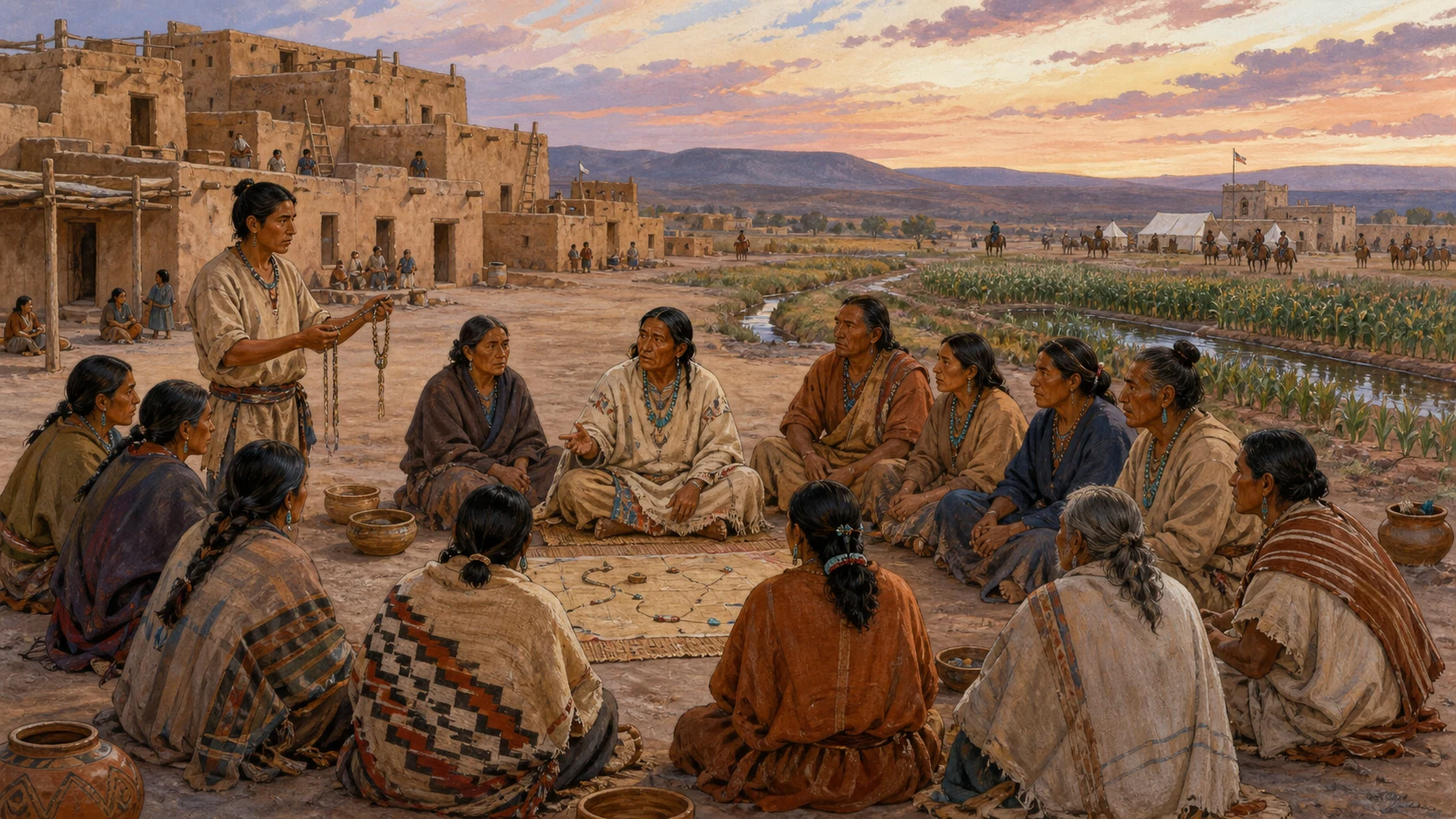
Family and kinship also shaped diplomacy. Adoption, marriage, clan membership, and fictive kinship could turn outsiders into relatives with reciprocal obligations. Europeans who viewed treaties mainly as transactions could miss those relationships. Native women, interpreters, traders, and mixed families often became crucial cultural brokers who connected communities while facing risks from both colonial and local power struggles.
Agency 06
Native nations defended sovereignty through diplomacy and military resistance
Indigenous response was strategic rather than automatically friendly or hostile. Nations negotiated trade, requested or rejected missionaries, formed alliances with Europeans against Indigenous rivals, relocated communities, controlled information, adopted useful technology, and played competing empires against one another. These actions could preserve autonomy even as disease and colonial expansion narrowed available choices.
Resistance intensified when Europeans encroached on land, attacked religious practice, imposed tribute, demanded labor, or disrupted political authority and gender relations. Resistance ranged from refusal, flight, concealment, and sabotage to coordinated warfare. Taíno resistance in the Caribbean, the Mixtón War in northern New Spain, Maya uprisings, and Pueblo opposition demonstrate that conquest was repeatedly contested rather than completed in one moment.
Military resistance sometimes failed because of epidemic loss, internal division, European–Indigenous alliances, supply constraints, or superior access to particular weapons. Failure does not make the effort insignificant. Resistance changed colonial policies, raised the cost of settlement, preserved communities, and sometimes delayed or removed European control for years.
Diplomacy
Treaties, councils, gift exchange, interpreters, marriage ties, and controlled trade could limit conflict or extract advantages.
Alliance
Native nations used Europeans within existing rivalries, while Europeans relied on Indigenous military power and logistics.
Everyday resistance
Flight, work refusal, hidden worship, petitions, selective compliance, and the protection of knowledge challenged colonial demands.
Armed resistance
Rebellions defended territory, political sovereignty, economic production, religious practice, and community authority.
Atlantic society 07
Africans were cultural and political actors as Europeans developed racial justifications for bondage
Africans participated in the earliest Spanish expeditions and settlements as sailors, soldiers, servants, interpreters, artisans, scouts, and enslaved laborers. Free and enslaved Africans were present in St. Augustine from its founding in 1565. Their varied statuses complicate any claim that every African experience was identical, while the expansion of hereditary slavery made forced labor and family separation central realities for a growing number of people.
African, Indigenous, and European people worked, traded, worshiped, fought, formed families, and exchanged knowledge in colonial towns and borderlands. Individuals of African descent could use language, military service, Catholic institutions, law, craft skill, or community networks to gain influence or freedom. Those possibilities existed inside a society that increasingly associated African ancestry with enslavement and lower status.
Extended contact produced competing European arguments. Some religious thinkers emphasized the shared humanity and capacity for Christian conversion of Native Americans and Africans. Others used religious difference, claims of cultural superiority, warfare, and increasingly racial ideas to justify conquest and bondage. Racialization was historical: Europeans constructed categories and arguments over time to defend unequal power; they did not discover objective biological hierarchies.
Exam method 08
Analyze claims and evidence by separating a source’s argument from historical reality
Bartolomé de las Casas condemned Spanish brutality and argued that Indigenous people were rational, free subjects capable of peaceful Christian conversion. Juan Ginés de Sepúlveda defended conquest by portraying Indigenous societies as inferior and warfare as just. The Valladolid debate of 1550–1551 placed these positions in direct conflict. Neither author represented an Indigenous voice, and the debate did not end conquest, forced labor, or cultural suppression.
For AP Skill 3.B, identify the author’s claim, then name the specific evidence used to support it. Las Casas might describe killings or exploitation as evidence that Spanish conduct was unchristian. Sepúlveda might point to Spanish interpretations of Indigenous warfare or religion as evidence for intervention. Evidence is not automatically reliable simply because the author presents it; consider audience, purpose, position, language, and what the source omits.
A complete source analysis distinguishes perspective from outcome. The New Laws of 1542 reveal that criticism influenced Crown policy and that the monarchy wanted to limit colonists’ power. Uneven enforcement, continuing labor drafts, and colonial resistance show that the law did not end exploitation. Pairing claim, evidence, and outside context produces a stronger SAQ or DBQ paragraph.
High-yield review
Key developments
Divergent worldviews shaped contact
Different assumptions about religion, land, gender, family, reciprocity, and authority gave the same encounter different meanings.
Selective adoption moved in multiple directions
Native peoples, Europeans, and Africans evaluated and adapted technologies, foods, languages, diplomatic practices, and religious forms.
Missions combined conversion and empire
Religious instruction operated alongside settlement, labor, food production, surveillance, and efforts to reorganize family and community life.
Native nations defended sovereignty
Diplomacy, alliance, trade control, relocation, selective compliance, and military resistance protected land, prosperity, religion, and authority.
Africans shaped emerging societies
Free and enslaved Africans contributed language, labor, military service, faith, skill, kinship, foodways, and resistance across Spanish America.
European debate coexisted with racialization
Humanitarian and religious criticism influenced reform while competing cultural, religious, and racial arguments justified conquest and bondage.
Chronological reasoning
Timeline — key moments
Sustained Atlantic encounters begin
Columbus’s voyage initiated continuing contact that forced Europeans, Native Americans, and Africans into new relationships of exchange, interpretation, conquest, and migration.
Taíno resistance and Spanish criticism intensify
Taíno communities resisted colonial labor demands while Dominican friar Antonio de Montesinos publicly condemned Spanish treatment of Indigenous people on Hispaniola.
Requerimiento formalizes an imperial claim
Spanish expeditions used a declaration demanding acceptance of Church and Crown authority, often in a language the intended audience could not understand.
Franciscan mission campaign expands in Mexico
The group remembered as the Twelve Apostles of Mexico began an organized effort to convert Indigenous communities and reshape religious practice.
Sublimis Deus affirms Indigenous humanity
Pope Paul III declared that Indigenous people were rational and capable of Christian faith, illustrating debate within European Christianity over conquest and enslavement.
Mixtón War challenges Spanish expansion
Caxcan and allied peoples resisted Spanish settlement, labor demands, and mission pressure in northern New Spain before a Spanish–Indigenous coalition suppressed the revolt.
Las Casas writes and the New Laws are issued
Las Casas condemned colonial violence, while royal legislation attempted to limit Indigenous enslavement and encomienda power without ending empire.
Valladolid debate
Las Casas and Sepúlveda advanced opposing arguments about conquest and Indigenous status before Spanish theologians and officials.
St. Augustine founded
Spanish colonists, including both free and enslaved Africans, established a lasting settlement in Florida amid Native homelands and regional diplomacy.
Spanish colonization enters Pueblo homelands
Oñate’s expedition imposed settlement, missions, tribute, and labor demands in New Mexico, intensifying Indigenous negotiation and resistance before Period 1 ended.
Remember these
Vocabulary
- Worldview
- A society’s connected assumptions about reality, belief, authority, community, land, morality, and proper social relationships.
- Cultural exchange
- The movement and reinterpretation of ideas, practices, technologies, languages, foods, and beliefs through contact among peoples.
- Selective adoption
- The deliberate choice to use some outside practices or technologies while rejecting, modifying, or limiting others.
- Acculturation
- Cultural change caused by sustained contact, often within unequal relationships; it does not necessarily mean complete assimilation.
- Syncretism
- The creation of a new practice or belief through the combination and reinterpretation of elements from different traditions.
- Mission
- A religious institution created to convert and instruct a population that could also support colonial settlement, labor, production, and political control.
- Conversion
- Adoption of a new religious identity or belief system; motives and depth of practice could range from sincere conviction to strategic or coerced participation.
- Sovereignty
- A people’s authority to govern themselves, control territory, conduct diplomacy, and make political decisions.
- Diplomacy
- Negotiation among political communities through councils, messengers, interpreters, treaties, gifts, kinship, and other formal practices.
- Alliance
- A strategic agreement to cooperate for military, diplomatic, or economic purposes; alliances did not require identical long-term goals.
- Resistance
- Actions that challenge control, including negotiation, refusal, concealment, flight, petition, sabotage, cultural preservation, and armed revolt.
- Matrilineal
- A kinship system in which clan identity, inheritance, or descent is traced through the mother’s line; political and property consequences varied by nation.
- Reciprocity
- An expectation that gifts, assistance, trade, or obligations will be returned and will maintain an ongoing social or political relationship.
- Doctrine of Discovery
- European Christian legal-religious ideas used to justify claims over lands governed by non-Christian peoples; Indigenous nations did not create or consent to the doctrine.
- Requerimiento
- A 1513 Spanish declaration that demanded Indigenous submission to Christianity and the Crown and threatened war for refusal.
- Bartolomé de las Casas
- A Dominican friar who condemned Spanish violence and argued that Indigenous people were free, rational subjects capable of peaceful conversion.
- Juan Ginés de Sepúlveda
- A Spanish scholar who defended conquest by portraying Indigenous peoples as culturally inferior and warfare against them as just.
- Racialization
- The historical process of assigning social meaning and unequal rights to perceived human differences, increasingly linking ancestry to bondage and status.
Clear the confusion
Frequently asked questions
20 detailed answers to the questions students most often carry into Topic 1.6.
01What is the main idea of APUSH Topic 1.6?
Sustained contact brought Europeans, Native Americans, and Africans into unequal but dynamic relationships. Divergent worldviews created misunderstanding and conflict; people selectively adopted useful practices; Native nations defended sovereignty through diplomacy and resistance; Africans shaped colonial cultures; and Europeans developed competing arguments about the humanity, conversion, conquest, and subjugation of non-Europeans.
02What does ‘divergent worldviews’ mean in this topic?
It means that societies brought different connected assumptions about religion, land, gender, family, reciprocity, and political authority. The term matters only when linked to an outcome. For example, different understandings of land use could cause Europeans to treat seasonally used territory as vacant and Native nations to view settlement as encroachment.
03Did all Europeans share one worldview?
No. Spaniards, French, Dutch, and English people pursued different colonial strategies, and merchants, missionaries, soldiers, settlers, and monarchs often disagreed. Catholic and Protestant traditions differed, and figures such as Las Casas challenged colonial brutality. Use ‘many European imperial authorities’ rather than claiming total uniformity.
04Did all Native American societies share the same beliefs?
No. Hundreds of nations had distinct languages, religions, economies, gender systems, governments, and diplomatic traditions. Some were matrilineal and others were not; land and leadership worked differently across regions. Broad comparisons must be qualified and replaced with a named nation whenever the evidence permits.
05How did religious differences shape interaction?
Many Europeans treated Christianity as exclusive truth and conversion as part of imperial responsibility. Native spiritual systems connected communities to ancestors, places, subsistence, and political authority in varied ways. Mission attacks on ceremonies or sacred objects could therefore threaten sovereignty as well as worship, producing conversion, selective adaptation, hidden practice, or resistance.
06How did Europeans and Native Americans understand land differently?
European empires emphasized written title, Crown grants, boundaries, cultivation, and exclusive possession. Many Native nations recognized collective territory alongside specific family or group use rights, seasonal movement, and shared access governed by diplomacy. Neither side lacked rules; the conflict arose because their rules and authorities differed.
07Why are gender roles and family part of Topic 1.6?
Gender and kinship shaped farming, property, inheritance, leadership, trade, and diplomacy. In several matrilineal societies women held authority that European patriarchal observers did not recognize. Missionaries tried to impose Christian marriage and male household leadership, so cultural change could redistribute labor and political power inside communities.
08How did political authority differ?
European monarchies claimed large territories and often expected recognized leaders to bind entire populations. Indigenous authority might rest with councils, clans, towns, chiefs, confederacies, or consensus and could be distributed across several leaders. Europeans sometimes treated a negotiator as a king with powers he did not possess, creating unstable agreements.
09What caused mutual misunderstanding during early encounters?
Language barriers, unfamiliar diplomatic rituals, different ideas about gifts and tribute, misleading analogies, strategic deception, and limited knowledge all mattered. Translation often passed through several intermediaries. Each side also interpreted events according to its own interests, so the same exchange could be remembered as alliance, trade, hospitality, tribute, or submission.
10Was cultural exchange one-way?
No. Native peoples adopted or adapted metal tools, horses, weapons, textiles, crops, and selected Christian practices. Europeans depended on Indigenous foods, geography, medicine, agriculture, canoe technology, diplomacy, and allies. Africans contributed language, crops, foodways, music, religion, craft knowledge, navigation, and military experience. Power was unequal, but influence moved in multiple directions.
11What was the role of Spanish missions?
Missions sought conversion and religious instruction, but also organized settlement, labor, farming, craft production, language learning, surveillance, and defense. Baptized residents could face new rules about residence, work, marriage, gender, and worship. Individual experiences ranged from willing participation to strategic entry, coercion, flight, and rebellion.
12What is religious or cultural syncretism?
Syncretism is the creation of new practices by combining and reinterpreting different traditions. A community might place Christian figures within Indigenous sacred understandings or use African musical and ritual forms in Catholic life. Syncretism demonstrates creativity and survival, but it should not be used to disguise mission coercion or unequal power.
13How did Indigenous peoples resist European encroachment?
Resistance included controlling trade, refusing demands, hiding ceremonies, slowing work, relocating, petitioning, fleeing missions, sabotaging colonial production, and armed revolt. Taíno resistance, the Mixtón War, Maya uprisings, and Pueblo opposition defended land, labor, religion, gender relations, prosperity, and political authority.
14How did diplomacy and alliances protect Native interests?
Nations used councils, interpreters, gifts, treaties, trade access, marriage, and military alliances to gain goods, limit violence, strengthen themselves against rivals, or balance competing empires. An alliance with Europeans did not mean surrendering sovereignty or endorsing all European goals; partners frequently pursued different objectives.
15What role did Africans play in cultural interaction?
Africans were sailors, soldiers, interpreters, scouts, artisans, farmers, traders, family members, religious practitioners, and enslaved laborers. Both free and enslaved Africans lived in early Spanish settlements such as St. Augustine. They carried diverse African knowledge and created new communities with Native and European people while resisting slavery and prejudice.
16Why did Europeans debate how non-Europeans should be treated?
Reports of conquest, enslavement, conversion, and colonial violence raised theological, legal, and political questions about human nature, just war, royal authority, and Christian obligation. Critics emphasized shared humanity and peaceful conversion; defenders invoked religious difference or cultural superiority. The Crown also used reform to restrain powerful colonists.
17How did Las Casas and Sepúlveda differ?
Las Casas argued that Indigenous people were rational, free subjects and condemned violent conquest, though he still supported Christian conversion. Sepúlveda described Indigenous societies as inferior and defended Spanish warfare and rule as justified. Their dispute reveals European disagreement, but neither speaker represented Indigenous perspectives.
18How did racial justifications develop during contact?
Europeans initially drew on Christianity, just-war arguments, captivity, and cultural hierarchy. As colonization and African slavery expanded, ancestry and physical difference became increasingly tied to inherited status and supposed inferiority. Racial categories were constructed to explain and defend unequal power; they changed over time and were never neutral science.
19How should I identify claims and evidence in a Topic 1.6 source?
State the author’s main argument in your own words, then quote or paraphrase one specific example the author uses as proof. Explain how that evidence supports the claim. Finally consider audience, purpose, position, and missing voices, and add outside evidence that confirms or complicates the author’s account.
20How can Topic 1.6 appear on an SAQ, DBQ, or LEQ?
An SAQ may ask for one worldview difference and its consequence or one form of resistance. A DBQ may include missionary accounts, Indigenous images, laws, maps, or Las Casas and Sepúlveda. An LEQ may ask how contact changed relations. Use specific evidence, show causation, and qualify broad claims with diversity and agency.
Use the knowledge
AP exam connections
- 1
Turn a worldview difference into analysis by explaining the concrete conflict, adaptation, alliance, or policy it produced.
- 2
Identify source claims and match each claim to specific internal evidence before evaluating purpose, audience, and omitted perspectives.
- 3
Show Indigenous agency through diplomacy, selective adoption, trade control, migration, petition, cultural preservation, and armed resistance.
- 4
Place Africans inside cultural, religious, political, military, and family history as well as the history of slavery and labor.
- 5
Qualify generalizations: European and Native societies were internally diverse, cultural influence moved in multiple directions, and syncretism developed within unequal power relations.
Editorial trust
Sources and review
These notes are original OnlyPrepy content. The syllabus scope and historical framing were checked against the following authoritative sources on August 15, 2026.
- AP U.S. History Course and Exam Description, Effective Fall 2026College Board
- Life in the Missions: Between Reality, Romance and RevoltU.S. National Park Service
- Spanish Colonial CultureU.S. National Park Service
- African Americans in St. Augustine, 1565–1821U.S. National Park Service
- Bartolomé de las Casas Statement of Opinion, 1542Library of Congress