The big picture
Examine the economic, religious, and geopolitical forces behind Atlantic exploration and the different colonial approaches that followed.
Exam framework 01
Topic 1.3 asks why European nations explored and pursued conquest
The College Board learning objective for Topic 1.3 is causal: explain why several European nations explored and attempted to conquer the Americas. The required framework emphasizes three connected forces—new sources of wealth, economic and military competition, and the desire to spread Christianity. A strong answer develops those categories with specific evidence instead of merely repeating “God, gold, and glory.”
Exploration was a process, not a single heroic voyage. Monarchs, merchants, missionaries, navigators, soldiers, and investors pursued different interests. Their expeditions also entered territories governed and used by Indigenous nations. European plans therefore interacted with Native diplomacy, trade, rivalry, resistance, environmental knowledge, and control of local resources.
Causation 02
Wealth, rivalry, and Christianity reinforced one another
European rulers and merchants wanted direct access to Asian luxury goods, precious metals, profitable fisheries, land, and new markets. Portuguese expansion around Africa sought to reach Indian Ocean commerce while bypassing intermediaries. After 1492, reports of American lands and mineral wealth encouraged additional voyages, conquest, and settlement.
Economic goals were inseparable from geopolitics. Stronger monarchies used overseas claims to deny resources and strategic positions to rivals. Spain and Portugal initially divided spheres of claim, while France and England challenged Iberian dominance. Missionary ambition also mattered: Catholic and later Protestant expansion gave rulers a religious language for empire and linked conversion to territorial control.
New wealth
Asian trade, precious metals, fisheries, land, tax revenue, and commercial markets promised gains to crowns, merchants, and investors.
Economic competition
States sought to control trade routes, ports, and resources while weakening rival empires and avoiding established intermediaries.
Military competition
Overseas bases and territorial claims could project naval power, protect commerce, and prevent competitors from monopolizing strategic regions.
Spread of Christianity
Missionary goals were sincere for many participants but also legitimized expansion, supported royal authority, and attempted to transform Indigenous life.
Enabling conditions 03
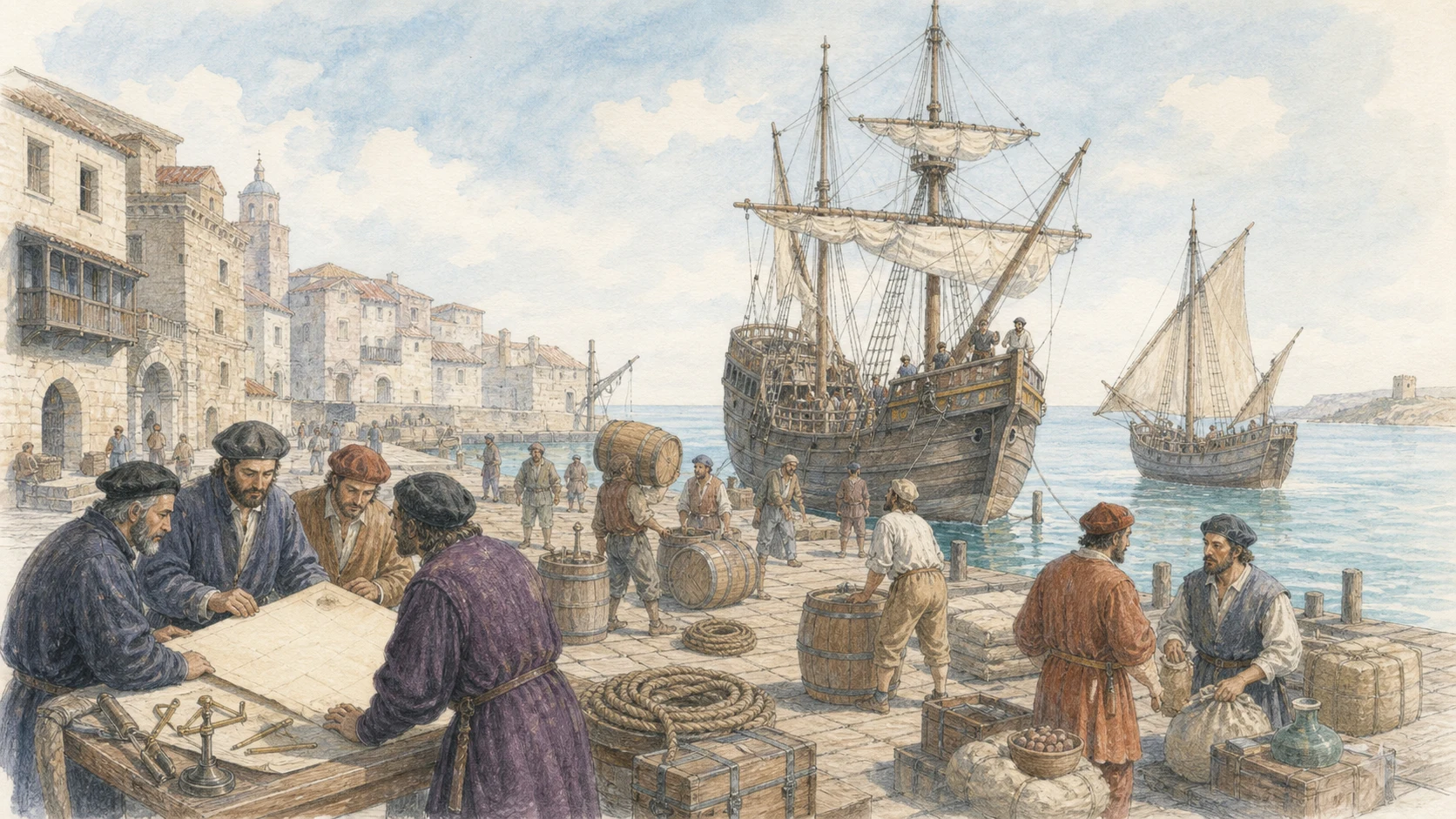
Maritime knowledge, finance, and state sponsorship made sustained voyages possible
No invention independently caused Atlantic expansion. Mariners combined the magnetic compass, astronomical instruments, improved charts, flexible sail plans, ship designs such as the caravel, and practical knowledge of winds and currents. Portuguese voyages accumulated route knowledge that later expeditions adapted. These tools reduced risk and improved range, but they mattered because states and investors had reasons to finance voyages.
Royal charters translated exploration into legal and political claims. Crowns authorized expeditions, promised privileges, and claimed sovereignty over lands already inhabited by Indigenous nations. Later joint-stock companies pooled capital and spread financial risk among investors, making repeated settlement attempts more feasible even when early colonies failed.
Navigation
Compasses, celestial observation, charts, and recorded experience helped mariners estimate direction and position.
Ships and sails
Ocean-going vessels combined cargo capacity, maneuverability, and sail plans able to use different wind conditions.
Knowledge networks
Mediterranean, Atlantic, African, and Asian geographic knowledge accumulated through merchants, pilots, mapmakers, and earlier voyages.
Institutions
Monarchies, charters, investors, and eventually joint-stock companies organized labor, funding, claims, and repeated expeditions.
Turning point 04
Columbus’s voyages initiated sustained imperial connections across the Atlantic
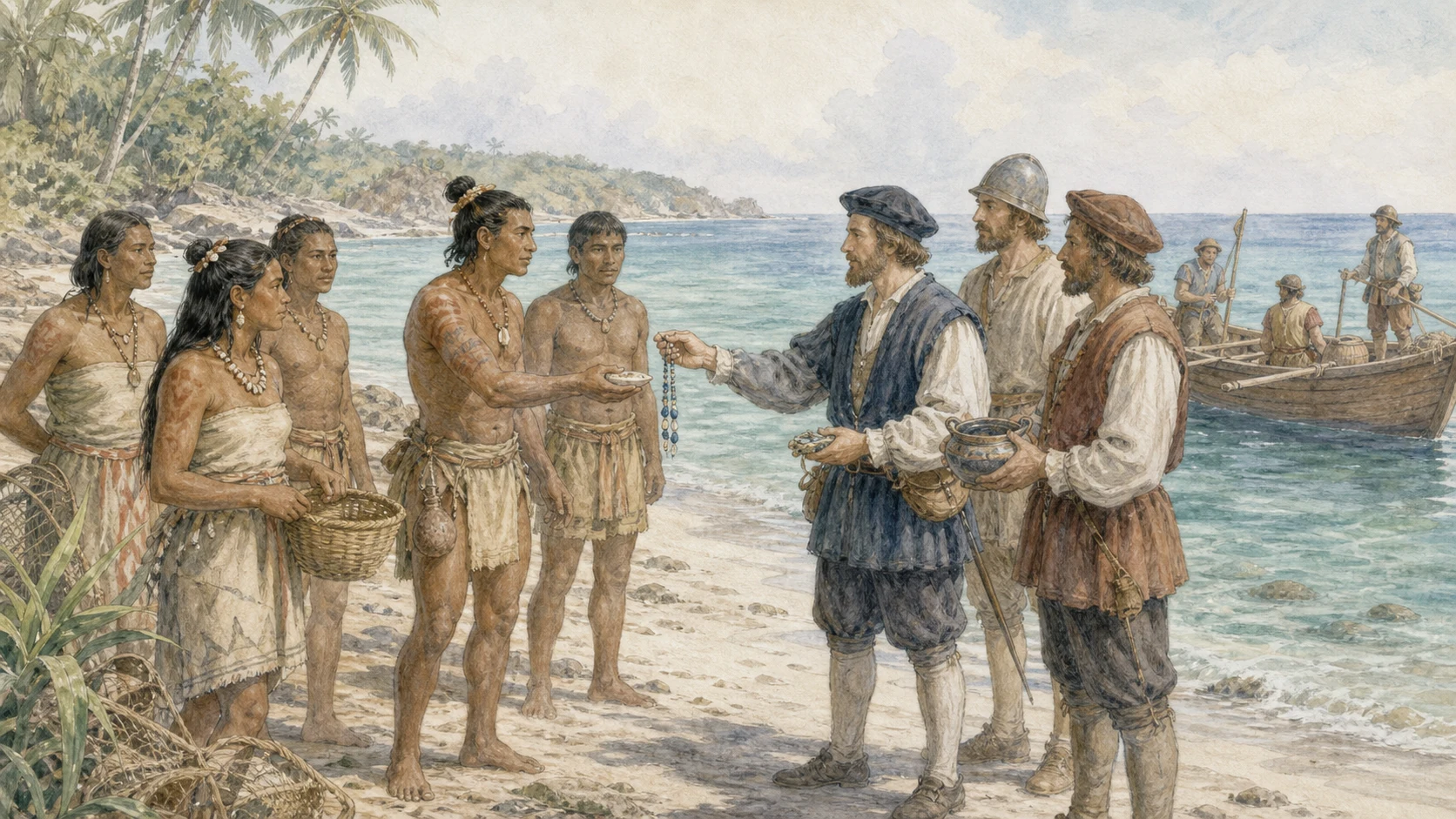
Portugal concentrated on an eastward maritime route around Africa. Spain instead financed Christopher Columbus’s westward expedition in 1492. Columbus reached Caribbean islands inhabited by Taíno and other Indigenous peoples, not Asia. His historical significance is not that he was the first human or even the first European to cross the Atlantic; it is that his voyages triggered continuing imperial expeditions, claims, settlements, and exchanges that permanently connected the Atlantic world.
Columbus’s 1493 letter advertised land, resources, potential converts, and people whom Spaniards could dominate. Read it as a persuasive source written for patrons and a European audience, not as a neutral record. The document reveals how exploration combined commercial promise, Christian mission, royal service, and assumptions of European authority over Indigenous lands and peoples.
Comparison 05
European powers shared broad goals but pursued different early strategies
Spain, Portugal, France, and England all pursued wealth, strategic advantage, and religious influence, but geography, timing, state capacity, and local conditions produced different priorities. The table identifies dominant early patterns rather than fixed national personalities. Every empire used coercion at times, and every empire also depended on negotiation and Indigenous knowledge.
The Netherlands became an important commercial competitor just after Period 1, especially following Henry Hudson’s 1609 voyage for the Dutch East India Company. Keep that chronology clear: Dutch activity belongs mainly to later colonial development, while Topic 1.3 centers the motives that generated wider European competition.
| European power | Major motives | Early geographic and economic strategy | Representative evidence and Indigenous relations |
|---|---|---|---|
| Portugal | Direct access to Asian trade, royal revenue, rivalry, Christianity | African coastal and Indian Ocean routes; Atlantic islands; Brazil after 1500 | Maritime trading posts and plantation precedents; diplomacy and violence along African and American routes |
| Spain | Precious metals, territorial empire, royal power, Catholic conversion | Caribbean bases followed by conquest, missions, mining, and exploration into Florida and the Southwest | Columbus, Treaty of Tordesillas, St. Augustine; alliances and coercion shaped encounters with Indigenous nations |
| France | Fisheries, trade, a route to Asia, strategic rivalry, Catholic mission | North Atlantic fisheries and exploratory claims; river access and exchange became increasingly important | Cartier and later Champlain; commerce often required diplomatic and military relationships with Native nations |
| England | Trade, land, anti-Spanish strategy, Protestant expansion, private profit | Cabot’s claim, Roanoke experiments, and joint-stock settlement at Jamestown | Hakluyt and the Virginia Company; early survival depended on relations with the Powhatan political network |
Encounter and power 06
Indigenous nations determined what European expeditions could learn, obtain, and survive
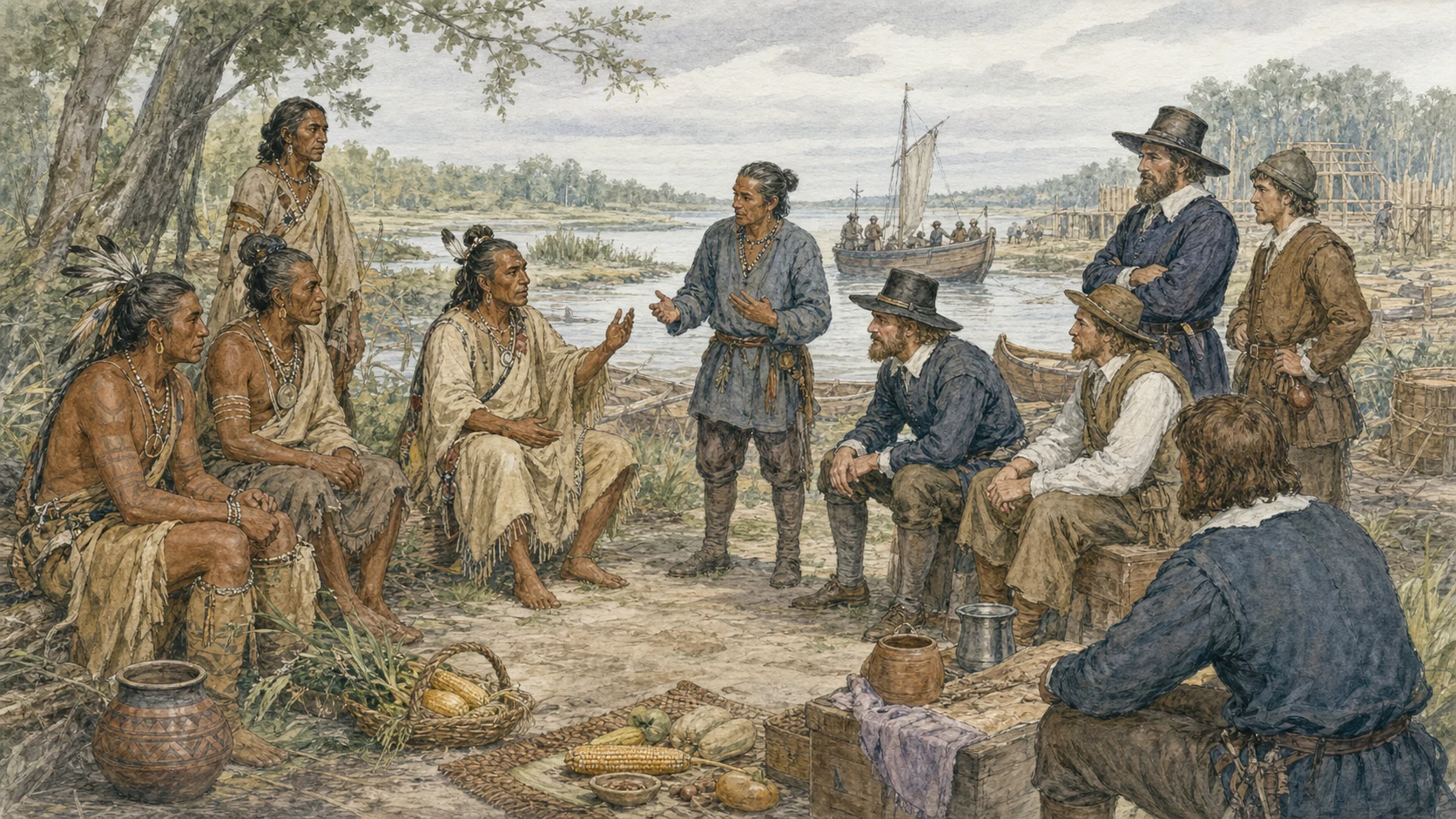
European maps and claims did not create control on the ground. Explorers depended on Indigenous guides, interpreters, food, water, trade routes, geographic knowledge, and permission or tolerance. Native communities evaluated newcomers within existing diplomatic and military relationships and chose among exchange, alliance, strategic accommodation, avoidance, relocation, or armed resistance.
These decisions could redirect imperial competition. Europeans often entered alliances with one Native nation against another, while Indigenous leaders sought trade goods or military partners for their own goals. Such alliances were not proof that Native peoples accepted European sovereignty. They were political choices made under changing and increasingly unequal conditions.
Chronology 07
Exploration became durable only where empires could maintain footholds
Spanish expeditions moved through the Caribbean, Florida, the Southeast, and the Southwest in search of wealth, converts, and strategic control. Many searches for legendary riches failed, yet Spain established St. Augustine in 1565 and launched a colonizing expedition to New Mexico in 1598. These footholds linked missions, military power, settlement, and contested claims.
France attempted a foothold in Florida and explored the St. Lawrence region, while England’s Roanoke colony disappeared. Failure did not end imperial ambition; it produced new financing and settlement strategies. In 1607, the Virginia Company founded Jamestown inside the Powhatan political world, marking both the endpoint of Period 1 and the beginning of a sustained English colonial presence.
Exam method 08
Build a multi-causal explanation and qualify every imperial comparison
For causation, separate long-term pressures from immediate triggers. Long-term conditions included commercial expansion, state consolidation, Christian missionary traditions, imperial rivalry, and accumulated maritime knowledge. Immediate triggers included a charter, a rival claim, a report of wealth, or a ruler’s decision to finance an expedition.
For comparison, state both the shared goal and the different strategy. A defensible claim might argue that Spain and England both sought wealth and geopolitical advantage, but Spain initially relied more heavily on conquest, missions, and mineral extraction, whereas England’s later efforts emphasized settlement and investor-backed companies. Then qualify the contrast by explaining variation and Indigenous agency.
High-yield review
Key developments
European demand for new wealth
Crowns, merchants, and investors sought direct trade routes, precious metals, fisheries, land, markets, and taxable commerce.
Imperial and military competition
Portugal, Spain, France, and England used voyages and claims to gain strategic advantage and prevent rivals from controlling Atlantic routes and resources.
Christian missionary ambition
Rulers and clergy sought converts and used religious authority to justify claims, missions, and efforts to reorder Indigenous societies.
Maritime and financial capacity
Ships, sails, navigation, route knowledge, charters, state support, and pooled investment made repeated long-distance ventures more practical.
Different imperial strategies
Geography, timing, resources, and political organization led European powers to emphasize conquest, trading routes, fisheries, missions, or settlement in different proportions.
Indigenous diplomacy and resistance
European expeditions relied on Native knowledge, exchange, alliances, and decisions; Indigenous nations also restricted, redirected, or resisted imperial projects.
Chronological reasoning
Timeline — key moments
Portuguese Atlantic and African voyages expand
Royal sponsorship, commercial goals, navigation, and accumulated route knowledge push Portuguese mariners farther along Africa’s coast.
Bartolomeu Dias rounds southern Africa
The voyage demonstrates progress toward a sea route linking the Atlantic to Indian Ocean trade.
Columbus reaches the Caribbean for Spain
The voyage initiates sustained European imperial connections with the Americas and intensifies competition for claims and resources.
Papal claims and the Treaty of Tordesillas divide Iberian spheres
Spain and Portugal attempt to settle competing claims without recognizing the sovereignty of the peoples already occupying the Americas.
John Cabot sails under an English patent
His North Atlantic voyage provides England with a basis for later claims despite the absence of an immediate permanent colony.
Jacques Cartier explores the St. Lawrence region for France
French voyages combine the search for wealth and a route to Asia with territorial and commercial ambitions.
Coronado’s expedition crosses the Southwest and Plains
The failed search for wealthy cities shows how reports of riches drove Spanish exploration and generated violent encounters with Indigenous communities.
Spain establishes St. Augustine
The durable Florida settlement protects strategic routes, supports Spanish claims, and blocks rival footholds.
Hakluyt promotes colonization and England attempts Roanoke
Arguments for trade, Protestant expansion, strategic competition, and settlement reveal England’s overlapping motives, even though Roanoke fails.
The Virginia Company establishes Jamestown
Investor-backed settlement creates a permanent English foothold within the Powhatan political world and closes Period 1.
Remember these
Vocabulary
- Atlantic world
- The interconnected societies and economies of Europe, Africa, and the Americas formed through travel, trade, conquest, migration, and forced movement.
- Caravel
- A maneuverable ocean-going sailing vessel associated especially with Portuguese and Spanish exploration.
- Lateen sail
- A triangular sail that helped vessels tack more effectively and use winds from different directions.
- Magnetic compass
- A navigational instrument that indicates direction relative to Earth’s magnetic field.
- Astrolabe
- An instrument mariners adapted to estimate latitude by measuring the altitude of celestial bodies.
- Charter
- A legal grant from a monarch authorizing exploration, trade, government, or colonial settlement.
- Mercantilism
- The broad idea that governments should use controlled commerce and colonies to strengthen national wealth and power.
- Conquistador
- A Spanish expeditionary conqueror who pursued territory, wealth, status, and royal service in the Americas.
- Mission
- A religious institution intended to convert Indigenous peoples and extend colonial cultural and political influence.
- Papal bull
- A formal decree issued by the pope; late-fifteenth-century bulls were used to authorize Christian imperial claims.
- Treaty of Tordesillas
- The 1494 agreement that divided Spanish and Portuguese spheres of claim while disregarding Indigenous sovereignty.
- Northwest Passage
- A hoped-for water route through or around North America connecting the Atlantic to Asian trade.
- Joint-stock company
- A company in which investors pool capital and share financial risk and potential profit.
- Virginia Company
- The investor-backed English company chartered to establish colonies, including Jamestown in 1607.
- Roanoke
- The unsuccessful English colonial venture on the North Carolina coast in the 1580s.
- St. Augustine
- The Spanish settlement founded in Florida in 1565 to secure strategic routes and territorial claims.
- Powhatan political network
- The tributary alliance of Algonquian-speaking communities led by Wahunsenacawh when Jamestown was founded.
- Indigenous sovereignty
- The authority of Indigenous nations to govern their peoples, homelands, and relationships with other political communities.
Clear the confusion
Frequently asked questions
20 detailed answers to the questions students most often carry into Topic 1.3.
01What is the central learning objective for APUSH Topic 1.3?
You should be able to explain the causes of exploration and conquest of the Americas by several European nations. The College Board groups those causes into the search for new wealth, economic and military competition, and the desire to spread Christianity. Strong responses identify a specific nation or expedition and explain how more than one cause operated together.
02What were the most important causes of European exploration?
Commercial opportunity, geopolitical rivalry, and Christian missionary ambition were the central causes. Crowns wanted access to trade and taxable wealth, merchants wanted profit, rulers wanted strategic advantage over rivals, and clergy and monarchs wanted converts. State consolidation and maritime knowledge made these ambitions easier to act upon.
03Is “God, gold, and glory” enough for an APUSH answer?
It is a memory device, not a complete explanation. Replace each word with precise evidence: Christianity could mean missionary conversion or Protestant–Catholic competition; gold could mean precious metals, fisheries, trade routes, land, and tax revenue; glory could mean royal prestige, military advantage, or an individual’s status.
04Did maritime technology cause European exploration?
Technology enabled exploration but did not independently cause it. Compasses, charts, ships, sails, instruments, and knowledge of currents reduced the difficulty of long voyages. Political and commercial motives explain why rulers and investors paid for those technologies to be used in Atlantic expeditions.
05Why was Portugal important to Atlantic exploration?
Portuguese mariners developed experience in Atlantic islands and along Africa’s coast while pursuing gold, trade, Christian allies, and a sea route to Asian markets. Their voyages accumulated navigational knowledge and established precedents for fortified trade, plantation production, and coerced labor that shaped later Atlantic expansion.
06Why is Columbus historically significant if he was not the first person to reach the Americas?
Indigenous peoples had inhabited the Americas for thousands of years, and Norse voyagers reached northeastern North America centuries earlier. Columbus is significant because his 1492 voyage initiated continuing Spanish expeditions and a durable imperial connection that linked Europe, Africa, and the Americas through conquest, exchange, settlement, and forced migration.
07How should I analyze Columbus’s 1493 letter as a source?
Consider audience and purpose. Columbus wanted to justify royal support and advertise the value of further expeditions, so he emphasized resources, converts, and opportunities for control. His language reflects European imperial assumptions and does not provide a neutral or complete account of Taíno perspectives.
08What did the Treaty of Tordesillas do?
Spain and Portugal agreed in 1494 to divide spheres of overseas claim along a negotiated line. The treaty reduced conflict between the two Iberian powers and helped support Portugal’s claim to Brazil, but it did not recognize the sovereignty or consent of the peoples already living in the claimed territories.
09How did Spanish exploration differ from other European approaches?
Spain moved early from Caribbean bases toward territorial conquest, precious-metal extraction, missions, and royal administration. Yet Spanish power still depended on Indigenous allies, knowledge, labor, and local conditions. Use this as a dominant pattern, not a claim that every Spaniard or every Spanish region operated identically.
10What motivated French exploration?
France sought fisheries, trade, territorial claims, a route to Asian commerce, religious influence, and strategic advantage against rivals. Explorers such as Cartier and later Champlain worked in regions where commerce and survival required relationships with Indigenous nations, making diplomacy and alliance especially important.
11Why did England establish permanent colonies later than Spain?
England initially devoted fewer resources to American settlement and faced other political and military priorities. Rivalry with Spain, promotional arguments such as Hakluyt’s, private investment, and the use of charters eventually encouraged attempts at Roanoke and the investor-backed Jamestown settlement.
12Where do the Dutch fit into Topic 1.3?
Dutch commercial and imperial competition becomes more important just after the 1491–1607 period, especially after Henry Hudson’s 1609 voyage for a Dutch company and the later development of New Netherland. Mention the Dutch when comparing the wider expansion of European competition, but keep the chronology clear.
13What is the difference between exploration, conquest, and colonization?
Exploration gathers geographic and commercial knowledge and may establish claims. Conquest uses force and political alliances to defeat or subordinate existing powers. Colonization attempts to maintain settlers, institutions, labor systems, and territorial control. The processes overlapped, but a voyage or map claim did not automatically create durable rule.
14Why were royal charters important?
A charter authorized an expedition or company and converted private activity into a state-backed claim. It could define trading privileges, governing authority, territorial ambitions, and investor rights. Charters helped organize repeated ventures while allowing crowns to project power without paying every cost directly.
15How did Indigenous nations shape European exploration?
Europeans required food, water, guides, interpreters, geographic knowledge, trade access, and sometimes military allies. Indigenous leaders decided when to exchange, negotiate, restrict access, relocate, or resist. These decisions affected routes, survival, reports sent home, and the practical limits of European claims.
16Why did some Indigenous nations ally with Europeans?
Native nations pursued their own political interests within existing rivalries. An alliance could provide trade goods, intelligence, or a temporary military advantage against another nation. Such cooperation was strategic and conditional; it did not mean Indigenous communities accepted European sovereignty or predicted the later consequences of empire.
17Why is Roanoke important even though the colony failed?
Roanoke demonstrates that claims and enthusiasm did not guarantee a durable colony. English settlers faced supply, environmental, and political challenges, and their survival depended on relationships with nearby Indigenous communities. The failure influenced later English planning, financing, and settlement strategy.
18Why does Jamestown mark the end of Period 1?
Jamestown created a permanent English foothold in 1607 after earlier failures. Its founding shifted English activity toward sustained colonization inside the Powhatan political world, setting up the labor, land, trade, and conflict developments that dominate Period 2.
19What is a strong comparison between Spanish and English exploration?
Both pursued wealth, Christian expansion, and geopolitical advantage. Spain moved earlier and emphasized conquest, missions, and mineral wealth, while England’s later efforts relied more on settlement charters and private investment. Qualify the contrast by noting that both negotiated with, depended on, and fought Indigenous nations.
20How can Topic 1.3 appear on an SAQ, DBQ, or LEQ?
An SAQ may ask you to identify and explain one motive or compare two imperial goals. A DBQ may use promotional writing, maps, or explorer accounts and ask you to analyze purpose and context. In an LEQ, Topic 1.3 can support a multi-causal argument about exploration or contextualize later colonization and European–Indigenous relations.
Use the knowledge
AP exam connections
- 1
Explain exploration through the College Board’s three required categories: new wealth, economic and military competition, and Christianity.
- 2
Distinguish motives from enabling conditions: commercial and political goals caused voyages, while technology, knowledge, finance, and charters made them more feasible.
- 3
Compare two empires through the same category and qualify the dominant pattern with variation and Indigenous agency.
- 4
Analyze Columbus, Champlain, or Hakluyt by connecting audience and purpose to the benefits the author emphasized.
- 5
Use Indigenous diplomacy, knowledge, alliance, restriction, and resistance as evidence that European claims did not equal control.
Editorial trust
Sources and review
These notes are original OnlyPrepy content. The syllabus scope and historical framing were checked against the following authoritative sources on August 15, 2026.
- AP U.S. History Course and Exam Description, Effective Fall 2026College Board
- Europe Claims America: The Atlantic JoinedLibrary of Congress
- Spanish Exploration of the Great PlainsU.S. National Park Service
- A Foothold in FloridaU.S. National Park Service
- From Contact to Present: Indigenous ChesapeakeU.S. National Park Service